Financial Reporting
Your Fund Paid $4.00 a Share. Why Your Series A Position Is Not Worth $4.00
Fund CFOs: a Series B round price is not your Series A mark. A worked liquidation waterfall shows how preferences move a Level 3 value, and what auditors ask.
By 409.AI Team - 2026-10-15
# Your Fund Paid $4.00 a Share. Why Your Series A Position Is Not Worth $4.00
An emerging-manager CFO closes the quarter, opens the portfolio company's latest cap table, and sees a Series B at $4.00 a share. The fund holds 1,000,000 Series A shares bought at $2.00. The mark seems to write itself: 1,000,000 times $4.00 is $4.0 million, a 2.0x gain on $2.0 million of cost. The auditor will not accept it without a second look, and for good reason. The $4.00 is what a new investor paid for a senior class of shares. It is not automatically the value of the junior class your fund owns.
This article is for the fund CFO, controller or administrator marking a Level 3 position in a company with more than one class of equity. It shows why the latest round price does not transfer across classes, walks through a small waterfall with numbers, and lists what the valuation file needs before the auditor asks.
Two steps, not one
Fair value for a private equity position generally takes two steps. First, estimate the value of the portfolio company's equity. Second, allocate that value to the specific security the fund holds. EisnerAmper's July 2026 guidance for venture funds states the point directly: a recent financing is strong evidence of value, but it does not automatically set the fair value of every class of equity, and assuming the latest price applies equally to all classes is a common pitfall ([EisnerAmper](https://www.eisneramper.com/insights/financial-services/venture-capital-fair-value-liquidation-preferences-0726/)).
The shortcut skips step two. It multiplies a headline post-money value by the fund's ownership percentage, which quietly treats a Series A share, a Series B share and a common share as the same thing. They are not. Each class has its own place in line when the company is sold or liquidated, and ASC 820 asks what a market participant would pay for the instrument the fund holds, not for the instrument a different investor bought.
That is also why the unit of account matters. ASC 820 largely leaves the unit of account to other Topics, so the unit of account for a fund's position follows the instrument it owns. Deloitte's roadmap explains the distinction between the unit of account and the unit of valuation, and what to do when they differ ([Deloitte DART](https://dart.deloitte.com/USDART/home/codification/broad-transactions/asc820-10/roadmap-fair-value-measurements-disclosures/chapter-4-unit-account/4-1-introduction)). If your valuation model produces a company-level number, the allocation to your class is where the mark is actually made.
A worked waterfall
The numbers below are illustrative, not from any real company. A portfolio company has three classes of equity:
- Series B: 2,500,000 shares at $4.00, a $10 million investment. Senior, 1x non-participating preference, converts 1:1.
- Series A: 4,000,000 shares at $2.00, an $8 million investment. Junior to Series B, 1x non-participating preference, converts 1:1. Our fund owns 1,000,000 of these.
- Common and options: 3,500,000 shares.
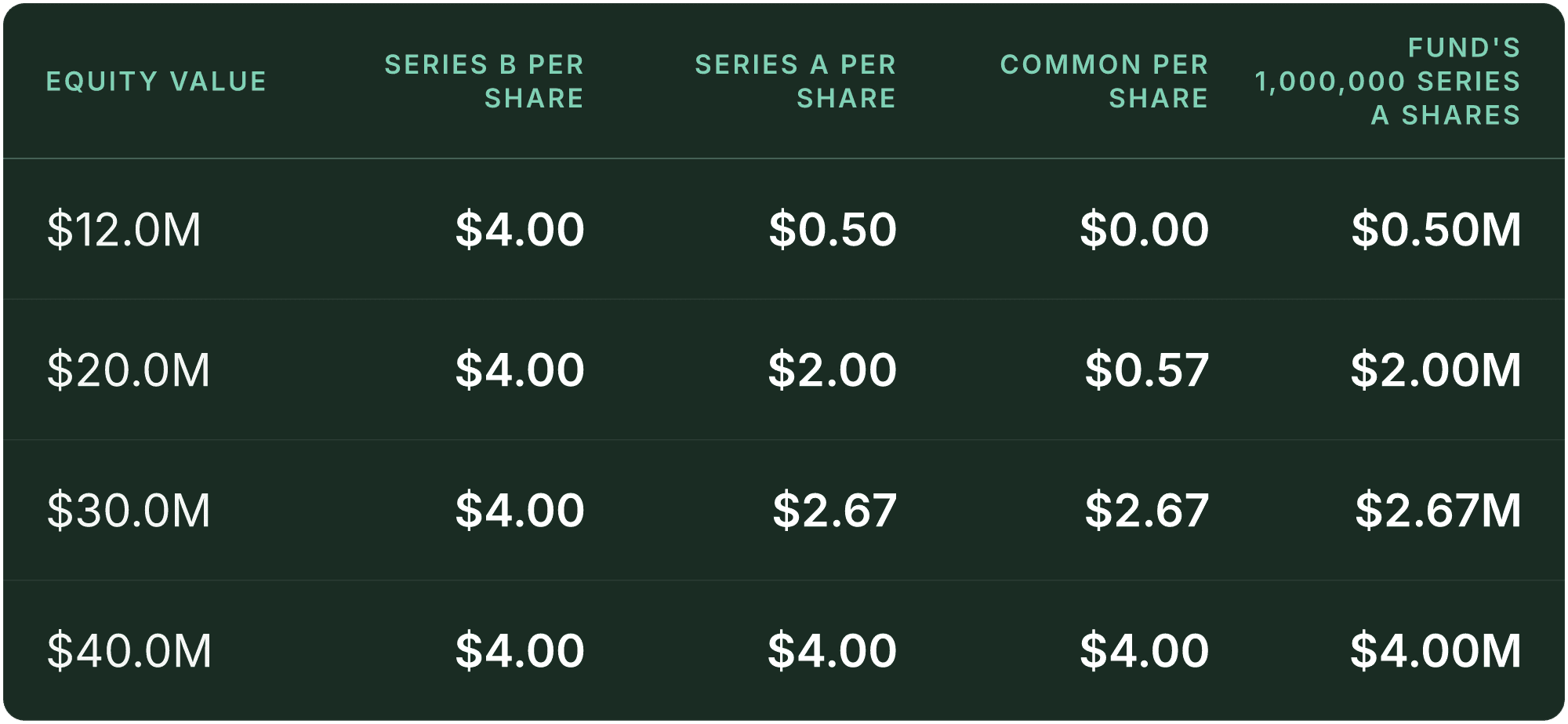
That is 10,000,000 shares at $4.00, which gives the $40 million post-money value in the press release. Now run the proceeds through the waterfall at four equity values. Each preferred class takes its preference or converts, whichever pays more.
[](https://www.409.ai/uploads/fund_mark_junior_preferred_liquidation_waterfall_asc_820_latest_round_price_table_1_d9db7314c4.png)
Read the table from the bottom up. Only when the company's equity is worth at least $40 million does every class share equally at $4.00. At $30 million, Series B still takes its $10 million first, and the remaining $20 million is split over the 7,500,000 Series A and common shares, which is $2.67 each. At $20 million, Series A stays on its preference and gets $2.00. At $12 million, Series B takes $10 million and the Series A holders split the last $2 million, or $0.50 a share.
The Series A position is worth $4.0 million only in the top row. In the other three rows the shortcut overstates it by $1.33 million, $2.0 million and $3.5 million. The fund's $4.00 mark is the best case dressed as the base case.
Why this is not just a downside problem
It is tempting to read the table as a down-round story. It is not. The company does not have one equity value tomorrow; a market participant pricing the Series A would weigh a range of outcomes, and the junior preferred is worth more than the common and less than the senior class in most of them. The mark has to reflect that spread.
EisnerAmper lists the usual ways to do the allocation. The current value method runs today's equity value through the waterfall as if the company were sold on the measurement date, and it fits best when an exit is close. The probability-weighted expected return method models discrete outcomes, weights them and discounts them back. The option pricing method treats each class as a call option on total equity value, with the preference amounts as breakpoints. A hybrid combines scenarios with an option model. An allocation by fully diluted share count is appropriate only when every class is expected to convert and the preferences will not change who gets what.
The table above is a current value method view, and it is a teaching device, not a mark. A fund with no imminent exit usually needs the option pricing method or a hybrid, because those capture the value of a class between its breakpoints. The 409A side of this problem uses the same machinery for common stock, which we cover in [how 409A allocation methods work](https://www.409.ai/articles/409a-allocation-methods-opm-pwerm-backsolve). The difference for the fund is the target: it values its own preferred class, not the common.
Where the Series B price still earns its place
None of this means the latest round is useless. A price paid by an arm's-length investor is the best calibration point the fund has. The method is to start from that price, find the equity value and inputs that reproduce it for the class that was sold, and then carry the same inputs forward to the class the fund holds. This is the logic behind a backsolve, and it is why the round price belongs in the file even when it is not the mark.
Calibration cuts both ways. Calibration to an entry price is also a place where private asset marks draw scrutiny, and we looked at the SEC staff's view for year-end work in [SEC Staff on Private Asset Fair Value](https://www.409.ai/articles/sec-staff-statement-private-asset-fair-value-calibration-nav). Our own earlier fund pieces cover two neighbouring cases: [why a new investment shows an unrealized loss at its first quarter-end](https://www.409.ai/articles/first-quarter-end-mark-unrealized-loss-transaction-costs-asc-820-asc-946) and [how to mark a SAFE or convertible note](https://www.409.ai/articles/fund-mark-safe-convertible-note-asc-820-quarter-end).
Be careful with rounds that are not clean arm's-length prices. EisnerAmper flags insider, bridge, rescue and strategic transactions, along with participating preferred, cumulative dividends, redemption rights and warrants, as situations that need extra care. A $4.00 price that comes with a side agreement is not the same evidence as a $4.00 price from a new lead.
What the file needs before the auditor asks
An auditor testing a Level 3 mark in a multi-class company will look for the same short list every time:
1. The charter or the current stock purchase agreement, and a fully diluted cap table that ties to it, with each class's preference, seniority, participation, conversion terms and dividends. 2. The security the fund holds, named exactly: which series, how many shares, at what cost. 3. The equity value estimate and how it was calibrated to the most recent transaction. 4. The allocation method, why it fits the company's expected path to liquidity, and the breakpoints it uses. 5. A sensitivity view, like the table above, showing how the fund's mark moves as equity value moves. 6. A line explaining why the result differs from the headline price, when it does.
That last line matters for the LP report too. If the Series A mark is $2.67 against a $4.00 round price, the LPs will ask. A sentence that names the senior class and its preference answers the question before it is asked. The same allocation also feeds the GP's share of the gain, which we traced in [carried interest accrual at quarter-end](https://www.409.ai/articles/carried-interest-accrual-hypothetical-liquidation-fund-marks).
The takeaway for this quarter
Pull the five largest positions in companies that have raised since your fund invested. For each one, check whether a newer class sits ahead of yours, and whether the mark was built from the round price alone. If it was, build the waterfall for that company before the quarter-end package goes out. A position where the answer barely moves is a quick confirmation. A position where it moves a lot is one you want to find yourself, not hear about from the auditor.
If you would rather have an independent valuation specialist build and document the allocation, 409.AI prepares [ASC 820 valuations](https://www.409.ai/products/asc-820) for fund portfolios, with each report reviewed by a valuation expert. The background on how Level 3 classification works is in [ASC 820 and the Level 3 problem](https://www.409.ai/articles/asc-820-level-3-fair-value-fund-portfolio-valuation).