Financial Reporting
How a Fund Marks a Portfolio Company That Is Running Out of Cash
A fund CFO's guide to marking a cash-starved portfolio company under ASC 820: scenario weighting, the lender paid first, and how to treat a fire-sale offer.
By 409.AI Team - 2026-10-21
# How a Fund Marks a Portfolio Company That Is Running Out of Cash
A fund CFO closing the quarter has a portfolio company with four months of cash, a lender asking questions and one unsolicited offer to buy its assets at a fraction of the last round. The auditor will ask which number goes in the schedule of investments, and why. The wrong answers are easy to name: the last round price because nothing else is on file, or zero because the news is bad.
This article is for the fund CFO, controller or GP who has to put a Level 3 mark on a distressed position at the quarter-end or year-end, and for the auditor who will test it. It covers what ASC 820 asks for, how to treat the fire-sale offer, and a worked example where the answer is neither the round price nor zero.
What ASC 820 asks for when a company is in trouble
Fair value is the price to sell an asset in an orderly transaction between market participants at the measurement date (ASC 820-10-35-2). It is a market-based measurement, not an entity-specific one (ASC 820-10-05-1B). Two consequences matter for a distressed position.
First, your intent does not set the mark. You may plan to support the company with a bridge, or to let it go. A market participant buying your stake would price the company as it is, with its cash runway and its lender. ASC 820-10-05-1C requires the assumptions market participants would use, and the reporting entity's intent to hold or settle is not part of them (see the [Deloitte roadmap](https://dart.deloitte.com/USDART/home/codification/broad-transactions/asc820-10/roadmap-fair-value-measurements-disclosures/chapter-1-background/1-2-objective-a-fair-value)).
Second, the round price is an entry price. It was fair value on the day it was paid, when the company had cash and a plan. A quarter later, with the runway gone, it is a stale data point. Calibrating to it is still correct while the facts match. Once they do not, the mark has to move with the facts, and the file has to show which facts.
This is the same discipline described in [how a fund marks a junior preferred position against the latest round](https://www.409.ai/articles/fund-mark-junior-preferred-liquidation-waterfall-asc-820-latest-round-price), applied when the scenarios on the downside get heavy.
Step one: decide what the company is worth in each way it can end
A distressed company rarely has one future. Three are common.
- **A sale of the business as a going concern.** A buyer pays for the operations, the customers and the team. Market multiples often fail here, because revenue is shrinking or earnings are negative, so the value usually rests on a discounted cash flow or on recent comparable sales of troubled businesses.
- **A quick sale of the business or its main assets.** A buyer knows the company is short of time and prices that in. The value is lower, and the timeline is short.
- **A liquidation of the assets.** The value is what the assets bring when sold piece by piece, less the cost of selling them.
The AICPA's guide on valuing portfolio company investments of venture capital and private equity funds, issued in final form in August 2019, says to apply more than one method based on the facts of the company and to use an allocation method when the capital structure has several classes. The distressed case is where that advice earns its keep. You do not pick one future. You value each one, and then you weigh them.
Each scenario needs support you would be comfortable handing over. A management forecast with a date and an owner. A broker's indication. A lender's payoff letter. The asset list with realistic recovery rates. Where a number comes from management alone, say so in the file.
Step two: pay the debt first
Equity does not receive enterprise value. It receives what is left after the people ahead of it are paid. In a company that is short of cash, that order drives the answer.
Build the payoff of the senior debt as the lender would claim it on the measurement date: principal, accrued interest, any prepayment or exit fee, and enforcement costs if the scenario is a liquidation. Venture debt often carries fees and warrants that make the claim larger than the headline balance, so read the agreement rather than the trial balance.
Then walk down the stack. Preferred stock gets its liquidation preference ahead of common in most structures, and your fund may hold only a share of one series. The mechanics are the same as in a normal waterfall, run at lower values, and the order between series matters much more when value is short.
Equity in this position behaves like an option. If the company's value lands below the debt and the preference, equity gets nothing in that scenario. If it lands above, equity captures part of the upside. Because that option has value while there is still time and a chance of a better outcome, a mark of zero is often wrong before the company is actually finished. The AICPA guide lists scenario-based, current value, option pricing and hybrid methods for allocating value, and says no single one is always best. In a company with weeks to live, the scenario-based method is usually the clearest to explain to an auditor.
Step three: treat the fire-sale offer as evidence, not as the answer
The unsolicited offer for the assets is the number everyone in the room wants to use. ASC 820 gives you a test for it. A price from a transaction is a data point only to the extent the transaction was orderly. ASC 820-10-35-54I lists circumstances that may show it was not:
- there was not adequate exposure to the market for a period before the measurement date;
- the seller marketed the asset to a single market participant;
- the seller was in or near bankruptcy or receivership;
- the seller was required to sell to meet regulatory or legal requirements;
- the price is an outlier compared with other recent transactions.
If the transaction is not orderly, ASC 820-10-35-54J says to place little, if any, weight on that price. If it is orderly, you take it into account, and its weight depends on its volume, how comparable it is to what you are measuring and how close it is to the measurement date.
Run the offer through that list. Was the asset shown to more than one buyer? For how long? Is the buyer reacting to the company's distress with a take-it-today deadline? Does the offer come from the lender or an insider? An offer that fails several of these tests still has one use. It supports the liquidation scenario, which is a real way the company can end. It does not define the value of the other two.
The same reasoning is covered for fund secondary sales in [a secondary sale priced below your mark](https://www.409.ai/articles/secondary-sale-below-fund-mark-asc-820-orderly-transaction-weight). The test is the same. Only the object of the sale changes.
A worked example
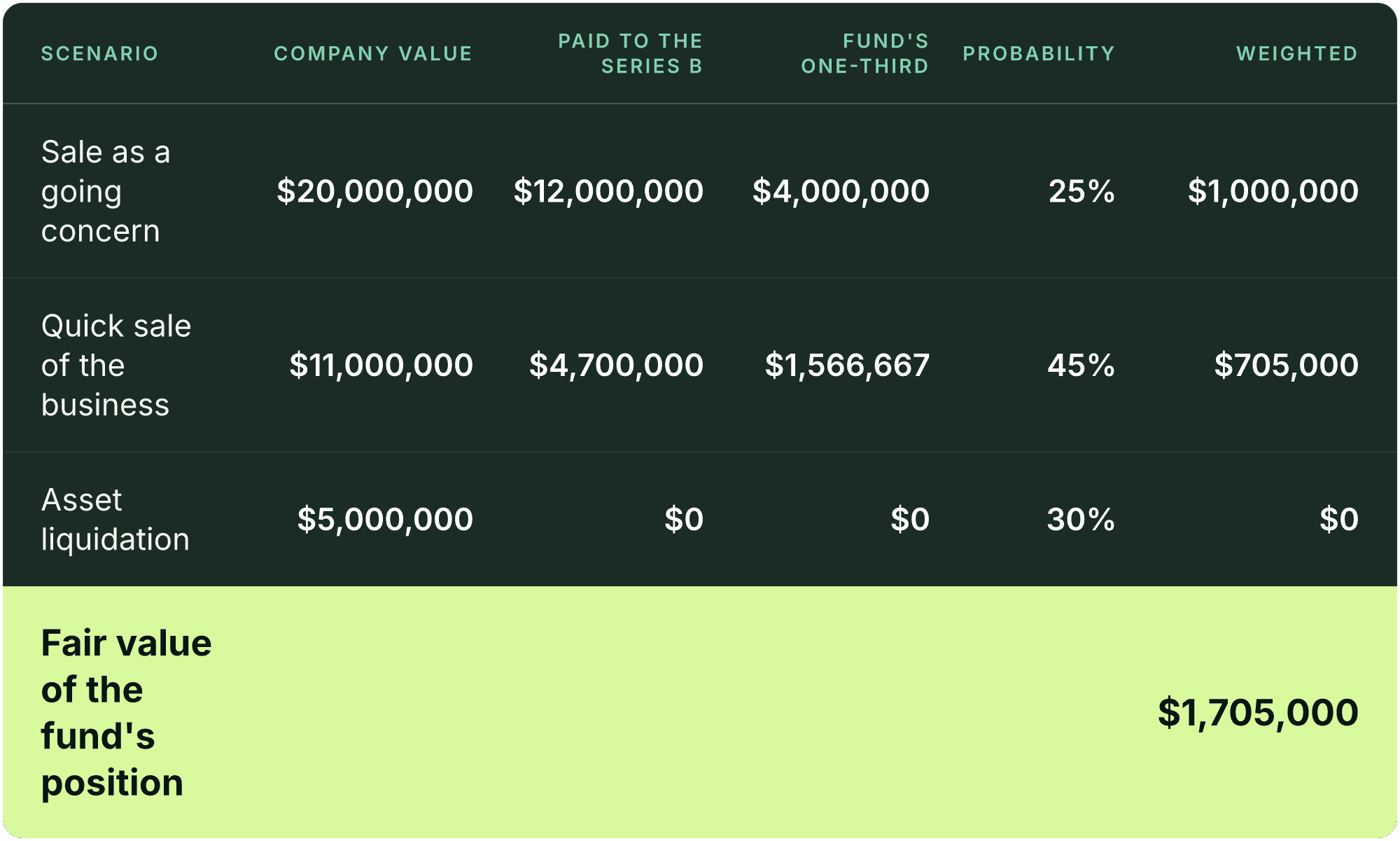
This example is illustrative, not drawn from any real fund. A fund paid $4,000,000 for one-third of a company's $12,000,000 Series B preferred, which is non-participating and sits ahead of common. The company owes a senior lender $6,300,000 on the measurement date, counting principal, accrued interest and the exit fee. Cash runs out in four months. The fund's valuation committee builds three scenarios, each stated at its present value on the measurement date, with a probability for each.
[](https://www.409.ai/uploads/fund_mark_distressed_portfolio_company_asc_820_scenarios_lender_first_table_1_ceedfe82ea.png)
In the going-concern sale, $20,000,000 less the $6,300,000 payoff leaves $13,700,000, and the Series B takes its $12,000,000 preference. In the quick sale, $11,000,000 less the payoff leaves $4,700,000, all of which goes to the Series B because it is below the preference. In the liquidation, the $5,000,000 does not cover the lender, so nothing reaches the fund.
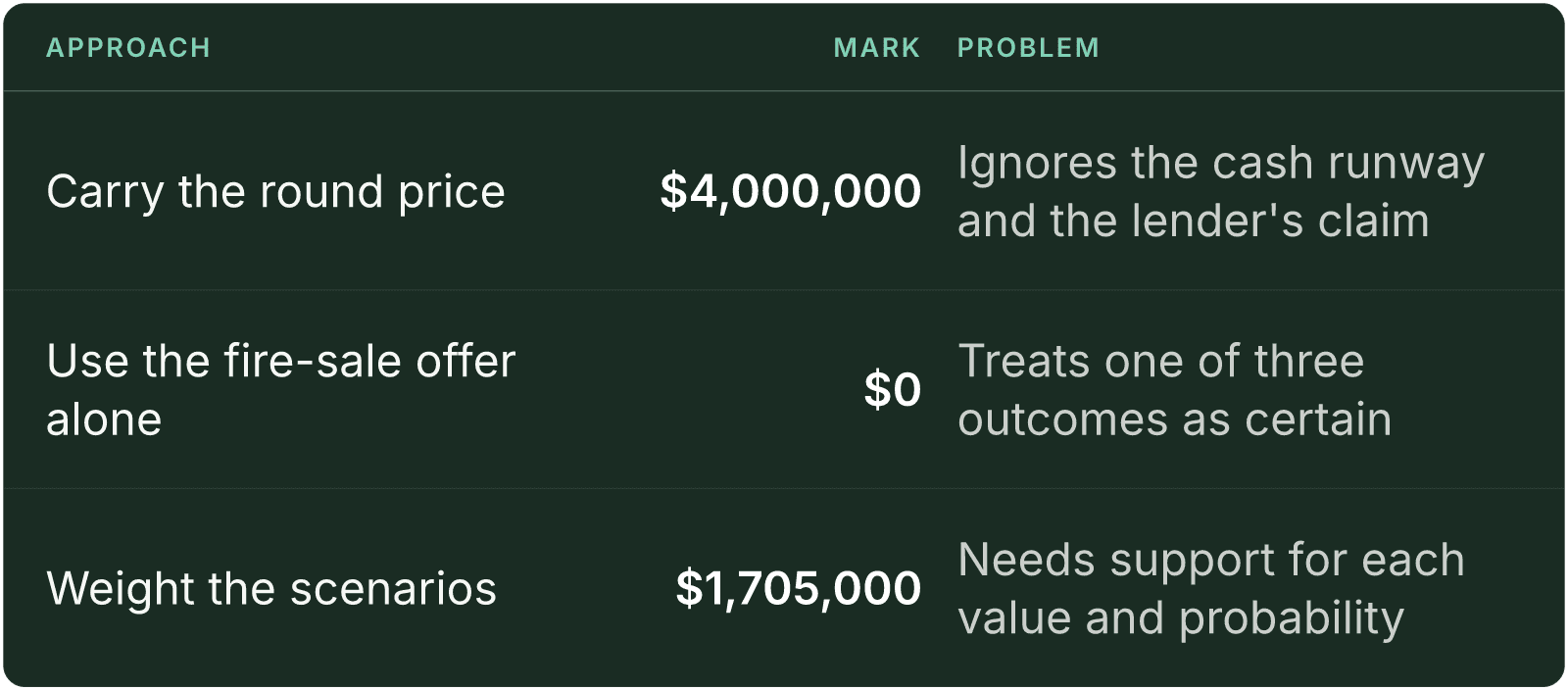
The weighted result is $1,705,000, or about 43% of cost. Compare it with the shortcuts.
[](https://www.409.ai/uploads/fund_mark_distressed_portfolio_company_asc_820_scenarios_lender_first_table_2_9837cc56aa.png)
The point of the table is not the figure. It is that the figure comes from inputs a reviewer can change one at a time. Shift 10 points of probability from the going-concern sale to the liquidation and the mark drops by $400,000. Raise the payoff from $6,300,000 to $7,300,000 and the fund's share of the quick sale falls by $333,334, which takes $150,000 off the weighted mark. Your auditor will probably run those moves. Run them first.
What goes in the file
An auditor testing a distressed mark will ask for the same short list each time.
1. The date and the facts. What was known at the measurement date: the cash balance, the runway, covenant status and any notice from the lender. Events after that date follow the rules in [what a fund does with information that arrives late](https://www.409.ai/articles/january-round-december-31-mark-asc-855-subsequent-events-fund). 2. The support for each scenario. The forecast, the broker indication, the asset recovery schedule. 3. The debt claim. The lender's payoff letter or a calculation from the agreement, not an estimate. 4. The orderly-transaction analysis for every offer. The five circumstances above, answered one by one. 5. The reason for each probability. If the board is leaning toward a wind-down, a larger weight on the liquidation scenario needs that fact beside it. 6. A comparison with the prior mark. A drop from the round price to $1,705,000 should be explained by named changes, in the same way a first-quarter loss is explained in [why a new investment shows an unrealized loss at its first quarter-end](https://www.409.ai/articles/first-quarter-end-mark-unrealized-loss-transaction-costs-asc-820-asc-946).
Your written policy should say who approves the marks of positions in distress and how often they are revisited. A policy that sets monthly refreshes for a company with four months of cash is the sort of detail that [holds up in an audit or an SEC exam](https://www.409.ai/articles/fund-valuation-policy-asc-820-audit-sec-exam).
Afterward, test the mark against what happened
When the company is sold or wound down, compare the proceeds to the last mark and record the gap. Distressed positions are the ones where a bias shows up, in either direction. A fund that always marks them too high will see it in the disposition analysis, and so will its auditor. The method is in [back-testing fund marks against exit prices](https://www.409.ai/articles/back-testing-fund-marks-exit-prices-asc-820-disposition-analysis).
The takeaway
For a portfolio company short of cash, build the mark from the ways it can end, pay the lender first, and give a rushed offer only the weight its circumstances earn. That produces a number the investment committee can defend line by line.
If your fund wants an independent, documented Level 3 mark for a position like this one, 409.AI's [ASC 820 portfolio valuation](https://www.409.ai/products/asc-820) service delivers an expert-reviewed report.