Financial Reporting
Who Should Value Your Fund's Level 3 Positions? Administrator, In-House or Independent Firm
Fund CFOs: an administrator calculates NAV, you form the mark, a firm supports it. Here is the provider file to keep, framed by SEC exam staff observations.
By 409.AI Team - 2026-11-02
# Who Should Value Your Fund's Level 3 Positions? Administrator, In-House or Independent Firm
If you're the CFO or COO of an emerging-manager venture fund, the first year-end audit of your Level 3 positions is closer than it feels. Someone has to form the fair value of every private holding, and the three obvious candidates (your fund administrator, your own team, an independent valuation firm) do three different jobs. Choosing without separating those jobs is how a fund ends up with a NAV that ties perfectly and marks nobody can defend.
This article separates the jobs, then shows the file an adviser should keep on whichever provider it picks. The frame is what the SEC's exam staff has reported about private fund advisers, not a sales comparison.
Three jobs that get called "valuation"
Calculating NAV. A fund administrator typically books the fund's accounting, allocates income and expense between partners, and produces the net asset value and capital account statements. For Level 3 positions it generally takes the marks as inputs. It arithmetically applies the mark you give it. That is a real service, and a different one from deciding what a Series B preferred position is worth.
Forming the mark. Someone must conclude on the fair value of each Level 3 position under [ASC 820](https://www.409.ai/articles/asc-820-level-3-fair-value-fund-portfolio-valuation): select the technique, calibrate to the entry price, weigh the evidence, and document why. Under the auditing standards, management owns that measurement even when it hires help. The fund's valuation committee approves the number, whoever drafts it.
Supporting the mark independently. An independent valuation firm performs the analysis as a specialist and delivers a conclusion with a written file. It does not take over the responsibility, but it brings a second set of eyes, a method that was not designed to arrive at the number the GP hoped for, and a file an auditor can test. Our piece on [what the auditor tests about an outside specialist](https://www.409.ai/articles/fund-valuation-firm-sas-143-auditor-tests-management-specialist-file) covers that side.
[](https://www.409.ai/uploads/fund_level_3_valuation_administrator_in_house_independent_firm_sec_exam_file_table_1_98d61be95d.png)
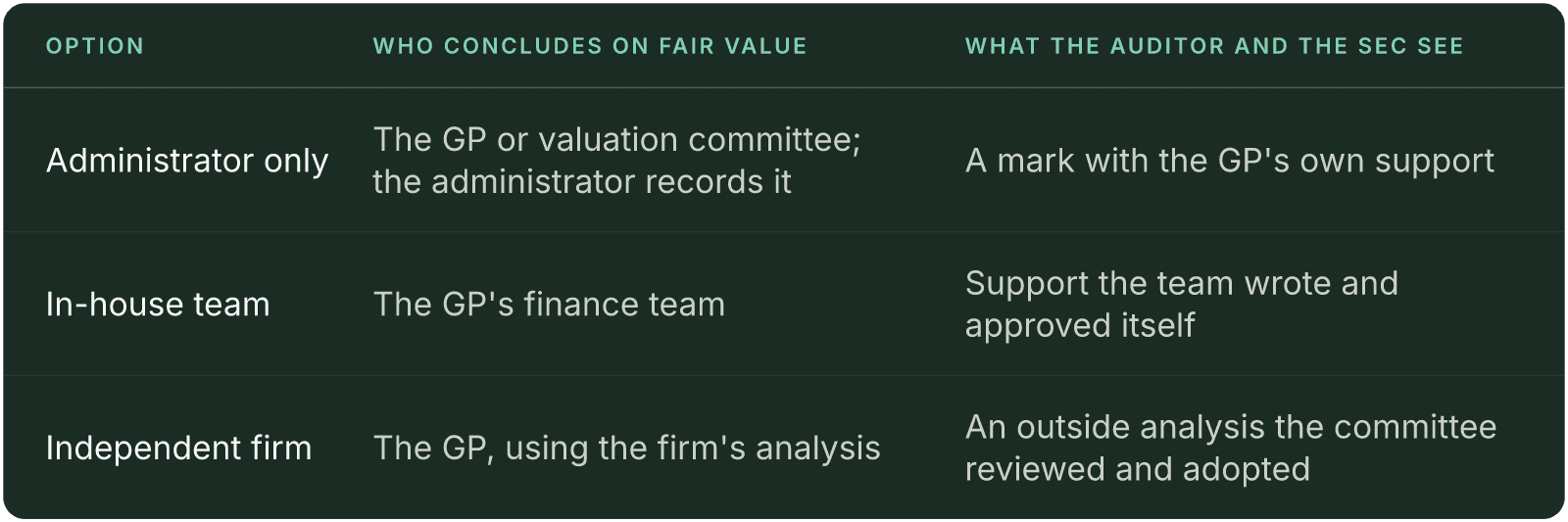
The table shows why "the administrator handles valuation" is an incomplete answer. If the administrator only calculates NAV, then for your Level 3 book the question of who forms the mark still has an answer, and the answer is you.
What the SEC exam staff has reported
Two Risk Alerts from the SEC's examination staff frame the stakes for a registered adviser.
The first, dated June 23, 2020, observed that some private fund advisers did not value client assets in accordance with their valuation processes or with their disclosures to clients, such as a disclosure that assets would be valued in accordance with GAAP. In some cases the staff reported that this led to overcharging management fees and carried interest, because the fees were based on holdings that were inappropriately overvalued.
That sentence connects a mark to money. A mark that departs from the written process is a compliance finding, and when fees are computed on it, an investor-facing one. Our article on [when your marks set your fees](https://www.409.ai/articles/fund-marks-set-fees-nav-based-fees-valuation-enforcement-policy) walks through the enforcement side.
The second Risk Alert, dated January 27, 2022, covered due diligence. The staff observed advisers that failed to perform adequate due diligence on important service providers, and it gave alternative data providers and placement agents as examples. It also observed advisers that described a due diligence process in fund disclosures but did not maintain policies and procedures tailored to their advisory businesses.
Neither alert mentions valuation providers or administrators in that passage. Applying the service-provider observation to the firm that supports your marks is an inference, not something the staff said. It is a reasonable one: a valuation provider is at least as important to a fund's financial statements as the examples the staff named, and an adviser that cannot show how it chose and monitored that provider is exposed in the same way. Treat it as a prudent reading, and write your policy so that it holds either way.
The file to keep on the provider you choose
Whichever route you take, an examiner or an auditor asking "why this provider?" should find answers in a folder, not in someone's memory. A workable file holds six things.
1. Scope. Which positions the provider covers, which it does not, and who values the rest. A fund that sends only its three largest positions out and marks the other twelve in-house should say so and say why. 2. Qualifications. Credentials and experience with your asset types: venture preferred, convertible notes, warrants, SAFEs. 3. Independence and conflicts. Whether the provider also sells you something else, whether the same firm audits you, and how fees are set. Fees that depend on the size of the mark undermine the work. Our note on [why an auditor usually can't do your valuation work](https://www.409.ai/articles/auditor-independence-409a-valuation-provider-rule) shows the same independence logic at the 409A level. 4. Method. The techniques the provider uses, how it calibrates to the transaction price, and how it handles an input it cannot observe. If the answer is "proprietary", ask for a different answer. 5. Review of output. The committee minutes in which the marks were challenged and adopted, including at least one mark that changed after discussion. A file where every draft number was accepted unchanged invites the question of whether anyone read it. 6. Ongoing monitoring. A back-test of marks against later exit prices or financing rounds, and a review at least annually, tied to the fund's [valuation policy](https://www.409.ai/articles/fund-valuation-policy-asc-820-audit-sec-exam). The same policy should say what happens when the provider disagrees with the GP.
The policy is the part to get right first. The 2020 observation was about advisers not following their own process; the 2022 one was about generic policies. A provider chosen and monitored exactly as your policy says is a stronger position than a better provider chosen informally.
A worked comparison
Take a fund with twelve Level 3 positions and a December 31 year-end. Illustratively, the administrator needs final marks by the second week of January to produce statements, and the audit fieldwork starts in February.
With an administrator-only approach, the GP's team drafts twelve marks in December, the committee signs, and the administrator loads them. Cost is low and so is independent support. The auditor will test each mark from scratch, using its own specialists, and every position without support becomes an audit question in February.
With an independent firm on the five largest positions, the committee gets five written analyses by mid-December, challenges two, and adopts the revised numbers. The other seven are marked in-house under a simple approach already documented in the policy. The auditor's testing of the five starts from a file that exists. Whether the cost is worth it depends on how large those five positions are relative to NAV, since fees and carried interest ride on them.
The point of the example is the split, not the vendor. Most emerging managers land on a hybrid: independent support where the value concentrates or the judgment is hardest, internal marking where it does not. A related decision is timing. The [custody rule's 120-day audit deadline](https://www.409.ai/articles/custody-rule-120-day-audit-deadline-fund-year-end-marks) means an April 30 delivery date for audited statements, which sets the latest date for the marks in a calendar-year fund.
Questions to settle before you sign
Before engaging anyone, the committee should be able to answer four questions in writing:
- Who concludes on fair value for each position, by name or by role?
- What happens to a mark if the provider and the GP disagree?
- Which valuation standard governs, and does the file show it? Some funds also follow the [IPEV guidelines](https://www.409.ai/articles/ipev-2025-valuation-guidelines-in-effect-2026-year-end-level-3-file); say which.
- How will the choice be reviewed next year?
If the fund's LPA or private placement memorandum describes the valuation process, the answers must match that text. That is the failure the 2020 alert described.
The takeaway
Don't ask "administrator, in-house or independent?" as if one of them replaces the others. Ask who forms each mark, who supports it independently, and where the file shows how you chose them. Write the answers into the valuation policy this quarter, then pick the provider the policy points to. If you want an independent view on the positions where your judgment is hardest, 409.AI scopes [ASC 820 work](https://www.409.ai/products/asc-820) per portfolio, so the first step is to send the position list.