Financial Reporting
The Deal Closed. Your Fund Still Holds an Escrow and an Earnout. What Are They Worth?
A portfolio company sale closed, but the escrow and earnout are unpaid. How a fund CFO marks them at fair value under ASC 820, with a worked $100M example.
By 409.AI Team - 2026-10-25
# The Deal Closed. Your Fund Still Holds an Escrow and an Earnout. What Are They Worth?
A portfolio company sale closes on a Tuesday and the wire arrives on Wednesday. The headline price was $100 million, your fund owned 20%, and the press release says "up to $20 million" for your side. Then quarter-end comes around, and the controller has to put a number on the part of that price that has not been paid yet.
This is a post for the fund CFO, controller or administrator who marks Level 3 positions and now owns something odd: a position that no longer exists as equity, but is not cash either. The cash at closing is easy. The escrow and the earnout are not, and the auditor will ask how you got to the figure.
The equity is gone. What do you hold?
Before closing, your fund held shares. After closing, the shares are gone and you hold contractual rights: a share of an escrow account that the buyer funded at closing, and a right to additional payments if the company hits a target. Those rights are what you measure.
An investment company under ASC 946 carries its investments at fair value, and ASC 820 defines fair value as the price you would receive to sell an asset in an orderly transaction between market participants at the measurement date. That is an exit price, not the amount written in the purchase agreement. If you want the broader frame, our guide to [ASC 946 for venture funds](https://www.409.ai/articles/asc-946-investment-company-venture-fund-financial-statements) covers why the fair value basis applies.
Practice differs on presentation. Some funds keep the escrow and earnout rights inside the investment line at fair value until they settle, others show a receivable. Either can be right. What matters is that you pick one, apply it every quarter, write it into the valuation policy and tell the auditor early. Cash received at closing is typically a realized gain or loss, while the rights still outstanding stay unrealized until the money arrives.
Start with the agreement, not the model
The valuation is only as good as your reading of the purchase agreement. Before you open a spreadsheet, pull these terms for each piece:
- **Escrow:** the amount, the release date or dates, who can claim against it, the cap and any basket on indemnity claims, and what happens to claims still pending on the release date.
- **Working capital or net debt adjustment:** whether a true-up is still open at quarter-end, and in which direction the buyer's estimate points.
- **Earnout:** the metric (revenue, EBITDA, a milestone), the measurement period, thresholds and caps, how the buyer must run the business meanwhile, and whether a later sale of the company accelerates payment.
- **Your share:** your fund's slice of each piece comes from the closing waterfall, not from your ownership percentage. If the company had preferred stock outstanding, the split of escrow and earnout between classes may differ from the split of cash. Our piece on [liquidation preferences and your fund's position](https://www.409.ai/articles/fund-mark-junior-preferred-liquidation-waterfall-asc-820-latest-round-price) shows how a class stack changes what each holder receives.
The worked example below uses a straight 20% of each piece to keep the arithmetic readable. Your funds-flow memo will not be that clean.
A worked example: $100 million, three pieces
Your fund owns 20% of a portfolio company. The buyer pays $80 million in cash at closing, funds a $10 million escrow released after 12 months, and owes up to $10 million more if the company reaches a revenue target within 24 months. Your fund last carried the position at $17.5 million.
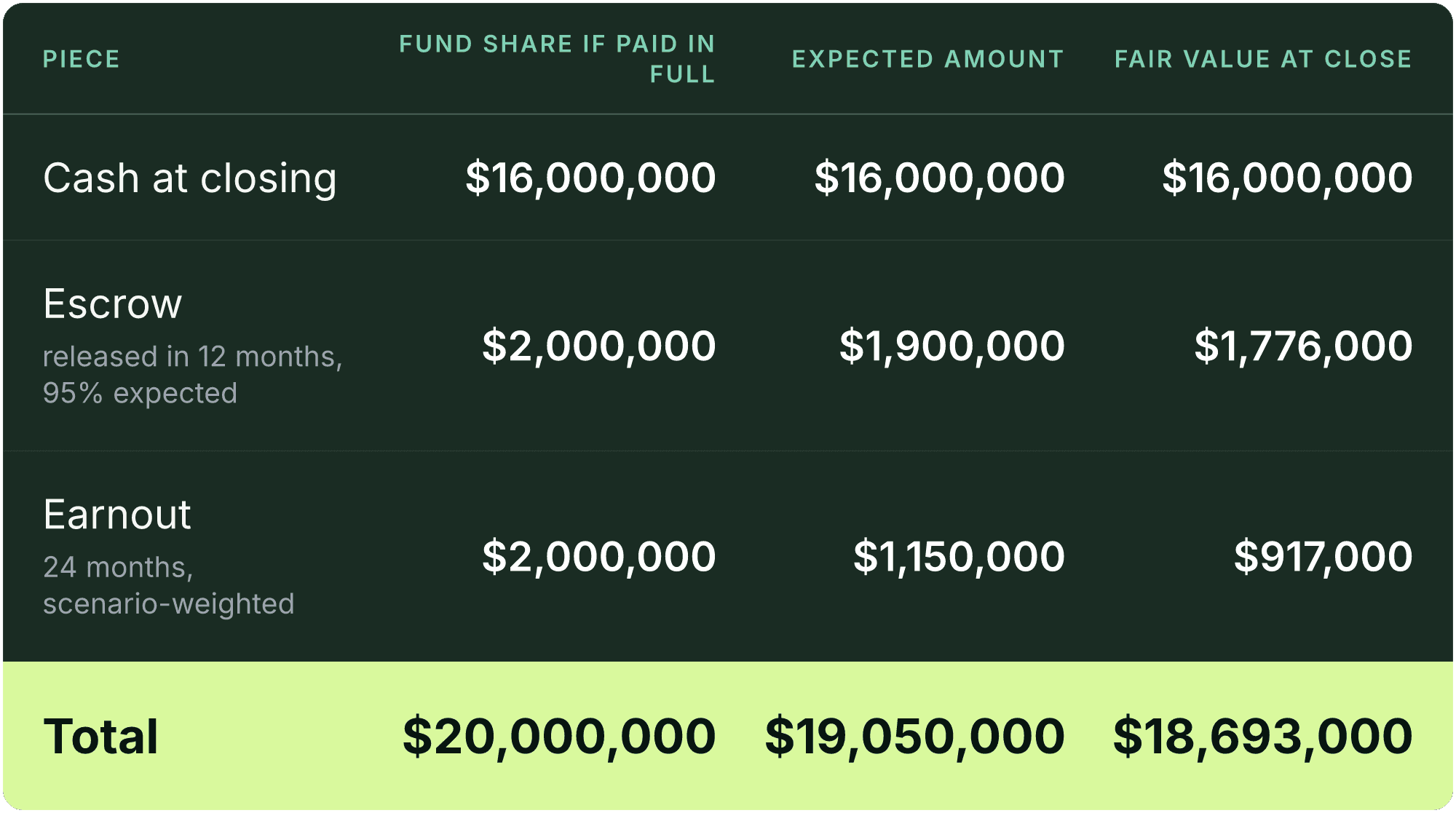
Applying 20% to each piece, here is how the headline price turns into a fair value at the closing date. The numbers are illustrative.
[](https://www.409.ai/uploads/fund_exit_escrow_earnout_receivable_fair_value_asc_820_after_portfolio_company_sale_table_1_b408458d60.png)
The table makes the main point: the fair value of what you hold is $18.7 million, not $20 million. The headline figure is a ceiling for the contingent pieces, not a measurement of them. The buyer priced the deal on what it expected to pay, and so should you.
Valuing the escrow
An escrow is closer to a receivable than to an equity stake, so the work is about two questions: how much of it will come back, and how long will it take.
How much comes back depends on the indemnity terms and what you know about claims. If the buyer has noticed a problem and sent a claim notice, that portion is no longer a 100% release. If nobody has claimed anything and the representations were clean, a small expected haircut may be enough. In the example we used a 95% expected release, which leaves $1.9 million of the $2.0 million.
How long it takes sets the discount. An expected-present-value approach of the kind ASC 820 describes in its implementation guidance (ASC 820-10-55) discounts the expected payment at a rate that reflects the time value of money and the credit risk of whoever owes it. Here we used 7%. At that rate for one year, $1.9 million is worth about $1.776 million today.
Valuing the earnout
The earnout needs more judgment, because the amount itself is uncertain. A scenario approach is usually enough when the payoff is simple: list the outcomes, assign each a probability, and take the weighted average. Kroll's [advisory on contingent consideration](https://www.kroll.com/en/insights/publications/valuation/valuation-insights-second-quarter-2019/financial-reporting-advisory-for-contingent-consideration) explains that scenario methods fit when the underlying metric can be diversified or the payoff is linear, and that thresholds, tiers and caps push you toward an option-pricing model instead. Mercer Capital [makes a related point](https://mercercapital.com/valuation-contingent-consideration): for milestone or tiered earnouts, the value is generally most sensitive to the probability-weighted expected payment, more than to the discount rate or the length of the contingency.
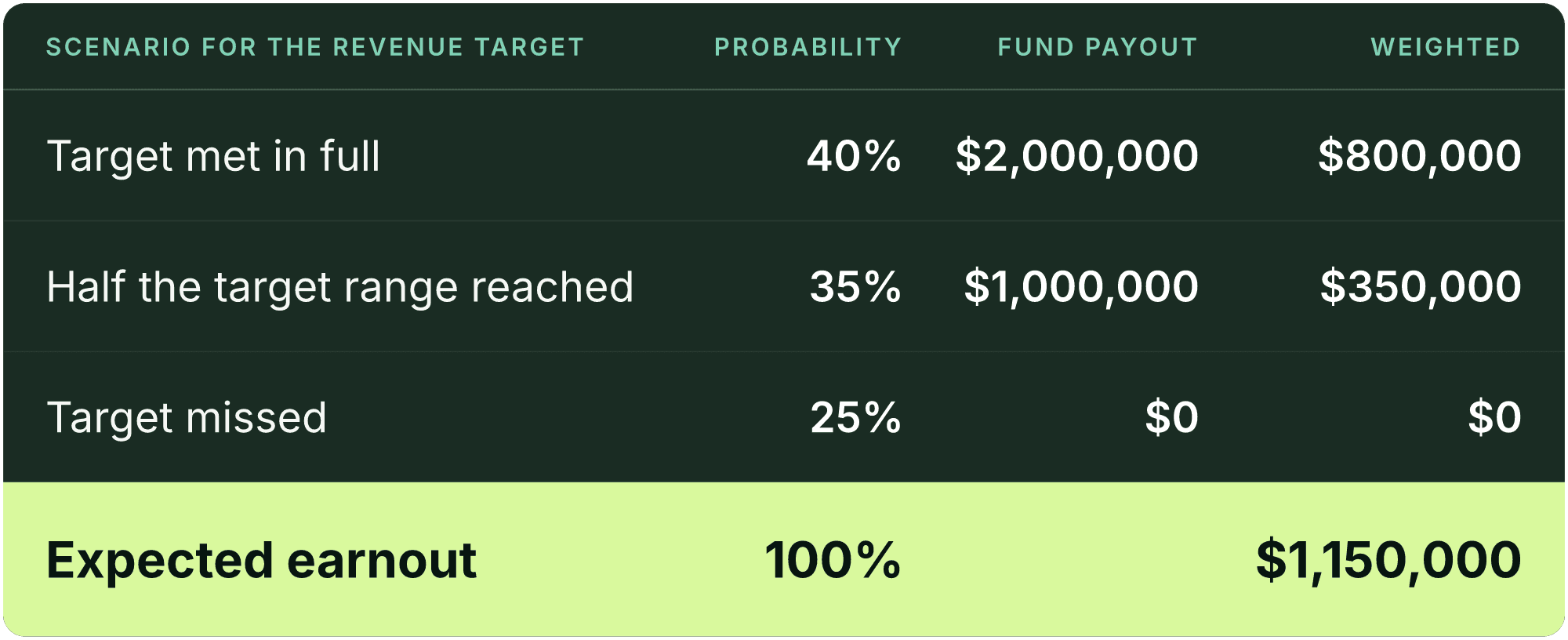
So spend your time on the probabilities. Here they are for our example:
[](https://www.409.ai/uploads/fund_exit_escrow_earnout_receivable_fair_value_asc_820_after_portfolio_company_sale_table_2_6366fc39c3.png)
Where do the probabilities come from? From the company's revenue to date against the threshold, the pipeline the buyer has described, any integration changes that affect the metric, and the buyer's operating covenants. A buyer that folds the business into a bigger one can make the metric hard to measure at all, which is why the definition in the agreement matters as much as the forecast.
Then discount. The $1.15 million arrives 24 months out. If the probabilities already carry the risk of missing the target, the discount rate only needs to cover time and the buyer's credit. We used 12% here because the buyer is a private company carrying debt; at that rate the expected $1.15 million is worth about $917,000. The rule worth writing in your policy: risk goes into the scenarios or into the rate, never both, or you count it twice.
Because the probability and the rate are not observable, these rights sit in Level 3 of the hierarchy. We explain why in [one unobservable input puts your entire measurement in Level 3](https://www.409.ai/articles/asc-820-level-3-classification-significant-unobservable-input). The earnout also belongs in your sensitivity discussion. In the example, moving 20 points of probability from the full-payout case to the missed case (full 20%, half 35%, missed 45%) drops the earnout to about $0.60 million.
What moves the number next quarter
Neither piece stays at its closing value. Each quarter, three things change:
1. Time passes. The discount unwinds, so a right that is simply a year closer to payment is worth more even if nothing else changed. 2. Facts arrive. A claim notice against the escrow, the buyer's first earnout statement, a dispute over how revenue is counted. Each is information that existed at the measurement date or came after it, and our note on [late-arriving information at year-end](https://www.409.ai/articles/january-round-december-31-mark-asc-855-subsequent-events-fund) sorts which is which. 3. The buyer's condition changes. A downgrade or a distressed refinancing shows up in the discount rate.
When the escrow is released, compare the cash with your last mark. That gap is the cleanest feedback you will get on your claim-risk assumptions, and it belongs in your [back-test of marks against exit prices](https://www.409.ai/articles/back-testing-fund-marks-exit-prices-asc-820-disposition-analysis).
The unrealized movement also reaches the GP. An escrow or earnout that is marked up or down changes the net asset value that [carried interest accrues against](https://www.409.ai/articles/carried-interest-accrual-hypothetical-liquidation-fund-marks), so a sloppy earnout mark is a fee question as well as an audit one.
What the auditor will ask to see
One folder per sale keeps the audit short:
- the executed purchase agreement, the escrow agreement and the funds-flow memo, with your share traced to the waterfall;
- the model, with the probabilities, the discount rate and the reason for each;
- the buyer's statements: working capital estimate, claim notices, earnout calculation;
- the prior quarter's mark and a bridge from it to this quarter's.
The auditor is not looking for a perfect forecast. They are looking for a number you can explain from the documents, built the same way each quarter.
The takeaway
The next time a portfolio company sells, do not book the press release. Mark the cash as cash, mark the escrow as a discounted and risk-adjusted receivable, mark the earnout as a probability-weighted and discounted payment, and write down which assumptions you will revisit each quarter. If your fund holds a closing in this state at year-end, start the file now, while the funds-flow memo and the escrow agreement are easy to find. If you want a second pair of eyes on the model and the file before the auditor sees them, our [ASC 820 portfolio valuation service](https://www.409.ai/products/asc-820) is built for exactly that.
*This article is general information about fair value measurement, not accounting, legal or tax advice. Agree your presentation and policy with your auditor.*