Education
Valuing a Franchise Resale: Why the Franchise Agreement Moves the Number
Selling or buying a franchise unit? See how royalties, remaining term and transfer rules change its value, with a worked SDE example for owners and advisors.
By 409.AI Team - 2026-10-28
# Valuing a Franchise Resale: Why the Franchise Agreement Moves the Number
A franchised sandwich shop and an independent sandwich shop can post the same sales and the same tax-return profit. They are still not worth the same amount. The franchised one comes with a contract that takes a slice of every dollar of sales, limits who can buy it, and runs out on a date the buyer cannot extend alone.
If you own a franchise unit and plan to sell it, or you are a broker, CPA or lender looking at a franchise resale, that contract is part of the valuation. This article walks through where it shows up, with one illustrative unit and the numbers worked out.
Start with the same earnings math as any small business
A franchise resale is still a small business sale, so the starting point is the same as for any owner-operated company: seller's discretionary earnings, or SDE. It is the profit a single working owner takes home, once you add back the owner's pay and the non-cash and non-recurring items. If SDE is new to you, [Owner Pay in a Small Business Valuation: SDE, EBITDA and the Salary Add-Back](https://www.409.ai/articles/owner-compensation-add-backs-small-business-valuation-sde-ebitda) covers the add-backs in detail.
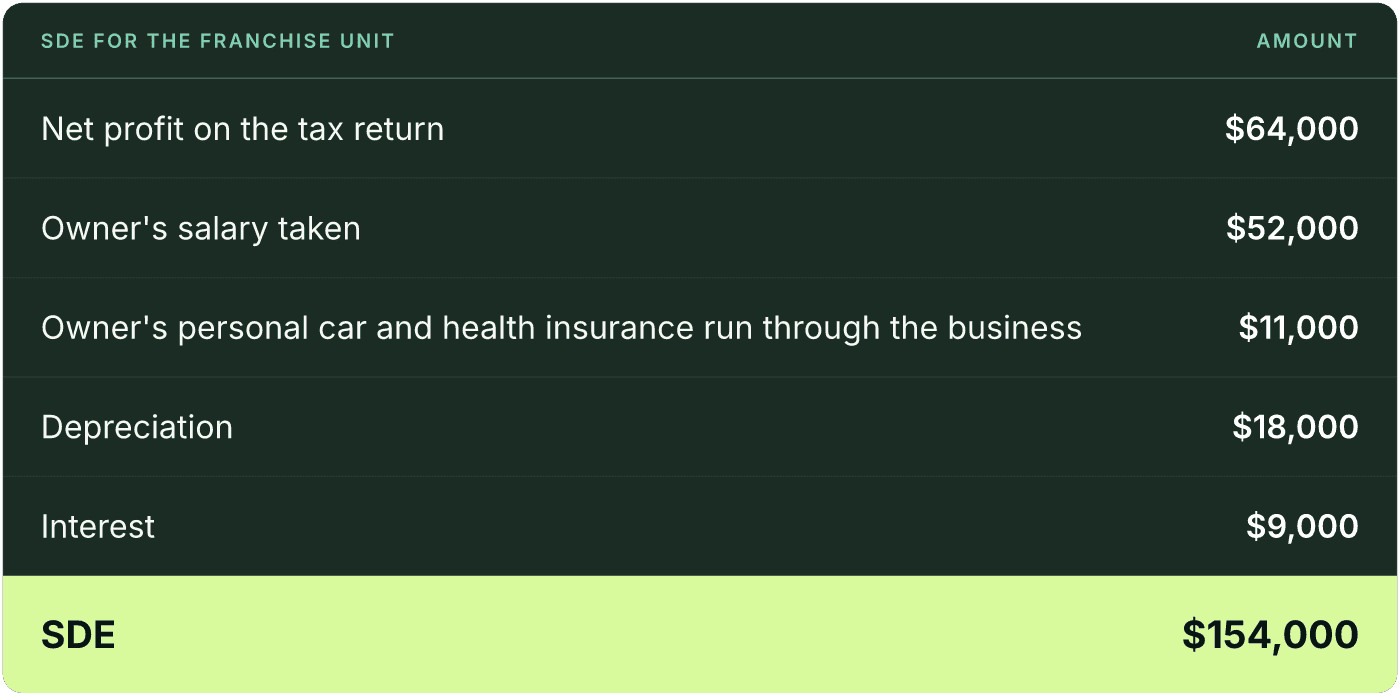
Here is the illustrative unit we will use. It sells sandwiches under a national brand, takes in $1,200,000 a year, and files a tax return showing $64,000 of net profit.
[](https://www.409.ai/uploads/franchise_resale_valuation_royalty_remaining_term_transfer_small_business_table_1_dbad3b79b4.png)
Royalties are not added back. The 6% royalty and 2% brand fund contribution on $1,200,000 of sales come to $96,000 a year, and they are already inside the $64,000 profit as ordinary operating costs. That is correct. A buyer inherits the obligation to keep paying them, so a valuation treats them like rent or payroll. Adding them back would value the unit as if the buyer could walk away from the brand and keep the sales, which is not an option the buyer has.
The table shows only the starting point. The sections below are where the franchise agreement changes the answer.
The royalty stays with the unit, so compare fees, not just profit
Two units with the same SDE are not equal when one pays 6% in fees and the other pays 3%. Before comparing a unit to anything, find out what the agreement charges beyond the headline royalty: the advertising fund, technology fees, required software, and any fee the franchisor can raise.
The Federal Trade Commission's Franchise Rule makes the franchisor list these in the disclosure document. Item 6 requires a table of all other fees the franchisee must pay to the franchisor or its affiliates, with the amount, due date and any formula used to compute it ([16 CFR 436.5](https://www.law.cornell.edu/cfr/text/16/436.5)). A seller who still has the document from when they bought, or a current one from the franchisor, has the fee list on paper. The numbers in a seller's tax return reflect what was actually paid, and the appraiser should tie the two together.
One more point on fees. If the fee schedule has changed since the seller's last full year, the appraiser should restate the earnings at today's fees. A buyer pays for what the unit will earn under the schedule they will live with, not the one the seller enjoyed.
Remaining term is the first big question
An independent business has no expiration date. A franchise unit does. The franchise agreement runs for a set number of years, and what happens at the end is spelled out in the contract.
Item 17 of the disclosure document is where the franchisor summarizes renewal, termination, transfer and dispute resolution, with a reference to the section of the agreement for each. For renewal, the summary has to explain what renewal means in that system, including whether franchisees may be asked to sign materially different terms ([16 CFR 436.5](https://www.law.cornell.edu/cfr/text/16/436.5)).
That phrase, materially different terms, matters for value. If a franchisee renewing in year ten can be handed the franchisor's then-current agreement, the royalty, the fund contribution and the remodel requirements at renewal are not fixed today.
Take two otherwise identical units. One has twelve years left on its agreement. The other has two. The buyer of the second unit is paying for a business whose cash flows after year two depend on terms nobody can read yet, and may have to fund a remodel to qualify for renewal. A real buyer, and so a real appraiser, will price that. The adjustment can show up as a lower multiple of earnings, or as a short projection period followed by a lower value after the term ends. Either way, the unit with two years left is worth less than the one with twelve, with the same SDE.
Test what a renewal would do to earnings
You do not need to guess at the exact renewal terms to see how much they matter. Run the numbers with a plausible change and see how far the value moves.
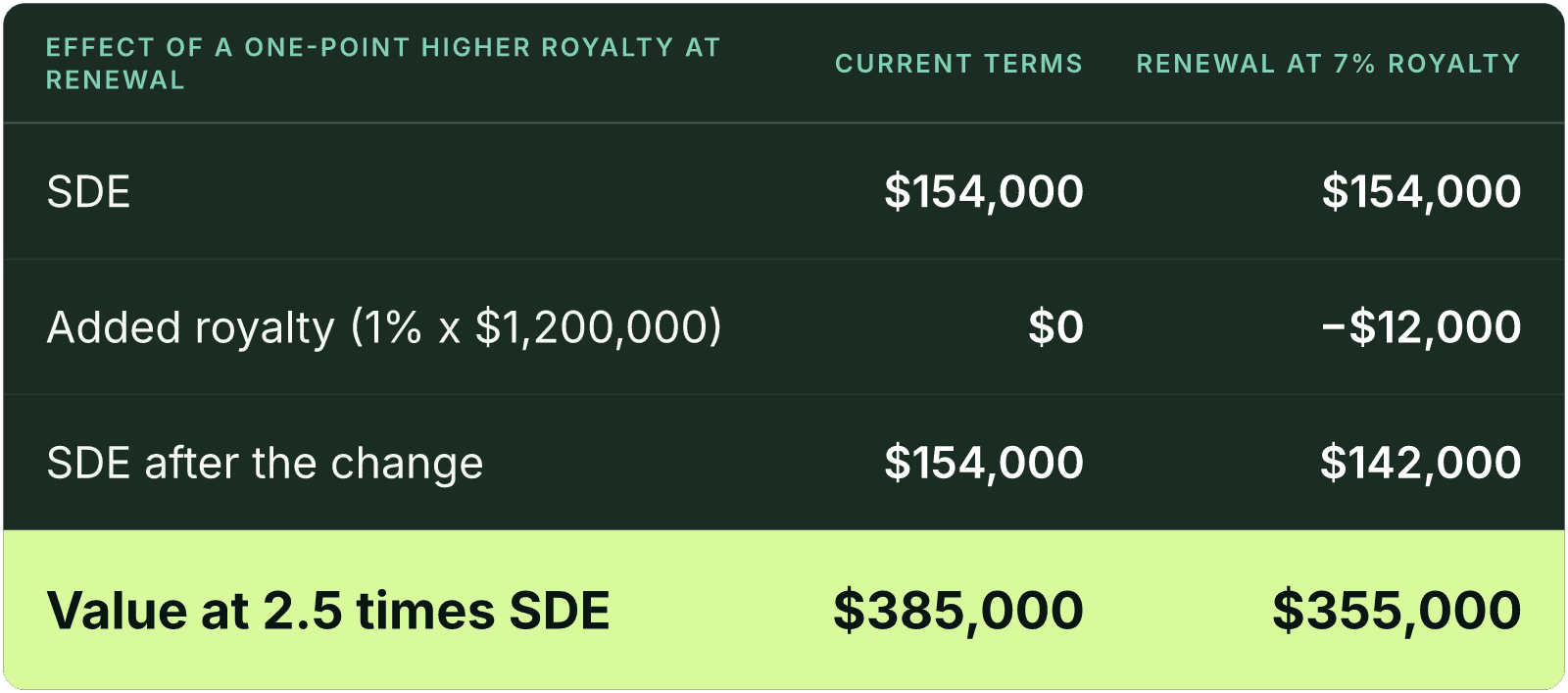
Suppose renewal comes with a royalty one point higher, 7% instead of 6%, on the same $1,200,000 of sales. That is $12,000 a year. At an assumed multiple of 2.5 times SDE, chosen only to keep the arithmetic simple, the result looks like this:
[](https://www.409.ai/uploads/franchise_resale_valuation_royalty_remaining_term_transfer_small_business_table_2_7c72b7faed.png)
The extra point costs $30,000 of value, two and a half times the $12,000 of annual earnings it removes. That is how an earnings multiple works: a dollar of permanent earnings is worth the multiple. The point for a seller is that the buyer will make this calculation about the renewal terms, so a unit nearing renewal carries that risk in its price. The point for a buyer is the same in reverse: ask how much room the price leaves for a change you cannot control.
The 2.5 multiple is an assumption for illustration. The actual multiple for a particular unit comes from market evidence and from the risk of that business, as [Capitalization Rate vs. Discount Rate](https://www.409.ai/articles/capitalization-rate-vs-discount-rate-small-business-valuation-earnings-multiple) explains.
A franchise transfer comes with conditions
A franchisee owns the unit's assets, but the right to operate under the brand comes from the agreement. The same Item 17 table that covers renewal also covers transfer, so the conditions a buyer has to meet before the franchisor lets the sale go through are summarized there and written out in the agreement.
For valuation, there are two practical consequences.
First, the sale price should be tested against what the sale can actually include. If the agreement lets the franchisor reject a buyer, or requires the buyer to sign the current form of agreement, the buyer the seller thinks they have may not be the buyer who closes. That affects how much weight to give a negotiated price when the appraiser looks at what the unit would sell for.
Second, check what the buyer must pay on top. The fee table and the agreement can list charges tied to a transfer. Those are costs of the transaction, not part of the unit's earnings, and they belong in the buyer's total cost, not in SDE.
None of this is legal advice, and the agreement controls. A franchise attorney should read the transfer and renewal sections before anyone signs a purchase agreement. What a valuation can do is put a price on the consequences once those terms are known.
Which numbers to trust: the unit's, not the system's
Franchisors sometimes publish system-wide results, and a buyer will see them. They are a reference, not the unit's value.
Item 19 of the disclosure document covers financial performance representations. If a franchisor makes none, it must say so, and if it does make one, the franchisor needs a reasonable basis and written substantiation for it, plus a statement that a new franchisee's individual results may differ ([16 CFR 436.5](https://www.law.cornell.edu/cfr/text/16/436.5)). Those statements describe the system. They say little about this unit, in this location, with this lease and this manager.
Item 20 gives a different kind of evidence. It reports the number of franchised and company-owned outlets, how many opened, closed and transferred over the last three fiscal years, and lists current franchisees ([16 CFR 436.5](https://www.law.cornell.edu/cfr/text/16/436.5)). A system where many units have transferred or closed in recent years is telling a buyer something about risk, and an appraiser can reasonably reflect it when choosing a multiple. A buyer can also call other franchisees from the Item 20 list and ask what they would pay.
For the unit itself, the evidence is the seller's own statements. Use at least three years of tax returns and monthly profit and loss statements, and tie sales to the franchisor's own reporting where the seller files it. [Which Years of Earnings Does a Small Business Appraiser Use?](https://www.409.ai/articles/which-years-of-earnings-small-business-appraisal-weighted-average-trend) explains how the years are weighted.
Three adjustments franchise resales often need
Beyond the royalty and the term, three items come up again and again:
- **Required remodels and equipment refreshes.** If the agreement or the franchisor's standards require a refresh within a few years, the buyer will treat the cost as a reduction in what they pay or a charge against future cash flow.
- **Lease terms.** Franchise leases often track the franchise term. A lease that ends before the agreement does, or the reverse, is a risk the appraiser prices. If the seller owns the building, [When You Own the Building: Normalizing Rent in a Small Business Valuation](https://www.409.ai/articles/related-party-rent-small-business-valuation-owner-owns-building) shows how to set market rent.
- **Owner dependence.** A unit the owner runs behind the counter every day is a different asset from one with a general manager. [Key Person Discount in a Small Business Valuation](https://www.409.ai/articles/key-person-discount-small-business-valuation-owner-dependence) covers how that is handled.
What this means before you list or buy
If you are selling, pull the agreement and read the term, renewal, transfer and fee sections before you set an asking price. Know how many years are left and what the franchisor will require of a buyer. A price built from a rule of thumb ignores all of that, and the lender or the buyer's advisor will not. [Rule-of-Thumb Multiples vs. a Real Appraisal](https://www.409.ai/articles/rule-of-thumb-multiples-vs-appraisal-small-business-valuation-sde) explains why that kind of price rarely survives scrutiny.
If you are buying, ask for the current disclosure document, the unit's agreement, three years of returns and the fee history, then ask your advisor to run the renewal test above with the numbers from your unit. If an SBA loan is in the plan, the lender's valuation requirements are covered in [The $250,000 Exception Is Gone: SBA Business Valuation Rules Change on October 1](https://www.409.ai/articles/sba-sop-50-10-8-1-business-valuation-change-of-ownership).
409.AI prepares independent small business valuations for owners, buyers, lenders and advisors. If you need a valuation that reflects the franchise agreement, start at [409.AI small business valuation](https://www.409.ai/products/smb-valuation).