Compliance
First SEC Exam as a New Adviser: Is Your Valuation File Ready?
A CFO or CCO at a newly registered adviser: what the SEC's FY2027 priorities say about valuation, and how to scope your Level 3 file before the first exam.
By 409.AI Team - 2026-11-09
# First SEC Exam as a New Adviser: Is Your Valuation File Ready?
If your firm registered with the SEC in 2025 or 2026 and you run the finance or compliance function of a venture or growth-equity adviser, you are in the group the Division of Examinations says it will look at first. Its fiscal year 2027 priorities, published on October 23, 2026, say the Division "will continue to prioritize examinations of advisers that have never been examined, with particular emphasis on recently registered advisers."
An exam letter gives you a short window to produce documents. The valuation file is the one that takes months to build properly and days to assemble badly. This article walks through what the priorities actually say, what they do not say, and how to scope your valuation work and your Level 3 file before the letter arrives.
What the FY2027 priorities say, and what they leave out
Three passages matter for a private fund adviser. We quote them because the wording is narrower than the commentary around it.
Recently registered advisers. Section I.C of the priorities says exams of never-examined advisers "evaluate, among other things, the adviser's compliance with regulatory requirements and its processes for identifying, addressing, and disclosing risks and conflicts of interest."
Valuation. In the section on fiduciary standards, the Division says examinations "will review whether advisers have ... assessed the reasonableness of their valuation processes and methodologies." The compliance programs section (I.B) lists valuation among the business areas whose policies the Division will review "as appropriate for each specific examination."
Private funds. When examining advisers to private funds, reviews "will assess investment-related disclosures of risks for consistency with fiduciary standards, and whether compliance policies, procedures, and controls are designed to address both fund-level and investment-level risks." The examples include "use of debt and fund-level lines of credit" and "the accuracy of fee and expense calculations at both the fund and investment levels."
Now the limits. The valuation sentence sits in the general adviser section, not in a paragraph addressed to venture funds. The priorities do not name Level 3 positions, ASC 820 or any document you must hold. They also say the list is not exhaustive. What follows connects each priority to a document in the file. That connection is our inference from how valuation feeds each area, not a requirement the SEC has written down.
Why a valuation file touches fees, not just marks
Management fees in many venture and growth funds step down on invested capital or net asset value. Carried interest accrues on the mark. A fund with a NAV facility borrows against the mark. So the valuation sits underneath several of the calculations the Division says it will test.
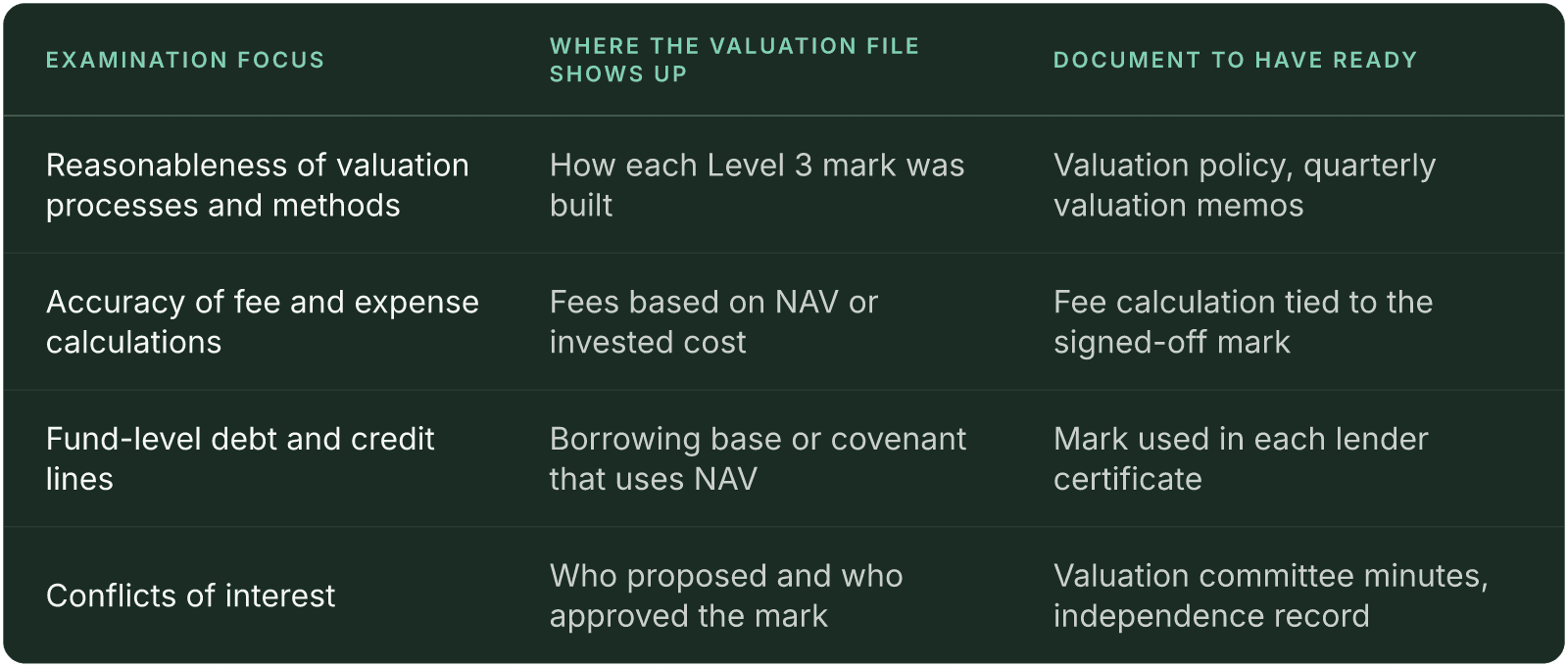
Here is how we would map the priorities to the file.
[](https://www.409.ai/uploads/first_sec_exam_newly_registered_adviser_fy2027_priorities_valuation_file_table_1_3dfa52e2cf.png)
The table does not say the SEC will ask for these four documents. It says that if an examiner asks how a fee was calculated, the answer runs through a mark, and the mark needs a trail. The fee review is only as defensible as the valuation under it.
The first exam is a process exam
A seasoned adviser gets asked about exceptions. A new adviser gets asked whether the process exists. The Division says first exams assess how an adviser identifies and addresses conflicts, which in a valuation context starts with one uncomfortable fact: the person who benefits from a higher mark (the GP, through fees and carry) is often the person who proposes it.
Examiners tend to look for a few things that you can prepare in advance:
- A written valuation policy that matches what you actually do. Our article on [why your auditor and the SEC read your valuation policy](https://www.409.ai/articles/fund-valuation-policy-asc-820-audit-sec-exam) covers what the policy has to say and why a policy copied from a template creates its own exposure.
- A clear owner for each mark, and a record that someone other than the deal partner reviewed it.
- A consistent method from one quarter to the next, with a documented reason when it changes.
- Evidence that inputs were tested, not just carried forward. Calibration to the last round and a back-test of management forecasts are the usual places a file is thin. See [how a fund updates a Level 3 mark without a new price](https://www.409.ai/articles/stale-round-fund-level-3-mark-asc-820-calibrated-roll-forward-no-new-price) and [why a Level 3 mark can't use a management plan as written](https://www.409.ai/articles/management-forecast-fund-level-3-mark-asc-820-haircut-plan-back-test).
The SEC has also published a staff view on private asset fair value. We summarised what it says about calibration and NAV in [SEC Staff on Private Asset Fair Value](https://www.409.ai/articles/sec-staff-statement-private-asset-fair-value-calibration-nav). It is worth reading before you finalise the policy.
Scoping the valuation engagement before the letter
A first exam usually lands after you have already closed at least one year-end. That is the moment to ask whether the work behind your marks would survive a request to see it. The decisions are practical.
Decide who values what. Some advisers value everything in-house and have a third party review. Others use an administrator for calculation and keep judgment in-house. Others hire an independent firm for the Level 3 positions. None of these is wrong, but each leaves a different trail and a different independence question. We compare the three in [Who should value your fund's Level 3 positions](https://www.409.ai/articles/fund-level-3-valuation-administrator-in-house-independent-firm-sec-exam-file).
Scope by positions and frequency, not by a flat fee in your head. ASC 820 work is scoped by the number of Level 3 positions, how often you mark them and the complexity of each security. A fund with eight preferred-stock positions marked quarterly is a different engagement from a fund with forty positions marked semi-annually. Count your positions, list the instruments, and decide whether each quarter gets a full valuation or a roll-forward of the prior one. Our guide to [how a fund buys its first Level 3 valuation](https://www.409.ai/articles/how-fund-buys-first-level-3-valuation-asc-820-scope-quote-december-31-file) shows what a quote should cover and what to bring to the first call.
Fix the December 31 file first. The year-end mark is the one your auditor and an examiner are both most likely to read. If the file for that date is complete, earlier quarters are easier to rebuild than the reverse. If you only have time to fix one thing, fix that one.
Keep the footnote consistent with the memo. The financial statements disclose Level 3 inputs, and an examiner can read the footnote next to your valuation memo. A mismatch invites questions. See [what a private fund's Level 3 footnote must say](https://www.409.ai/articles/asc-820-level-3-footnote-private-fund-asu-2018-13-nonpublic).
A pre-exam check you can run in an afternoon
Pick one position and one quarter. Starting from the fee invoice or the LP statement, trace back to the mark. Then ask:
1. Can you find the valuation memo for that position and that date? 2. Does it state the method, the inputs and where each input came from? 3. Does the policy in force that quarter allow that method? 4. Who approved the mark, and is that recorded? 5. Does the NAV in the fee calculation, any lender certificate and the financial statements equal that approved mark?
If any answer is a hunt through email, you have found what an examiner would find. Fix the process, then repeat the exercise on a second position.
What to do this quarter
The priorities do not tell a new adviser what to produce. They tell you where the Division will look. For a valuation file, that means a policy that matches practice, a documented review of every Level 3 mark, and a trail from each mark to every number that depends on it. Start with the December 31 positions, because that is the date an examiner is most likely to ask about first.
If you want a scoped view of what an independent ASC 820 valuation would cover for your portfolio, our [ASC 820 valuation service](https://www.409.ai/products/asc-820) starts from your positions and your reporting frequency.