Financial Reporting
Why a New Fund Investment Shows an Unrealized Loss at Its First Quarter-End
A first-time fund's first mark shows an unrealized loss on a sound deal. Why ASC 946 cost and ASC 820 fair value differ, and how to calibrate and explain it.
By 409.AI Team - 2026-10-13
# Why a New Fund Investment Shows an Unrealized Loss at Its First Quarter-End
You closed a Series B position in September. The company has hit every milestone since. Then the first quarterly package lands on your desk and the line shows an unrealized loss of $120,000. Nothing went wrong with the deal. The loss comes from two accounting rules that measure the same investment on two different bases, and the first mark is where they meet.
This post is for the controller or CFO of a first-time venture or growth fund preparing the first LP report after its initial investments. It explains where the loss comes from, how to calibrate the first mark so the number holds up, and how to explain the line to LPs and your auditor before they ask.
Two rules, two starting points
Investment companies report investments at fair value at each reporting date. That is the core of ASC 946, and ASC 820 defines what fair value means.
The two standards treat the cost of doing a deal differently. Under ASC 946, an investment is recorded initially at its transaction price. In practice that means what you paid, including the commissions and other charges that were part of the purchase. Legal fees, diligence fees and similar costs that your valuation policy treats as part of acquiring the position sit in cost.
ASC 820 goes the other way. Fair value is an exit price, and the guidance says the price in the principal market is not adjusted for transaction costs (ASC 820-10-35-9B). A buyer who stepped into your position tomorrow would not reimburse you for your lawyers. So fair value excludes those costs.
One accounting commentary puts the consequence plainly: costs of transacting that sit in cost but not in fair value show up as a ["day 1" unrealized loss](https://www.gaapdynamics.com/?p=20760) in the income statement. The investment is not impaired. The costs were real cash out of the fund, and the fair value measure does not carry them.
A worked example
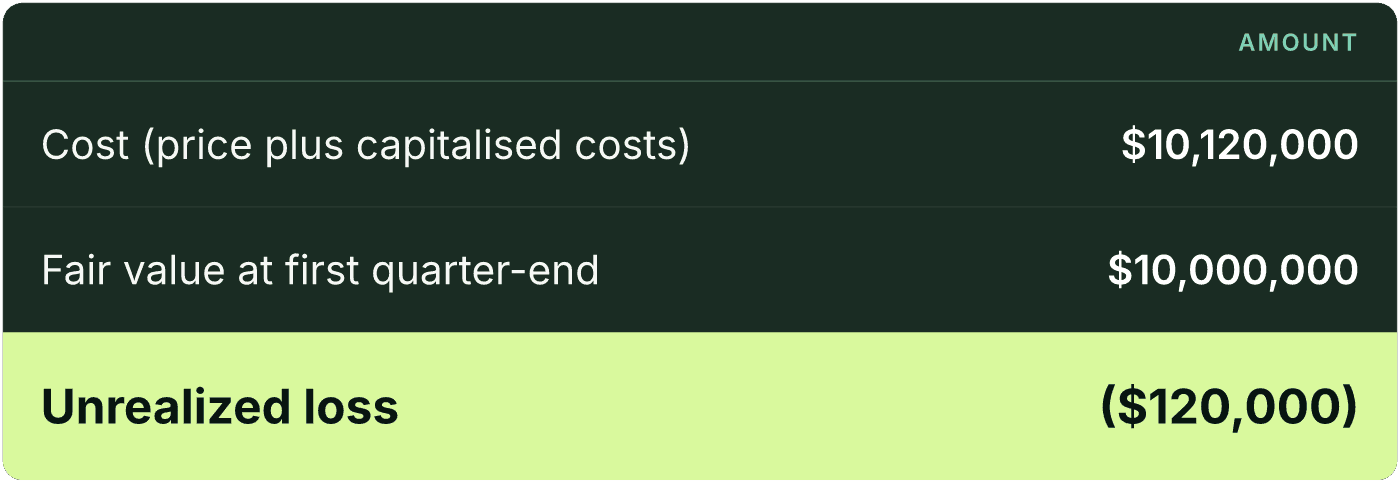
Illustrative numbers. A fund with $50,000,000 of net assets buys $10,000,000 of Series B preferred stock in a priced round. It pays $120,000 in legal and diligence costs that its policy capitalises into the investment. Cost on the books is $10,120,000.
At the first quarter-end the company has made no news, good or bad, and no other investor has priced the company. The fund concludes, as it can, that the price paid is the best evidence of fair value. Fair value is $10,000,000.
[](https://www.409.ai/uploads/first_quarter_end_mark_unrealized_loss_transaction_costs_asc_820_asc_946_table_1_18fab18c21.png)
That is 0.24% of net assets, small enough to look like noise and large enough to draw a question in an LP call.
Now suppose the company's own multiple expands and the fund's valuation supports an 8% increase in fair value, to $10,800,000. Against cost the unrealized gain is $680,000. The change in fair value is $800,000, and the $120,000 of costs still comes off the top. LPs who compare the schedule of investments with the company's reported progress will see a gain smaller than the move they expected. The schedule is right. It needs a sentence of explanation.
Calibrate to the price, not to the all-in cost
The more important decision is what your model starts from. A valuation technique used at a later date should be consistent with the one that gave fair value at initial recognition. Deloitte's fair value roadmap notes that an entity [may use the initial transaction price, excluding transaction costs, as a starting point](https://dart.deloitte.com/USDART/home/codification/broad-transactions/asc820-10/roadmap-fair-value-measurements-disclosures/chapter-9-initial-measurement/9-2-transaction-price-is-not) for later valuations, for example by calibrating model parameters. The same passage cautions that the entity cannot assume the transaction price equals fair value in later periods.
Both halves matter for the first mark.
Calibrate at the price. Build the model so that, on the closing date, it returns the $10,000,000 you paid for the shares. If it returns $10,120,000 because you fed it the all-in cost, you have built the capitalised fees into the implied multiple, and every later mark inherits them. If it returns $9,600,000, the model disagrees with an arm's-length price and you have a calibration problem to explain, not a day-one loss to book.
Then update for what changed. A calibrated model that you roll forward with observable changes in the market, the company's results and the terms of the security carries the information forward. Calibration of private asset marks is also the subject of [our post on the SEC staff statement on private asset fair value](https://www.409.ai/articles/sec-staff-statement-private-asset-fair-value-calibration-nav). Auditors ask for the calibration memo first, and a first mark is the easiest one to document because the price is right there.
Check whether the price still holds. A transaction price is not always fair value. Related-party deals, forced sales and a different principal market can all separate the two. For a plain priced round led by an independent investor, price at close is strong evidence. Say so in the file and say why.
What belongs in cost, and what does not
The example capitalised the fees. Your policy has to say which costs it treats that way, and the answer has to match what you tell the auditor and what the fund documents allow the fund to bear.
Some costs never reach the fund. A management company may bear deal expenses under the limited partnership agreement. Broken-deal costs on a transaction that never closed do not belong in any position's cost. Fund formation and organisation costs follow their own treatment and are not part of a portfolio company's cost basis.
Draw the line once, in writing, and apply it to every deal. Our post on [ASC 946 financial statements for venture funds](https://www.409.ai/articles/asc-946-investment-company-venture-fund-financial-statements) covers the wider statement set that these costs flow into. A written line is easier to defend than a case-by-case judgment made at the end of a quarter.
The effect on NAV and carried interest
The first-mark loss reduces net assets at the reporting date, and it feeds any calculation built on net assets or unrealized gains. If your management fee runs on invested capital, nothing moves. If the fund accrues carried interest on a hypothetical liquidation basis, the cost-versus-fair-value gap sits inside that calculation, and a fund under its preferred return hurdle may accrue nothing at all. The mechanics are in [our walk-through of carried interest accruals under a hypothetical liquidation](https://www.409.ai/articles/carried-interest-accrual-hypothetical-liquidation-fund-marks).
A fund that deploys in several tranches can see this loss recur each quarter with each new closing, and the cumulative effect becomes visible in year-one performance. Because the amounts are small, they are also easy to explain early.
Explaining the line to LPs
Do not wait for the question. A short note under the schedule of investments does the job:
"Unrealized depreciation of $120,000 on Company X at quarter-end reflects transaction costs capitalised at acquisition, which are excluded from fair value. The investment is carried at its transaction price. No change in the company's value was recognised in the period."
Three practices make the note hold up.
- **Break it out in the working file.** Show cost, transaction costs and the price-based fair value in separate columns, so the loss is visible as a bridge, not a plug.
- **Keep the note consistent with the footnotes.** Level 3 positions carry their own disclosures. Our guide to the [Level 3 footnote for private funds](https://www.409.ai/articles/asc-820-level-3-footnote-private-fund-asu-2018-13-nonpublic) shows how the unobservable inputs and valuation techniques tie to the mark.
- **Write the rule into the valuation policy.** A short paragraph stating that fair value excludes transaction costs, that the initial mark is calibrated to the transaction price, and which costs the fund capitalises, saves a discussion at every audit. The [fund valuation policy post](https://www.409.ai/articles/fund-valuation-policy-asc-820-audit-sec-exam) lists what examiners and auditors expect to see in one.
A takeaway for your next close
Before the next quarter-end, pull every position bought in the period and put three numbers beside each: price paid, costs capitalised, and the fair value your model returns on the closing date. The first two should reconcile to cost on the ledger. The third should equal the first. If it does not, find out why before the auditor does.
If your fund needs an independent view on a first mark or a calibration memo, 409.AI's [ASC 820 portfolio valuation service](https://www.409.ai/products/asc-820) starts at $2,999 and is built for exactly this kind of Level 3 position.