Compliance
Extracted Performance in a Fund II Deck: The SEC's Four Conditions and the Marks Behind Them
For the GP or CFO building a Fund II deck: when the SEC staff accepts gross-only extracted performance, and why unrealised deals put your Level 3 marks on it.
By 409.AI Team - 2026-11-20
# Extracted Performance in a Fund II Deck: The SEC's Four Conditions and the Marks Behind Them
If you're the GP or CFO of an emerging venture or growth manager registered with the SEC, and you're building a Fund II deck for the first quarter of 2027, the slide you care most about is probably the one that shows Fund I's five best deals. Most of those deals haven't exited. Their value on the slide is your December 31 mark.
That slide is "extracted performance" under the SEC's marketing rule, and the SEC staff has said when such a slide can show gross numbers without net. The conditions are workable. What they leave untouched is the question an examiner or a diligent LP will ask next: where did the unrealised values come from, and can you prove them? This article walks through the rule, the staff's four conditions, the January 2026 model-fee answer, and why the Level 3 file now belongs in the marketing review.
Who the rule actually binds
Start with scope, because a lot of Fund II decks are built by firms the rule doesn't reach. [Rule 206(4)-1](https://www.law.cornell.edu/cfr/text/17/275.206(4)-1) applies to an investment adviser "registered or required to be registered" under section 203 of the Advisers Act. An adviser that advises only venture capital funds is exempt from registration under [section 203(l)](https://www.law.cornell.edu/uscode/text/15/80b-3), and section 203(m) exempts an adviser solely to private funds with less than $150 million of assets under management in the United States. Exempt reporting advisers in either group aren't bound by the marketing rule's performance conditions.
They aren't free of the problem, though. [Rule 206(4)-8](https://www.law.cornell.edu/cfr/text/17/275.206(4)-8) makes it a fraudulent act for any adviser to a pooled investment vehicle to make an untrue statement of a material fact, or omit one, to an investor or prospective investor. A highlight reel built on marks you can't support is exposed under that rule whether or not you're registered. So read what follows as a requirement if you're registered and as a sound standard if you're not.
What the rule says about an extract
The rule defines extracted performance as "the performance results of a subset of investments extracted from a portfolio." Two provisions then apply to it. Paragraph (d)(5) bars extracted performance unless the advertisement "provides, or offers to provide promptly," the performance of the total portfolio it came from. Paragraph (d)(1) bars any gross performance unless net performance sits beside it, with at least equal prominence, over the same period and using the same type of return and methodology.
That second provision is the hard one for a deal slide. Fees and carry are charged at the fund level, not deal by deal, so a "net MOIC" for five investments is an allocation exercise that can confuse more than it informs. Don't expect to relabel your way out, either. The staff's March 2025 FAQ on portfolio characteristics carves IRR, MOIC and TVPI out of its gross-only relief for characteristics, "regardless of how such metrics are labelled in the advertisement." Treat every multiple on the slide as performance.
The four conditions in the staff's March 2025 FAQ
The Division of Investment Management's [Marketing Compliance FAQ](https://www.sec.gov/rules-regulations/staff-guidance/division-investment-management-frequently-asked-questions/marketing-compliance-frequently-asked-questions) (extracted performance answer updated March 19, 2025) says the staff would not recommend enforcement under paragraph (d)(1) if an adviser shows gross performance of an extract without its net, provided that:
1. the extracted performance is clearly identified as gross performance; 2. it's accompanied by the total portfolio's gross and net performance, presented consistently with the rule; 3. the total portfolio's gross and net performance appears with at least equal prominence to the extract, in a manner designed to facilitate comparison; and 4. the total portfolio's performance covers a period that includes the entire period of the extract.
The footnotes do practical work. "Clearly identified" can mean a statement that the extract doesn't reflect the fees and expenses investors paid, plus a pointer to the total portfolio's figures. The total portfolio needn't sit on the same page, and the staff suggests that showing it before the extract can help satisfy equal prominence.
Two limits are worth keeping in view. This is a no-action position under (d)(1); the general prohibitions in paragraph (a) still apply. And the FAQ page itself says staff guidance has "no legal force or effect." It describes what the staff would recommend, not what the Commission has decided.
A worked example: how much of the slide is a mark?
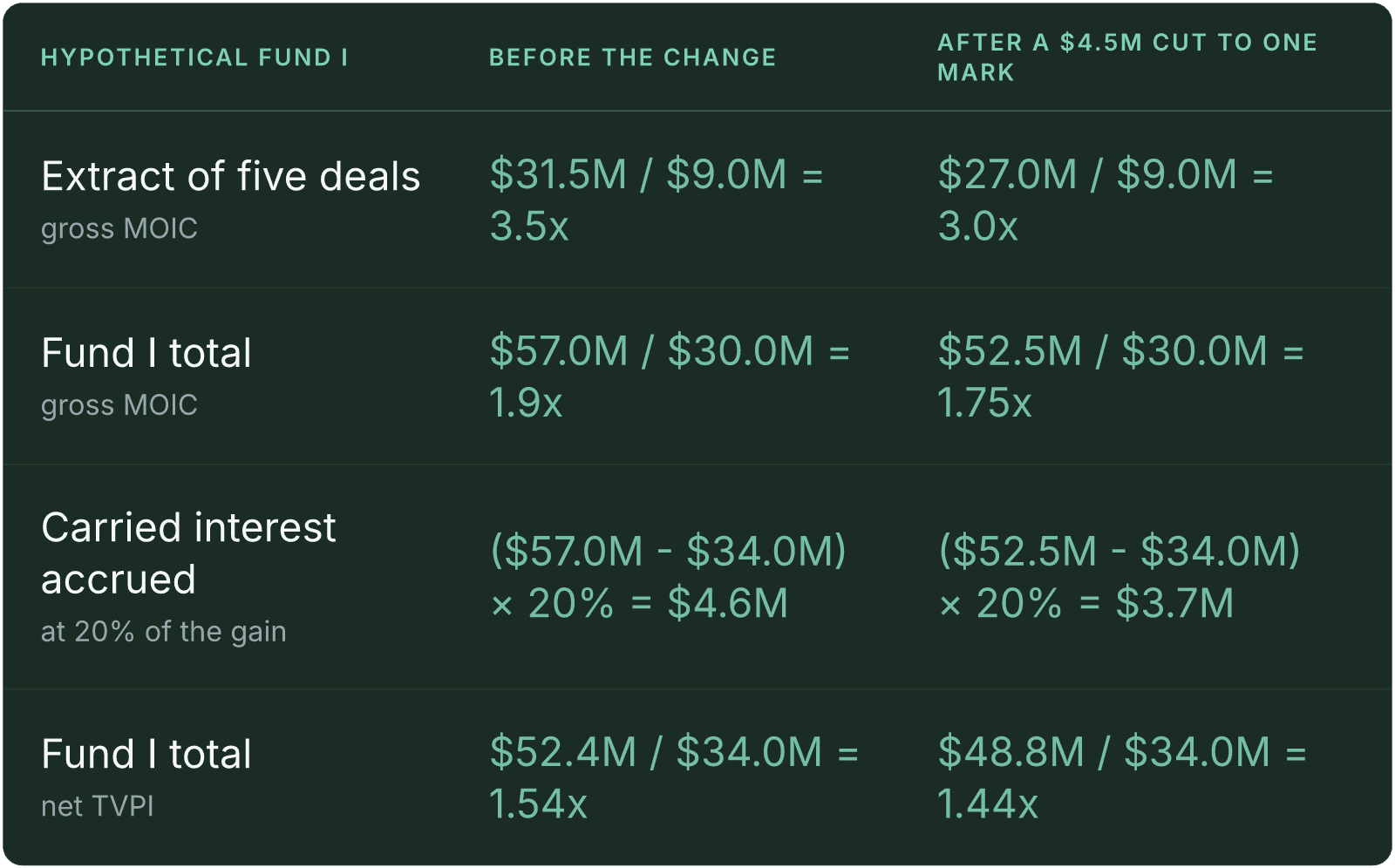
Take a hypothetical Fund I: $34.0 million paid in by LPs, $30.0 million invested, and a deck that highlights five deals with $9.0 million of cost. At December 31, 2026, those five carry $31.5 million of value. Only $3.0 million of that has been realised. The other $28.5 million, about 90% of the extract, is Level 3 fair value from your year-end marks.
Now suppose the audit, or your own review, cuts the largest unrealised mark of $15.0 million by 30%, a $4.5 million reduction. Here is what moves, with carried interest accrued at 20% of the fund's gain for the net figure:
[](https://www.409.ai/uploads/extracted_performance_fund_ii_deck_sec_marketing_rule_gross_net_level_3_marks_table_1_462a12fa91.png)
The extract loses half a turn. The fund's net TVPI loses a tenth of one. That asymmetry is the whole issue: a highlight slide concentrates exposure to the handful of marks that carry it, and the four conditions say nothing about whether those marks are right. The total portfolio comparison protects the investor from the fee effect. It doesn't protect anyone from a soft mark.
The January 2026 answer on model fees
The second update matters to almost every Fund II. Many first funds gave anchor LPs a discounted management fee or a lower carry. Fund II goes out on full terms. Footnote 590 of the [2020 adopting release](https://www.sec.gov/rules/final/2020/ia-5653.pdf) said that if the fee to be charged to the intended audience "is anticipated to be higher than the actual fees charged, the adviser must use a model fee that reflects the anticipated fee."
In the FAQ posted January 15, 2026, the staff said some advisers had read that footnote as a categorical ban on net performance using actual fees. Its view is narrower: showing only actual-fee net performance "may be inconsistent with the rule's general prohibitions," whether it is depends on all the facts and circumstances of the advertisement, including disclosures, and advisers "may use various means to illustrate the effect of differences between actual fees and anticipated fees."
So the Fund I net TVPI of 1.54x above, computed on the fees Fund I's LPs actually paid, can still appear. If Fund II's fees are higher, the deck needs to show or explain what that difference does to the number. If you use a model fee instead, the rule's own definition of net performance applies: a model fee that produces figures no higher than the actual fee, or one equal to the highest fee charged to the intended audience.
Subscription lines and the IRR on the slide
One more staff answer catches first-time managers. If Fund I used a capital call facility, the February 2024 FAQ says a gross IRR measured from the investment date can't be paired with a net IRR measured from when LP capital was called. The two must use the same period and methodology. And a net IRR that includes the facility's effect, shown alone, needs comparable figures without it or disclosure of the impact. If your deal slide quotes an IRR, check which clock it uses before you check anything else. Our piece on [ILPA's 2026 templates and the four IRRs behind one year-end NAV](https://www.409.ai/articles/ilpa-2026-templates-year-end-marks-four-irrs-one-nav-fund-lp-report) shows how far apart those clocks can sit.
Why the Level 3 file is now part of the marketing review
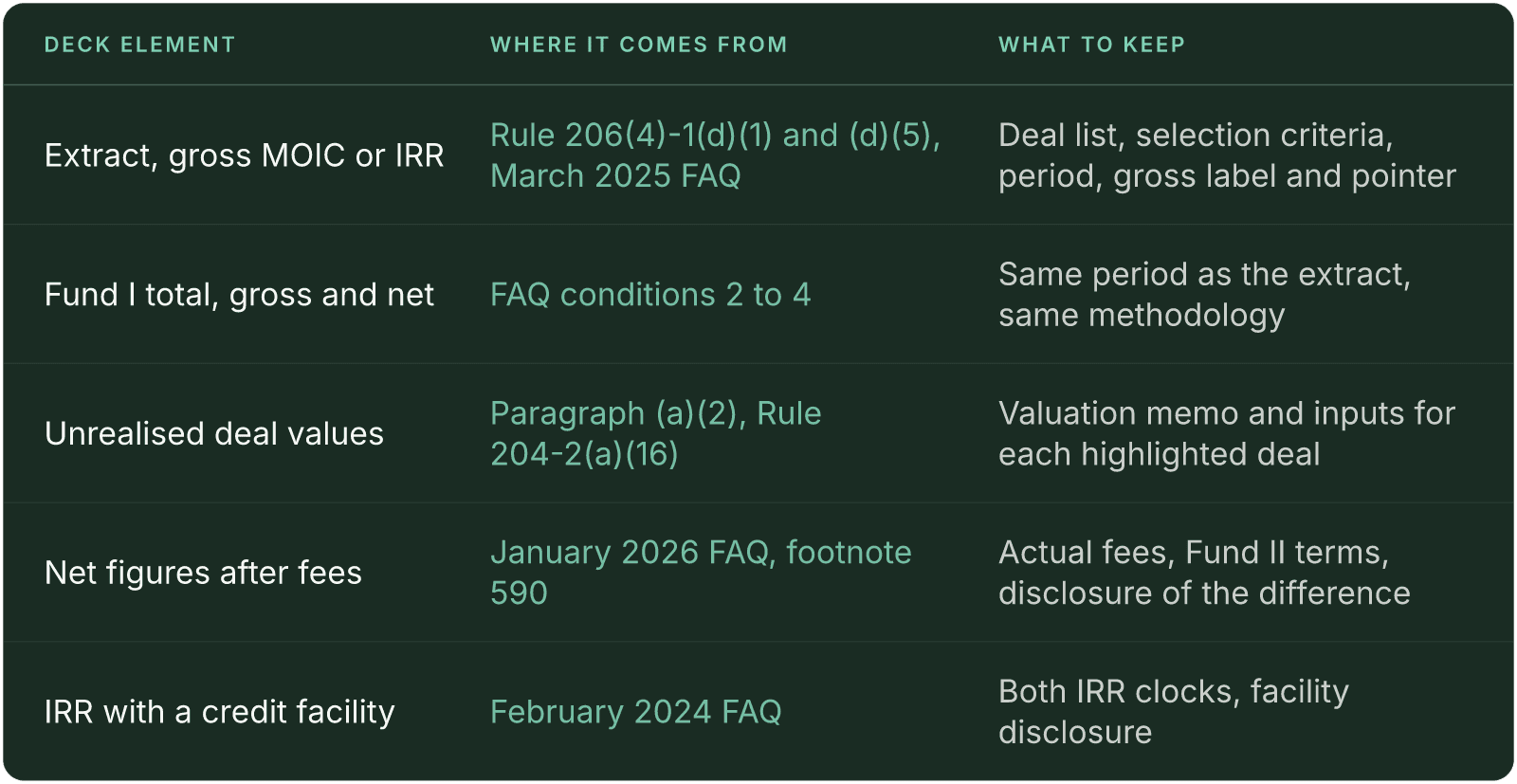
Three provisions tie the deck to your valuation work. Paragraph (a)(2) bars a material statement of fact the adviser has no reasonable basis to believe it can substantiate on demand by the Commission. Paragraph (a)(6) bars including or excluding performance results in a manner that isn't fair and balanced, which is exactly the judgement a highlight slide makes. And [Rule 204-2(a)(16)](https://www.law.cornell.edu/cfr/text/17/275.204-2) requires a registered adviser to keep the records "necessary to form the basis for or demonstrate the calculation of" any performance in an advertisement.
For an extract that is 90% unrealised, the records that demonstrate the calculation are the marks. In our view that means the valuation memo for each highlighted deal, the inputs and calibration behind it, and the approval under your [valuation policy](https://www.409.ai/articles/fund-valuation-policy-asc-820-audit-sec-exam). The rule doesn't name ASC 820 or a Level 3 memo; that link is our reading of what "demonstrate the calculation" requires when the number is a fair value estimate.
Here is how we would map the deck to the file before it goes out:
[](https://www.409.ai/uploads/extracted_performance_fund_ii_deck_sec_marketing_rule_gross_net_level_3_marks_table_2_7b9d3b4217.png)
Timing deserves a thought. A deck sent in January or February usually runs on December 31 marks before the audit opinion; for many registered advisers, the [custody rule's 120-day audit delivery](https://www.409.ai/articles/custody-rule-120-day-audit-deadline-fund-year-end-marks) can push the audited statements to late April. If a mark moves in the audit, the deck that used it is out of date. Keep each version of the deck with the marks it used, and decide in advance who refreshes the slide when a number changes.
It also helps to know how good your marks have been. A [back-test of Fund I's past marks against exit prices](https://www.409.ai/articles/back-testing-fund-marks-exit-prices-asc-820-disposition-analysis) is evidence you can put in the file, and it answers the LP who asks whether your unrealised values tend to hold up. If you're newly registered, the same file serves your [first SEC exam](https://www.409.ai/articles/first-sec-exam-newly-registered-adviser-fy2027-priorities-valuation-file).
The takeaway
The staff's four conditions settle the presentation: label the extract gross, show the whole fund's gross and net first, and cover the extract's full period. They don't settle the substance. When five deals carry the slide and most of their value is unrealised, the highlight reel is only as defensible as five Level 3 memos. Build those memos before the deck, not after the first LP asks. If the marks on your highlighted deals need an independent fair value file for December 31, our [ASC 820 portfolio valuation](https://www.409.ai/products/asc-820) is scoped to the positions you hold.