Financial Reporting
Excess Cash and Non-Operating Assets in a Small Business Valuation
Cash in the bank and assets the business does not use sit outside an earnings multiple. How owners and their CPAs value them before a sale, buyout or loan.
By 409.AI Team - 2026-10-23
# Excess Cash and Non-Operating Assets in a Small Business Valuation
If your company keeps a large cash balance, owns something the business does not use, or has lent money to its owner, a multiple of earnings will not capture all of its value. This article is for owners of small private companies and for the CPAs, attorneys, brokers and lenders who sit beside them before a sale, a buyout, a divorce or an estate event.
The short version: an appraiser values what the business needs to earn its profit, then adds the assets that sit outside that engine at their own value. Skip that second step and the owner usually leaves money on the table. Do it carelessly and a buyer or a lender will take it back in diligence.
Why the multiple does not see the cash
A multiple of earnings prices a stream of profit. A $900,000 savings balance does not produce operating profit, so it never shows up in the earnings figure. Whatever multiple you apply, those dollars are invisible to it.
The Treasury regulation on valuing a business interest for estate and gift tax says the net value is found by looking at "a fair appraisal as of the applicable valuation date of all the assets of the business" and at its "demonstrated earning capacity" ([Treas. Reg. 20.2031-3](https://www.law.cornell.edu/cfr/text/26/20.2031-3)). Both halves matter. Earning capacity covers the engine. The appraisal of all the assets covers what the engine does not use. [Revenue Ruling 59-60](https://www.irs.gov/pub/irs-tege/rr59-60.pdf) lists the book value and financial condition of the company among its factors, which is where an appraiser starts reading the balance sheet.
Our guide to [the eight factors in Revenue Ruling 59-60](https://www.409.ai/articles/revenue-ruling-59-60-small-business-valuation-eight-factors) shows how that factor fits next to earnings and goodwill.
How much cash is excess
Every business needs some cash to run: payroll between invoices, a supplier deposit, a slow month. That cash is part of the engine. Only the amount above that need is excess.
There is no single formula. Appraisers look at how the account moves across a year, how long customers take to pay, how seasonal the company is and what the owner has actually kept on hand in lean months. A landscaping company that books most revenue from April to October needs a bigger winter cushion than a dental practice that collects every week.
Two rules of thumb keep the argument short. Cash the business has never needed to dip into during three years of statements is a good candidate for excess. Cash held for a specific, documented purpose, such as a customer deposit or a tax payment due next month, belongs to the operation or is offset by a liability.
What counts as a non-operating asset
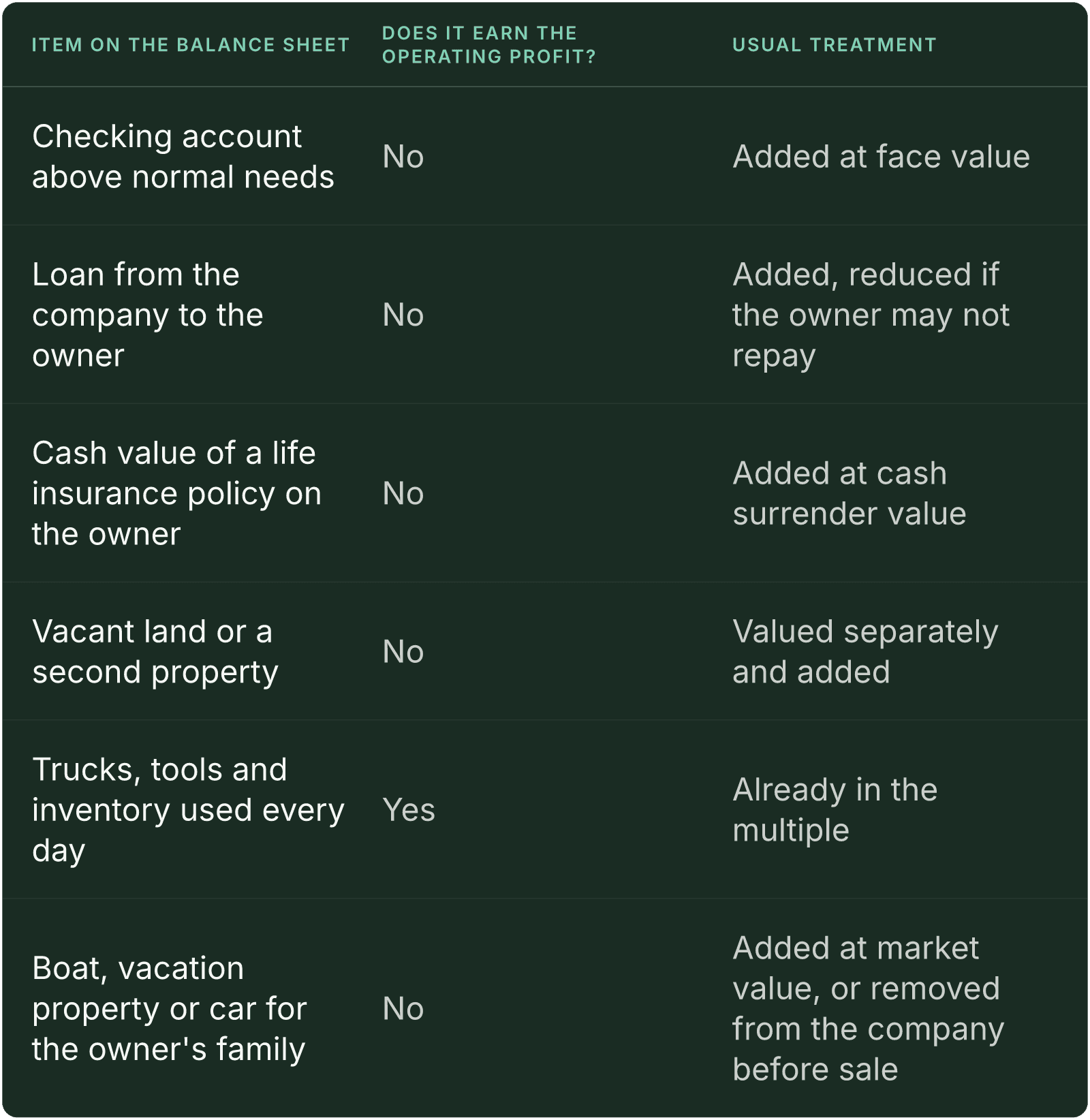
Cash is the common case, but the category is wider. An asset is non-operating when the business could sell it tomorrow and its earnings would not change.
[](https://www.409.ai/uploads/excess_cash_non_operating_assets_small_business_valuation_owner_balance_sheet_table_1_978185c929.png)
The last row is the familiar one. Personal items that run through the company inflate expenses, which is why we adjust them in the earnings, as we describe in [owner pay, SDE and EBITDA add-backs](https://www.409.ai/articles/owner-compensation-add-backs-small-business-valuation-sde-ebitda). The item itself then needs a place in the value too. Doing one without the other is a common slip.
A worked example
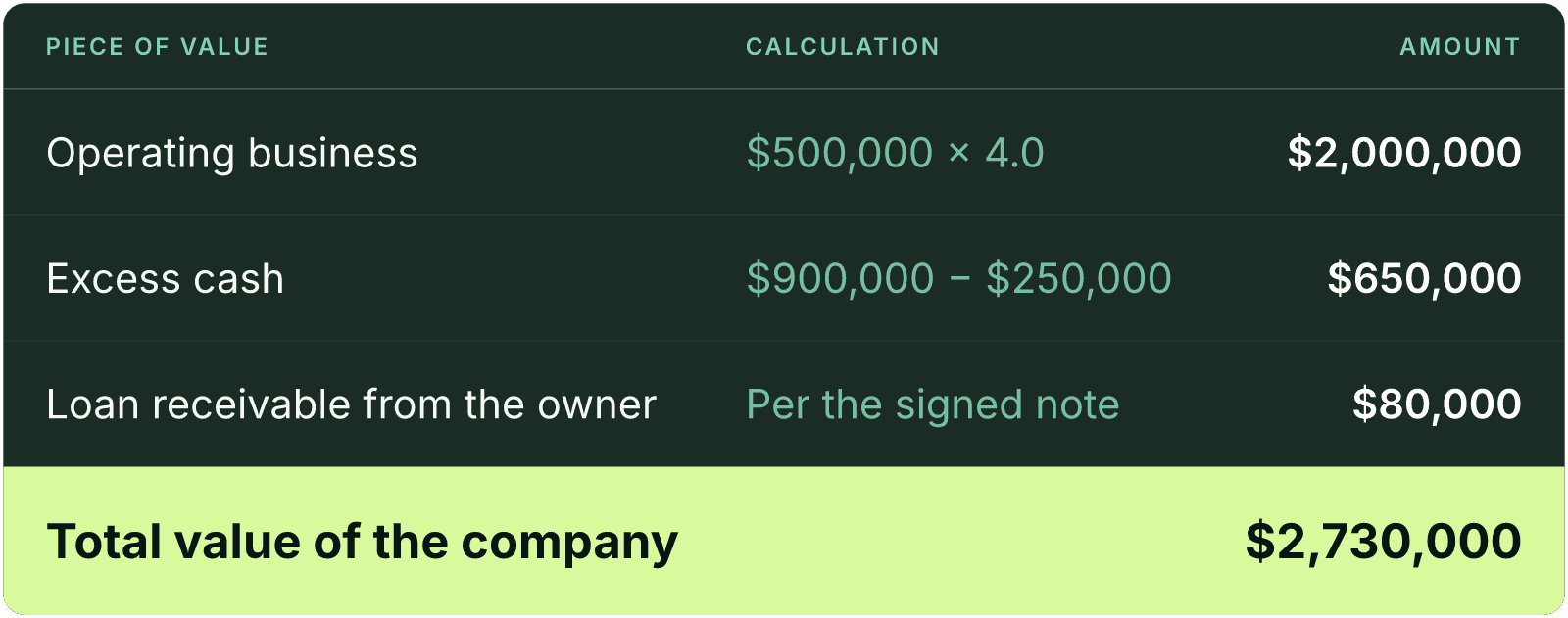
Take a commercial cleaning company with normalized earnings of $500,000 a year. The appraiser applies a 4.0 times multiple, which is invented for this illustration. The right figure depends on the market, the size of the business and the industry.
At the valuation date the balance sheet holds $900,000 in the bank. Over three years the account never fell below $250,000, and payroll is about $180,000 a month, so the appraiser treats $250,000 as the cash the business needs and $650,000 as excess. The company also holds an $80,000 loan receivable from the owner, which the owner has agreed in writing to repay.
[](https://www.409.ai/uploads/excess_cash_non_operating_assets_small_business_valuation_owner_balance_sheet_table_2_58334c0443.png)
The earnings multiple alone gives $2,000,000. The balance sheet holds another $730,000, which is more than a third on top. An owner who negotiates from the first number alone gives that away.
A second check keeps the arithmetic honest. If the $650,000 of excess cash earned $20,000 in interest and that interest sits in the profit the appraiser capitalized, it has to come out of the earnings. Otherwise the same dollars are counted twice: once as interest inside the multiple, once as cash on top.
When the deal does not hand over the cash
A valuation says what the company is worth. It does not say what a buyer will pay in a specific deal. Many small business sales are structured so that the seller keeps the cash and pays off the debt before closing, and the buyer pays for the operating business alone. In that structure the $650,000 is yours already, outside the price.
That changes how you read the number. Under a structure like that, the $2,000,000 is the price of the business and the $730,000 stays with you as the seller. Under a sale of the whole company with everything on the balance sheet, the buyer pays for both and the price should show it. Confirm which one the purchase agreement uses before you compare offers. A $2,000,000 offer and a $2,730,000 offer can be the same deal.
If the sale is of the assets alone, the allocation of the price also affects taxes. Our article on [Form 8594 and asset allocation in a small business sale](https://www.409.ai/articles/form-8594-asset-allocation-small-business-sale) explains the classes, and cash falls into the first.
The opposite problem: too little cash
The same logic runs the other way. A company that has been paying owners and suppliers faster than it collects may have less cash than it needs, or may have unpaid taxes and overdue bills that the books show as normal liabilities. If normal working capital is short, a buyer will usually subtract the shortfall from the price or require that it be funded.
Cash-basis books can hide this. A company that records revenue when the money arrives and expenses when it pays them can look flush on paper while owing its vendors. We cover that in [cash-basis versus accrual statements and what an appraiser does with tax returns](https://www.409.ai/articles/cash-basis-vs-accrual-small-business-valuation-tax-return-earnings).
Partial interests and lenders
Three situations change the picture, and each is worth raising with your advisor early.
You are selling less than all of the company. A minority owner cannot spend the company's cash. How much credit a minority interest should get for assets it does not control is a point on which appraisers disagree, so ask your appraiser to state the treatment and the reason in the report.
A bank or the SBA is lending. A lender wants the value of the business and the cash flow that repays the loan. Spare cash that will leave at closing does not repay anything. Our summary of [valuation under the SBA change-of-ownership rules](https://www.409.ai/articles/sba-sop-50-10-8-1-business-valuation-change-of-ownership) covers what the lender asks for.
An asset is hard to sell. Land that has been vacant for a decade is on the books at what you paid for it. The appraiser wants a recent market estimate, not a cost figure, and often a broker's opinion.
What to bring to the appraiser
Give your appraiser the bank statements for at least three years, a schedule of every asset and who uses it, the note for any loan between you and the company, the insurance policy statements and a recent estimate for any property that is not part of the operation. Add a short note explaining why you keep the cash you do.
That note often matters more than expected. An owner who says, in writing, that the account never fell below $250,000 because of a seasonal gap in November has done most of the work in the appraiser's cash analysis.
If you want an independent number for the operating business and a clear list of what sits outside it, [409.AI's small business valuation](https://www.409.ai/products/smb-valuation) is built for owners and the advisors beside them.
Before you compare any two offers, ask one question: does this price include the cash, or does the cash stay with me?