Tax
Selling to an ESOP: How Section 1042 Defers Your Gain and Who Sets the Price
A C corporation owner selling to an ESOP can defer gain under Section 1042. See the 30% test, the replacement window, basis carryover and who sets the price.
By 409.AI Team - 2026-10-24
# Selling to an ESOP: How Section 1042 Defers Your Gain and Who Sets the Price
A retiring owner of a closely held C corporation usually compares two offers on one number: the headline price. A third-party buyer says $5 million. An employee stock ownership plan (ESOP) says $5 million too. On paper they tie. After tax they often do not, because the tax code lets a C corporation owner who sells to an ESOP push the capital gain into the future. The same sale also comes with a valuation requirement that decides what the price is allowed to be.
This article is for the owner weighing that choice, and for the CPA modelling the after-tax result. It covers the Section 1042 conditions, the replacement window, what happens to your basis, the appraisal behind the price, and a change that reaches S corporation owners for sales after 2027.
What Section 1042 actually does
Section 1042 of the Internal Revenue Code does not make the gain disappear. It limits the gain you recognize in the year of the sale, as long as you buy qualified replacement property and meet the conditions below. The statute says the long-term capital gain on the sale "shall be recognized only to the extent" that the amount realized exceeds the cost of the replacement property you bought. Spend the whole proceeds on replacement property and, in principle, you recognize nothing now. Spend less and you recognize the difference, up to your total gain.
The conditions come from the statute itself ([26 U.S.C. 1042](https://www.law.cornell.edu/uscode/text/26/1042)):
- **The buyer is an ESOP** (or an eligible worker-owned cooperative). A sale to an individual, a competitor or a private equity firm does not qualify.
- **The plan owns at least 30 percent after the sale.** The ESOP must hold at least 30 percent of each class of outstanding stock (setting aside certain limited preferred stock), or at least 30 percent of the total value of all outstanding stock.
- **You held the shares for at least 3 years.** The holding period is measured at the time of the sale.
- **The shares were not acquired through an option or a retirement plan distribution.** Stock you received by exercising a stock option or from a qualified plan does not count.
- **You file a written election** by the due date, including extensions, of the return for the year of the sale.
- **The company consents** in writing to the ESOP excise-tax rules in Sections 4978 and 4979A.
Two points trip owners up. First, the 30 percent test looks at the plan after the sale, not at the block you sell. If the ESOP already owns 10 percent, you do not need to sell it 30. Second, the benefit as written belongs to C corporation stock. A company that is an S corporation today does not get it, which is where the 2027 change below matters.
The replacement window and what counts
You do not have to reinvest the day of closing. The replacement period starts 3 months before the sale and ends 12 months after it. That window lets an owner buy ahead of a closing and still qualify.
Qualified replacement property is stock or bonds of a domestic operating corporation. Two screens apply. The issuer cannot be the company whose shares you sold, or a member of its controlled group. And the issuer cannot have had passive investment income above 25 percent of its gross receipts in the prior year, which keeps holding companies and funds out. An operating corporation, for this purpose, is one that uses more than half of its assets in an active trade or business.
In practice, owners build a portfolio of corporate bonds and stock of qualifying operating companies, often over several months, with an advisor who reads each issuer against the 25 percent screen. The election itself is filed with the return, so the paper trail has to be tight before then.
A worked example
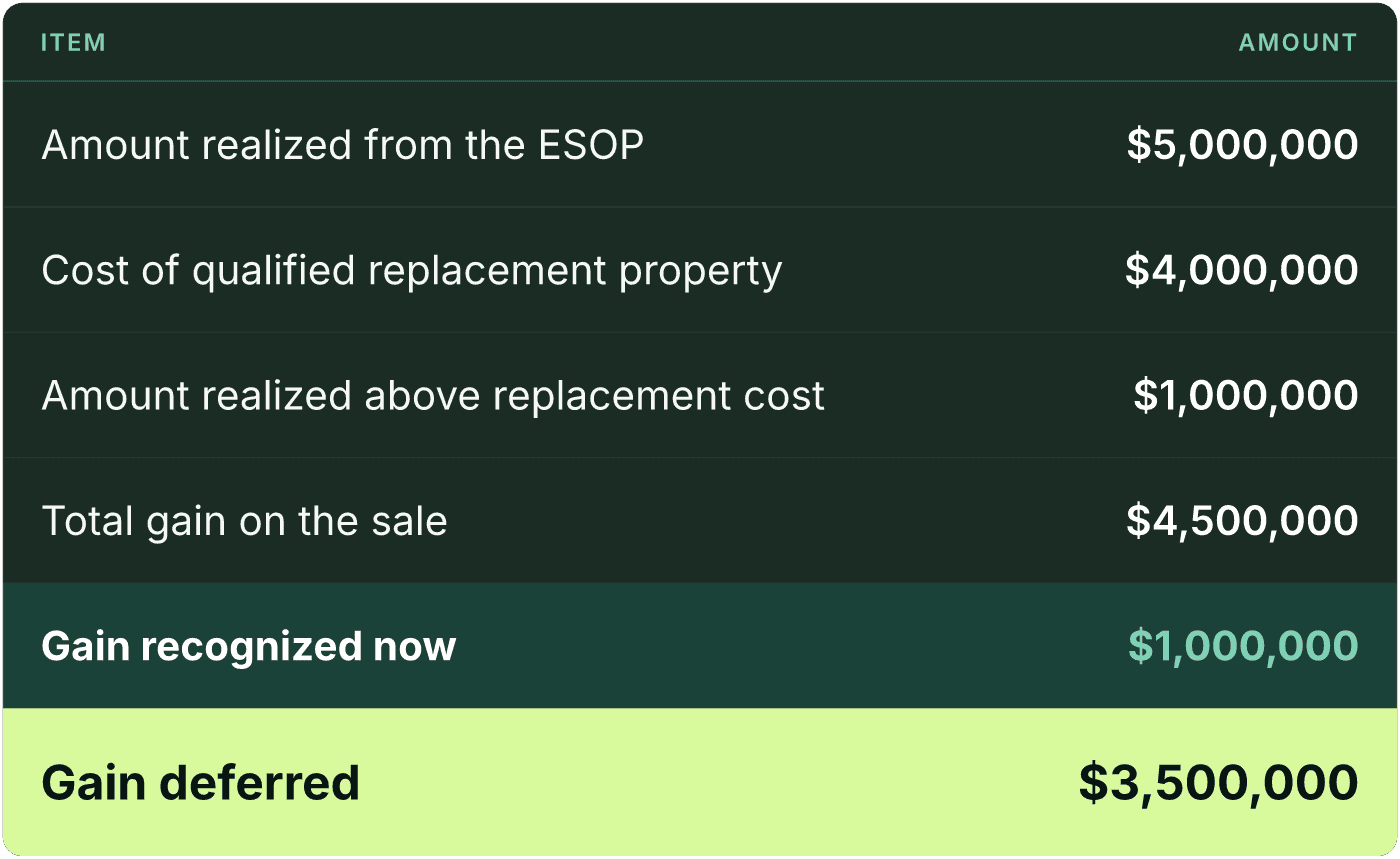
Take an illustrative owner. These are round numbers, not a client. The owner sells shares to the ESOP for $5,000,000. The shares have a basis of $500,000, so the gain is $4,500,000. The owner buys $4,000,000 of qualified replacement property within the window.
[](https://www.409.ai/uploads/esop_sale_section_1042_gain_deferral_replacement_property_independent_appraisal_table_1_a5a2bb80a6.png)
Only $1,000,000 is taxed in the year of the sale. The other $3,500,000 waits. Had the owner reinvested the full $5,000,000, the recognized gain would be zero.
Basis carries over, and the deferral can end
Deferral is not forgiveness. The statute reduces the basis of your replacement property by the gain you did not recognize. In the example, the replacement property cost $4,000,000, but its basis becomes $500,000, which is $4,000,000 less the $3,500,000 deferred. If you later sell that replacement property, the deferred gain is recognized to the extent it was not recognized earlier, with exceptions for events such as death and gifts. Death in particular matters for estate planning, and an advisor should model it against your family's plan.
So the real comparison is not "tax now versus no tax." It is a sale taxed today against a sale taxed whenever the replacement portfolio is sold, with the money working in the meantime. For an owner who intends to hold the replacement property for decades, or to pass it on, that gap is large. For an owner who expects to spend the proceeds, it may be small. Seller financing in a third-party deal can spread tax too, so test that route as well. Our piece on [what a seller note is really worth](https://www.409.ai/articles/seller-financed-business-sale-note-value-installment-sale-imputed-interest) covers it.
Who sets the price: the independent appraiser
The tax treatment depends on a real sale at a price a regulator will accept. An ESOP is a retirement plan, so it cannot pay more than fair market value for employer stock. The Internal Revenue Code requires that all valuations of employer securities that are not readily tradable on an established securities market be done by an independent appraiser, defined by reference to the requirements for qualified appraisers under Section 170(a)(1) ([26 U.S.C. 401(a)(28)](https://www.law.cornell.edu/uscode/text/26/401)).
That requirement has consequences for you as seller. The price is not a negotiation between friends. The trustee needs a defensible valuation, and the appraiser works for the plan's side of the table, not for you. Our guide to the [adequate consideration standard](https://www.409.ai/articles/esop-valuation-adequate-consideration-2026) explains how those annual appraisals are tested.
Three valuation questions tend to move the number:
1. Control. A minority ESOP purchase and a control purchase are priced differently. Read how the [discount for lack of control](https://www.409.ai/articles/discount-lack-of-control-dloc-409a-gift-tax-valuation) works before you assume a premium. 2. Earnings quality. Owner pay, add-backs and one-time items change what the business earns, so the schedule behind the income matters. See [owner pay in a small business valuation](https://www.409.ai/articles/owner-compensation-add-backs-small-business-valuation-sde-ebitda). 3. Standard of value. The IRS framework in [Revenue Ruling 59-60](https://www.409.ai/articles/revenue-ruling-59-60-small-business-valuation-eight-factors) lists the factors an appraiser weighs for closely held stock.
A practical step for the owner: get your own valuation before you hear the ESOP's. If the plan's appraiser lands far below your number, you will want to understand why before you sign a letter of intent, and a prior independent view gives you something to test it against.
The S corporation change after 2027
Today the Section 1042 deferral is a C corporation benefit. Section 114 of SECURE 2.0 changed that for sales after December 31, 2027: a domestic corporation, S corporations included, can issue qualified securities. For S corporation stock, the election can cover not more than 10 percent of the amount realized on the sale. So an S corporation owner selling to an ESOP in 2028 or later could defer tax on at most a tenth of the proceeds, a smaller benefit than the full deferral a C corporation owner can seek, but not zero.
That is a reason to start planning now. Owners who convert, or who are considering a conversion, should read how the [built-in gains tax puts a price on your valuation date](https://www.409.ai/articles/c-corp-to-s-corp-conversion-built-in-gains-tax-valuation-date), because moving from C to S changes which rule applies to the ESOP sale.
What to do before year-end
Year-end is when succession and tax meetings cluster, and a Section 1042 sale takes months to build. A sensible order:
- Confirm the entity type and the 3-year holding period for every share you plan to sell.
- Ask a CPA to model the sale at the 30 percent threshold and at a larger stake, with and without full reinvestment.
- Line up a valuation view of your own so the plan appraiser's number is not the first one you see.
- Calendar the replacement window and the election deadline together, because the first opens 3 months before closing and the second is the return due date.
If your next step is a valuation of your company, [409.AI's small business valuation](https://www.409.ai/products/smb-valuation) starts from $899 and gives you an independent number to bring to the table. Companies that already run an ESOP can see the [ESOP valuation service](https://www.409.ai/products/esop-valuation).
This article is general information, not tax advice. Section 1042 has conditions that depend on facts about your company, your shares and your replacement property, so have a tax advisor read your situation before you commit.