Compliance
ESOP Repurchase Obligation: The Cash Bill That Grows With Your Share Price
The ESOP repurchase obligation grows with each appraisal. How CFOs and trustees forecast the put option cash bill under IRC 409(h), with a worked example.
By 409.AI Team - 2026-11-08
# ESOP Repurchase Obligation: The Cash Bill That Grows With Your Share Price
If you run finance for a company with an employee stock ownership plan, or you sit on the board of one, the annual appraisal gives you a number you will be glad to see rise. It also writes the size of a future cash bill. Every dollar the independent appraiser adds to the price per share is a dollar the company may have to pay out when a departing employee asks it to buy shares back. This piece is for the CFO, the plan trustee and the owner who sold to the plan, and it explains how the repurchase obligation works, why it is a valuation question as much as a cash question, and what to ask for before it surprises you.
Where the obligation comes from
Most ESOP companies are private. Their stock has no market, so a worker who leaves and receives shares from the plan cannot sell them anywhere. The Internal Revenue Code fixes that with a put option. Under [IRC section 409(h)](https://www.law.cornell.edu/uscode/text/26/409), an employee who receives employer stock that is not readily tradable on an established market must be able to demand that the employer buy it back at fair value. The option has to be open for at least 60 days after the shares are distributed. If the employee does not use it, it opens again for at least 60 days in the following plan year.
The put is aimed at the employer, not at the plan. The Treasury regulations under section 4975 say the put must let the holder sell to the employer, and that the plan may be given the right to step in and buy instead, but it cannot be bound to do so ([26 CFR 54.4975-7](https://www.law.cornell.edu/cfr/text/26/54.4975-7)). So when the trust runs short of cash, the obligation does not disappear. It lands on the company's balance sheet.
When the clock starts
A put only matters once shares are distributed, and the plan decides when that happens within limits set by [section 409(o)](https://www.law.cornell.edu/uscode/text/26/409). For a participant who leaves because of retirement, disability or death, distributions must begin no later than one year after the close of the plan year of the separation. For a participant who leaves for another reason, the plan may wait until the fifth plan year after the year of separation. Many plans choose the later date to spread the load.
That timing is a lever, not a cure. The shares of a worker who left three years ago keep their place in the plan and keep moving with the appraisal. When the distribution finally arrives, it is priced on the value at that time, not on the value the day the person walked out. A plan that delays through a strong run can distribute at a much higher price than the one the departing employee would have seen.
How the payment can be spread out
The statute lets the employer pay over time, with conditions. For a total distribution, the employer may pay in substantially equal annual installments over a period of up to five years, provided payment starts within 30 days of the put being exercised, the company gives adequate security for the unpaid balance and it pays reasonable interest on it. For installment distributions, the code instead requires payment of the amount due within 30 days of exercise. The plan document may also set the schedule for the plan's own distributions, and section 409(o) allows the payout period to run past five years for large accounts, by thresholds the IRS adjusts for inflation.
"Adequate security" and "reasonable interest" are not decorations. A company that stretches payments over five years has a note outstanding to every departing participant who chose that route, and those notes are liabilities that the auditor, the lender and the trustee will all read.
Why this is a valuation problem
Most finance teams treat the repurchase obligation as a treasury forecast. It is that, but its main input comes from the appraisal. The obligation at any date is roughly the value of the shares that vested participants are expected to take out, times the price per share the independent appraiser will use. Three things in the valuation move it:
- **The price per share.** A higher appraisal raises the cost of every future put, including puts on shares that were distributed at an earlier, lower price. The plan's growth and the company's cash need rise together.
- **The discount for lack of marketability.** The employee holds shares with a put right. The valuation has to reflect that right, which is one reason the marketability discount in an ESOP appraisal is not the one used in a 409A. Our walk through the [annual appraisal](https://www.409.ai/articles/what-is-an-esop-valuation-annual-appraisal-trustee-independent-appraiser) explains what the appraiser must document.
- **The tax status of the company.** An S corporation ESOP does not pay federal income tax on the plan's share of income, which affects both value and cash. For the valuation side of that question, see [tax affecting for pass-through entities](https://www.409.ai/articles/tax-affecting-pass-through-entity-s-corp-valuation).
A worked example
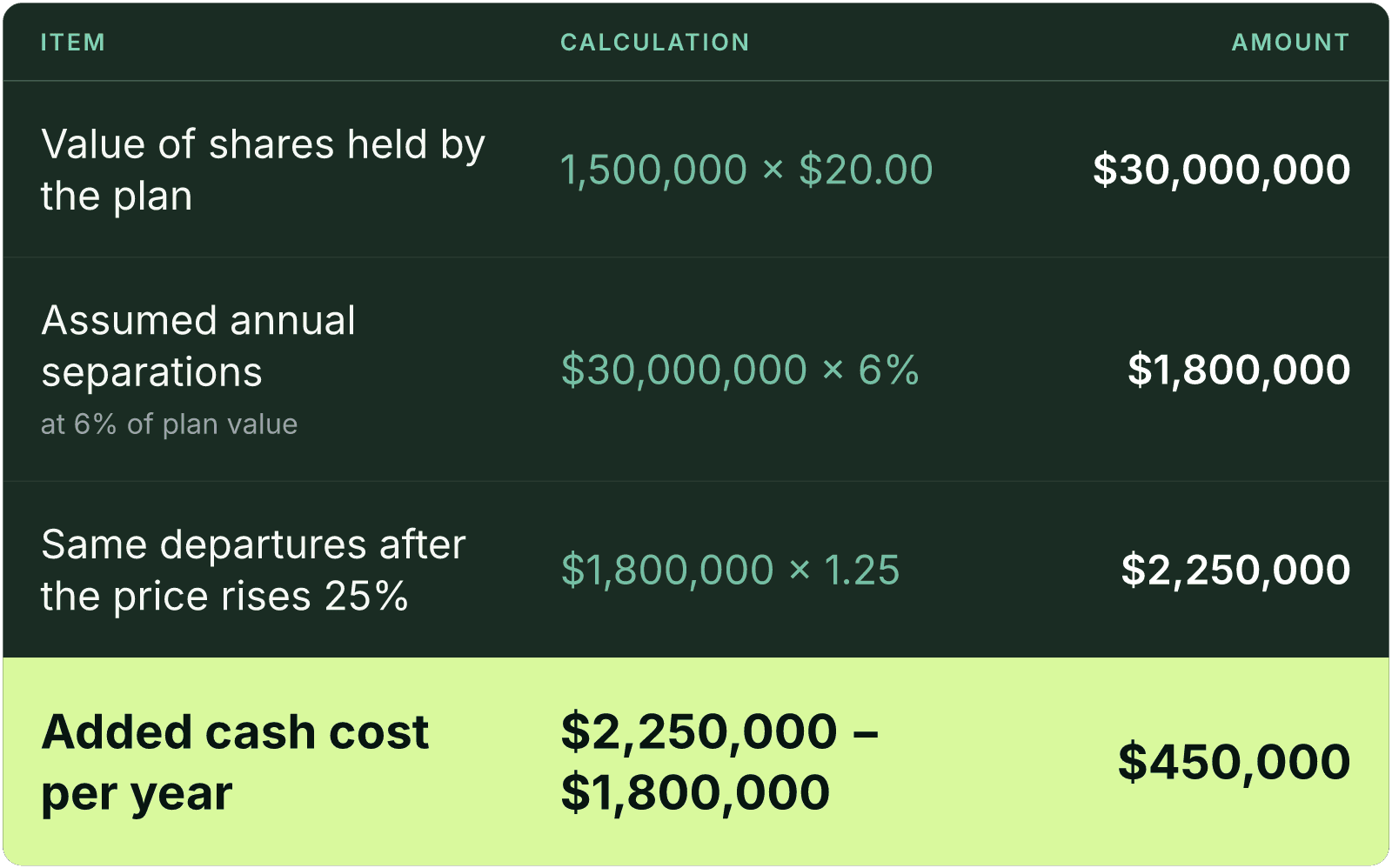
Take a company whose plan holds 1,500,000 shares at an appraised $20.00. Assume that, on average, 6% of the plan's value belongs to vested participants who leave each year and ask to be paid out. The numbers below are illustrative and not a forecast for any company.
[](https://www.409.ai/uploads/esop_repurchase_obligation_put_option_409h_cash_forecast_share_price_table_1_76f5364b36.png)
The point is the last line. The company did nothing wrong. It grew, the appraiser reflected the growth, and a $450,000 higher annual obligation followed. If the same company has taken on acquisition debt in the same year, the lender will want to know that the plan's put is in the cash flow model.
The repurchase obligation study
A repurchase obligation study is the forecast that answers this. It is a projection, not a valuation: it takes the plan's participant data, the expected separations, the distribution policy, the share price path and the company's cash flow, and shows when the cash is needed and how much. It is usually ordered by the company or the trustee, and it is worth running every year with the appraisal, since the price per share is the input that changes the most.
Several reasons make it more than a nice-to-have. The trustee has a duty to the participants, and a plan that cannot pay its put holders puts that duty under strain. The board of an owner who sold to the plan and took notes is often a creditor of the same company that owes the puts. And the auditor will ask how the company classified the shares subject to the put, which depends on facts about the plan that the study makes explicit.
What to ask before the next appraisal
Give the independent appraiser and the person who builds the study the same set of assumptions. A price per share that does not match the study's price path is the commonest reason the two documents disagree. Ask the appraiser to state the marketability discount, the weights of the valuation methods and the cash flow projections in a form the study can reuse. Ask the plan administrator for age and service data by participant, not totals, since the study depends on the mix of who is close to leaving.
Then read the result against the sale agreement. An owner who sold to the plan in a leveraged transaction, as described in our piece on [Section 1042 deferral](https://www.409.ai/articles/esop-sale-section-1042-gain-deferral-replacement-property-independent-appraisal), already has a repayment schedule in the company's debt. The put sits on top of it. For the standard that governs every appraisal in this chain, the ERISA concept of adequate consideration, see [ESOP valuations in 2026](https://www.409.ai/articles/esop-valuation-adequate-consideration-2026).
The same logic applies outside ESOPs: a company that buys back stock from departing employees has the same cash exposure, and the price it should pay is a [valuation question](https://www.409.ai/articles/repurchase-departing-employee-shares-409a-price-not-the-rule) too.
The takeaway
Put the repurchase obligation next to the appraisal, not in a different folder. When the trustee receives the annual report, the CFO should have the study that shows what that price per share means for cash over the next five years. If it does not exist, build it before the next valuation date. If your plan needs the independent appraisal itself, 409.AI's [ESOP valuation](https://www.409.ai/products/esop-valuation) is built for the trustee and the company that rely on it.