Compliance
Does an ESOP Pay a Control Premium? What the Trustee Has to See Before Paying for Control
For ESOP trustees and owners selling to one: when a plan buying 100% may pay a control premium, and what the $29.8M Brundle overpayment shows about the risk.
By 409.AI Team - 2026-11-15
# Does an ESOP Pay a Control Premium? What the Trustee Has to See Before Paying for Control
If you are the trustee of an employee stock ownership plan about to buy 100% of a private company, or the owner selling to one, the price you are about to agree carries an assumption an appraisal can dispose of in a single sentence: that the ESOP is buying control. When that assumption is wrong, the plan pays for rights it never receives, the employees carry the debt that financed them, and the trustee is the one who answers for it.
This post explains when an ESOP can pay a control premium, what "control" actually means for a plan whose trustee often votes as the board directs, and how one court priced the cost of getting it wrong.
Why control matters to the price
A controlling interest is worth more than the same shares held as a minority stake, because the holder can decide what the company does. The Fourth Circuit, borrowing its own definition from a gift tax case (*Estate of Godley v. Commissioner*), described control as an interest that lets the shareholder "unilaterally direct corporate action, select management, decide the amount of distribution, rearrange the corporation's capital structure, and decide whether to liquidate, merge, or sell assets."
An appraiser can build that difference into the number in two ways. Starting from a minority, marketable value (a public-company multiple, say), they add a control premium. Starting from a control value (an acquisition multiple, or a discounted cash flow that assumes the buyer runs the business), they leave it alone, or apply a [discount for lack of control](https://www.409.ai/articles/discount-lack-of-control-dloc-409a-gift-tax-valuation) when the interest being priced cannot direct anything. Either way, the question the trustee has to answer is the same: does this plan, after closing, hold those powers?
The legal frame the trustee works in
A sale of stock by the owner to the ESOP is a prohibited transaction under ERISA unless an exemption applies. The one that matters is [ERISA section 408(e)](https://www.law.cornell.edu/uscode/text/29/1108), which allows the purchase only if the plan pays no more than "adequate consideration." For stock with no public market, [section 3(18)(B)](https://www.law.cornell.edu/uscode/text/29/1002) defines that as fair market value "as determined in good faith by the trustee or named fiduciary."
There is still no final regulation spelling out what that requires. The Department of Labor proposed one in 1988 and never finalized it, and courts read the proposal for guidance without treating it as binding. Our post on [the adequate consideration standard in 2026](https://www.409.ai/articles/esop-valuation-adequate-consideration-2026) follows that history. What the courts do enforce is the process: the trustee has to understand the appraisal, test its assumptions and push back where one does not fit the deal.
Control is on the Department of Labor's own list. In its 2014 [process agreement with GreatBanc Trust Company](https://www.dol.gov/agencies/ebsa/about-ebsa/our-activities/enforcement/esop-agreement-appraisal-guidelines-greatbanc), the trustee committed to document how its valuation advisor treated a set of specific items, and "minority interests and control premiums" is second on that list, right after marketability discounts. The agreement binds only GreatBanc, but it is the clearest written statement of what the department expects a careful trustee to check.
Owning 100% is not the same as controlling
This is where deals go wrong. An ESOP that buys every share looks like a controlling buyer on paper. Whether it is one depends on the documents signed at closing.
Four things decide it:
- **Who appoints the board.** If the sellers keep the right to name a majority of directors, management answers to them, not to the plan.
- **How the trustee votes.** Many plan documents direct the trustee to vote as the board instructs. A trustee that must follow the board the sellers appoint cannot direct anything.
- **What the sellers keep.** Warrants, stock appreciation rights, or options to buy back equity can return value and influence to the sellers after the sale.
- **What the lenders hold.** Seller notes and bank loans come with covenants. Tight ones can restrict distributions, capital spending or a later sale more than a minority shareholder ever would.
Participants also have a say on the largest decisions. For a company with no registered class of stock, [section 409(e)(3) of the Internal Revenue Code](https://www.law.cornell.edu/uscode/text/26/409) gives each participant the right to direct the vote of the shares allocated to their account on a merger or consolidation, a recapitalization, a reclassification, a liquidation or dissolution, or a sale of substantially all of the assets. That is a protection for employees, and it also means the trustee alone does not decide those matters.
None of this makes a control premium wrong. It means the premium has to match what the plan really gets, and the trustee has to be able to show the link.
Brundle: what a 10% premium cost
The case trustees now learn this from is [*Brundle v. Wilmington Trust*](https://www.ca4.uscourts.gov/Opinions/171873.P.pdf), decided by the Fourth Circuit in March 2019. The facts, all from the opinion:
- On December 20, 2013 the Constellis ESOP bought the company's stock at $4,235 a share, the very top of the range its trustee was authorised to offer, after negotiations that lasted little more than five hours. The appraiser's draft put enterprise value between $275 million and $330 million; a revision before closing lowered the top to $325 million, and the price per share did not move.
- The structure was unusual. Instead of selling 100% outright, the sellers sold 90% of their shares to the ESOP and exchanged the remaining 10% for warrants that let them buy equity back at a set price and guaranteed them a majority of the board.
- The plan documents required the trustee to vote the ESOP's shares as the Constellis board directed.
- The appraisal still added a 10% control premium, and, in the court's words, "devoted just one sentence to articulating its decision." The trustee never asked the appraiser about it.
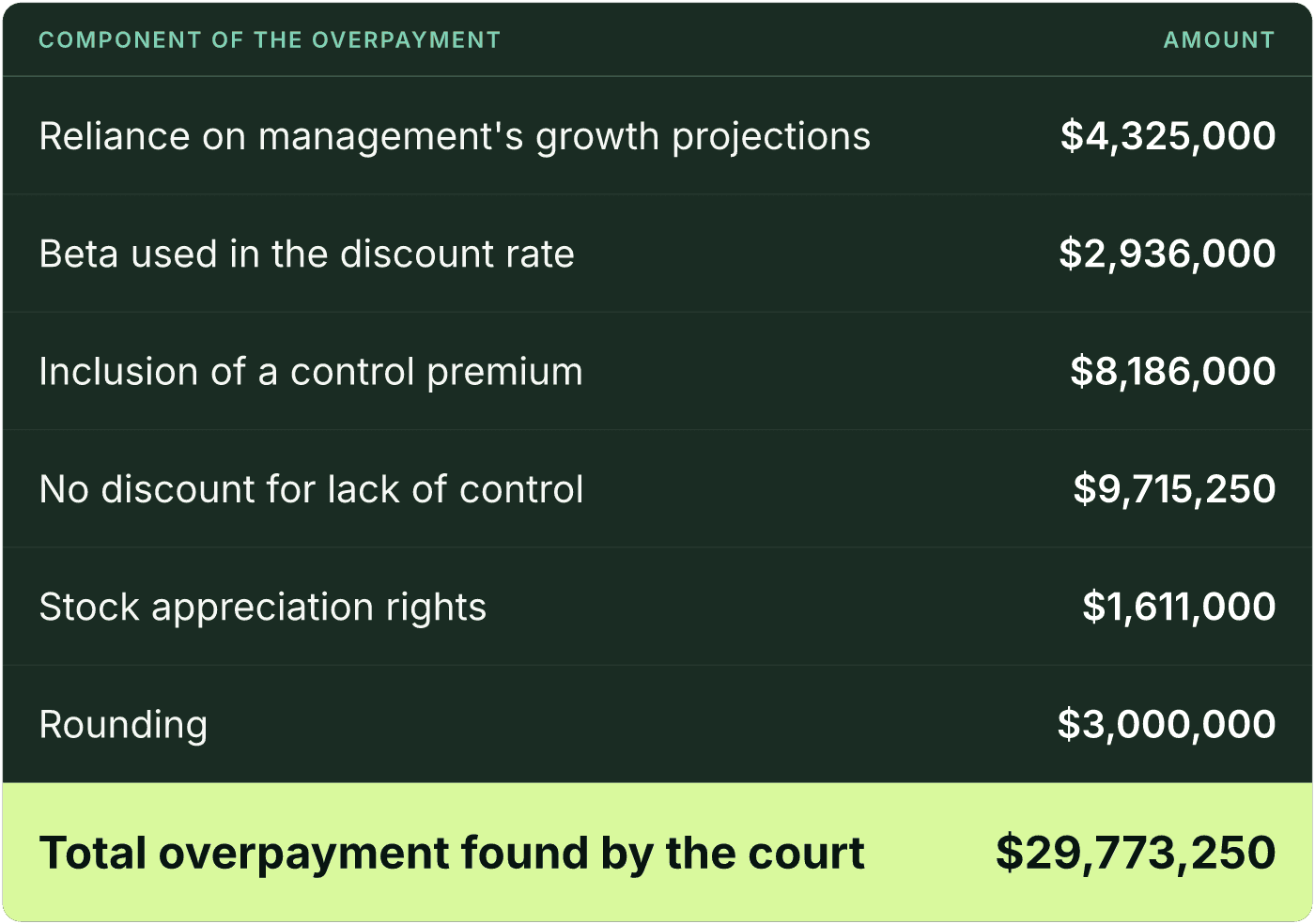
The trial court found the ESOP "essentially had no power to control Constellis." The trustee argued that 10% was a modest figure next to market control premiums of 35% to 40%. The appeals court did not accept that: given how little the plan received, the trustee should have challenged the use of any premium at all. It affirmed a judgment that the ESOP had overpaid by $29,773,250.
The court's damages table shows how much of that came from the control question alone.
[](https://www.409.ai/uploads/esop_control_premium_trustee_100_percent_purchase_lack_of_control_discount_table_1_f681fa7045.png)
Add the two control lines and you get $17,901,250, about 60% of the total. The premium that was added was only half the problem. The other half was the discount that was never taken, because the ESOP was effectively a minority holder that paid a controlling buyer's price.
A worked example
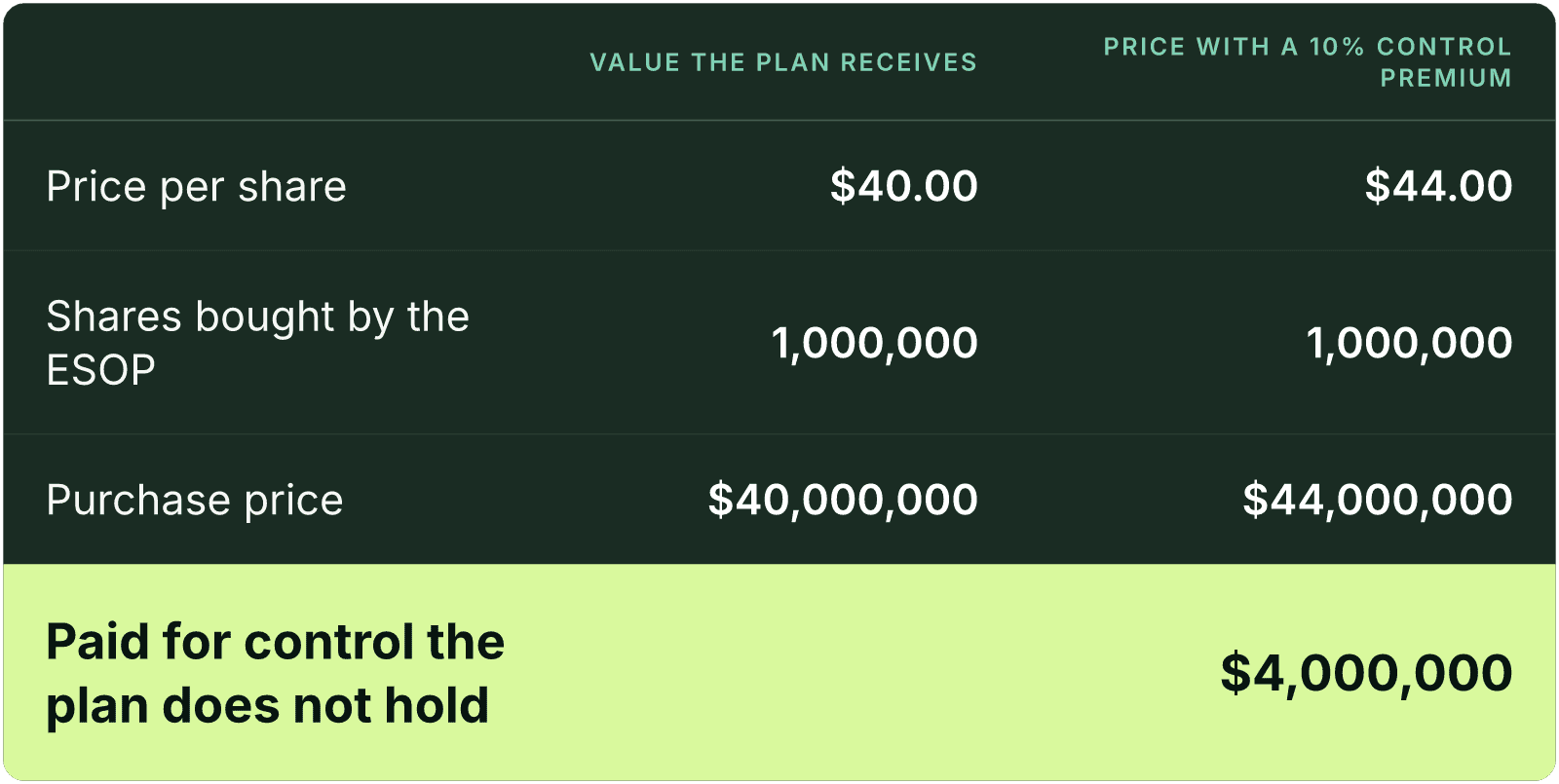
The arithmetic is simple, which is why it is easy to wave through. Take an illustrative company with 1,000,000 shares and a fair market value of $40 a share on a basis that reflects what the ESOP will truly hold after closing.
[](https://www.409.ai/uploads/esop_control_premium_trustee_100_percent_purchase_lack_of_control_discount_table_2_61ab5acc2f.png)
That $4 million does not sit somewhere harmless. In a leveraged ESOP the purchase is often financed by the company, a bank and the sellers, and the company services that debt through its contributions to the plan, cash it cannot spend on anything else. The GreatBanc agreement even bars that trustee from a leveraged purchase in which the principal of the debt exceeds the stock's fair market value. A premium that the facts do not support pushes the price, and often the debt, above the value the plan receives.
It also shows up at the first annual appraisal. Under [section 401(a)(28)(C)](https://www.law.cornell.edu/uscode/text/26/401), every valuation of stock that is not readily tradable has to be done by an independent appraiser, and that appraiser values the shares the plan actually holds. If the plan has no real control, the premium it paid has nothing to attach to. Participants may see a lower share price on their first statement, and the gap between what the plan paid and what it owns becomes visible to anyone who reads the two reports side by side. Our post on [what an ESOP valuation is and who orders it](https://www.409.ai/articles/what-is-an-esop-valuation-annual-appraisal-trustee-independent-appraiser) covers that annual cycle.
What the trustee should ask before closing
A trustee does not need to rebuild the appraisal. It needs to make the appraiser connect the level of value to the deal documents, and it needs a written answer to each of these:
1. Which level of value does the report start from, and why? Minority or control, and which method carries the assumption. 2. Which closing documents support it? The board appointment rights, the voting provisions of the plan and trust, and any shareholder agreement. 3. What do the sellers keep? Warrants, stock appreciation rights, employment agreements, board seats, seller-note covenants, and what each does to the plan's control and to the value per share. 4. If a premium is applied, how is its size supported? A single sentence is not support. Neither is a market average for buyers who take full control. 5. If the plan does not get control, where is the discount? Leaving out a premium is not the same as pricing a minority interest. 6. What will the first annual appraisal look like? If the same appraiser would value the plan's shares well below the purchase price a month later, the difference needs an explanation before closing, not after.
The owner selling to the ESOP has a reason to care too. The sale price is the number that determines the gain, and for a C corporation seller, whether a [Section 1042 rollover](https://www.409.ai/articles/esop-sale-section-1042-gain-deferral-replacement-property-independent-appraisal) defers it. A price that later turns out to include a premium the plan never received is exactly what a participant lawsuit like Brundle goes after. The cash the company pays to service the debt also feeds the [repurchase obligation](https://www.409.ai/articles/esop-repurchase-obligation-put-option-409h-cash-forecast-share-price) that comes later, so an inflated purchase price strains the business twice.
The takeaway
An ESOP may pay for control, but only for the control it holds the day after closing, shown in the board rights, the voting provisions and what the sellers keep. When those documents leave the sellers in charge, the honest number is a minority value, and the trustee's job is to make the appraiser say which one the report uses and why. If you are preparing an ESOP transaction or the annual appraisal that follows it, our [ESOP valuation](https://www.409.ai/products/esop-valuation) reports set out the level of value and the documents behind it, so the trustee can test the assumption before relying on it.