Tax
EMI Disqualifying Events: The 90-Day Window and the Value HMRC Will Tax
UK founders and finance leads: what an EMI disqualifying event is, how HMRC's 90-day exercise window works, and the event-date share value that sets the tax.
By 409.AI Team - 2026-11-09
# EMI Disqualifying Events: The 90-Day Window and the Value HMRC Will Tax
If you run a UK company that has granted Enterprise Management Incentive options, one list matters more than the grant paperwork: the events that can strip the tax advantages from options already in your employees' hands. HMRC calls them disqualifying events. Most founders learn the term when a buyer's lawyer, a new investor or a resigning engineer brings it up. By then the clock is already running.
This article is for UK founders, finance leads and the accountants beside them. It sets out what the events are, how the 90-day exercise window works, and why the number that decides the bill is a share value on a date you may never have valued.
What a disqualifying event does
An EMI option is attractive because, when it is granted at no less than the market value of the shares, there is normally no income tax charge on exercise. A disqualifying event interrupts that. HMRC's Employee Tax-Advantaged Share Scheme manual puts the consequence in two sentences: if the option is exercised within 90 days of the event, the tax advantages are preserved, and if it is not, there will be a tax charge on exercise. The 90 days used to be 40 days. HMRC's manual notes the change took effect on 17 July 2013.
Two points are easy to miss. The event does not cancel the option. It starts a clock on the part of the gain that stays tax-advantaged. And the window applies even where the option cannot be exercised within it, for example because it has not vested. In that case the manual says the exercise is still liable to the charge.
The seven events
HMRC's manual lists seven disqualifying events, set out in sections 532 to 536 of the Income Tax (Earnings and Pensions) Act 2003. In plain words:
- The company loses its independence, for example because another company takes control of it.
- The company no longer meets the trading activities requirement. A company that qualified because it was preparing to trade is also caught if those preparations come to a halt.
- The employee is no longer eligible. That covers leaving the company or group, and falling below the working time requirement of 25 hours a week or 75% of working time, which is tested at the end of each tax year.
- The terms of the option change.
- The company's share capital is altered in a way that affects the value of the shares and breaks the scheme's requirements, or increases their value for reasons that are not commercial.
- Shares are converted.
- The holder is granted a CSOP option that takes them over the £250,000 limit.
Two of these deserve a closer look because founders meet them first.
A sale of the company. HMRC's manual says loss of independence is a disqualifying event except where there is a company reorganisation. If the company becomes a 51% subsidiary of another company, that is not a disqualifying event, provided a replacement option that meets the EMI legislation is granted. So the structure of the deal decides whether the clock starts. A buyer who takes control and offers cash for the options is a different case from a buyer who rolls the options into replacement options. The US treatment of options in a deal is a different regime with its own tests; our piece on [what happens to your stock options when a startup is acquired](https://www.409.ai/articles/stock-options-acquisition-rollover-section-424a-ratio-test) covers the Section 424(a) ratio test, which has no EMI equivalent.
A resignation. An employee who ceases to be an employee of the company, or of any company in the group, triggers the event. Many companies write the window into their leaver terms for exactly this reason.
How the tax is calculated after the window closes
The charge falls only on options granted at a discount, meaning an exercise price below the market value of the share at grant, and exercised more than 90 days after the event. Section 532 of ITEPA taxes two things: the discount at grant, and the amount by which the market value at exercise exceeds the market value immediately before the disqualifying event. Income tax applies, and so does National Insurance where the shares are readily convertible assets.
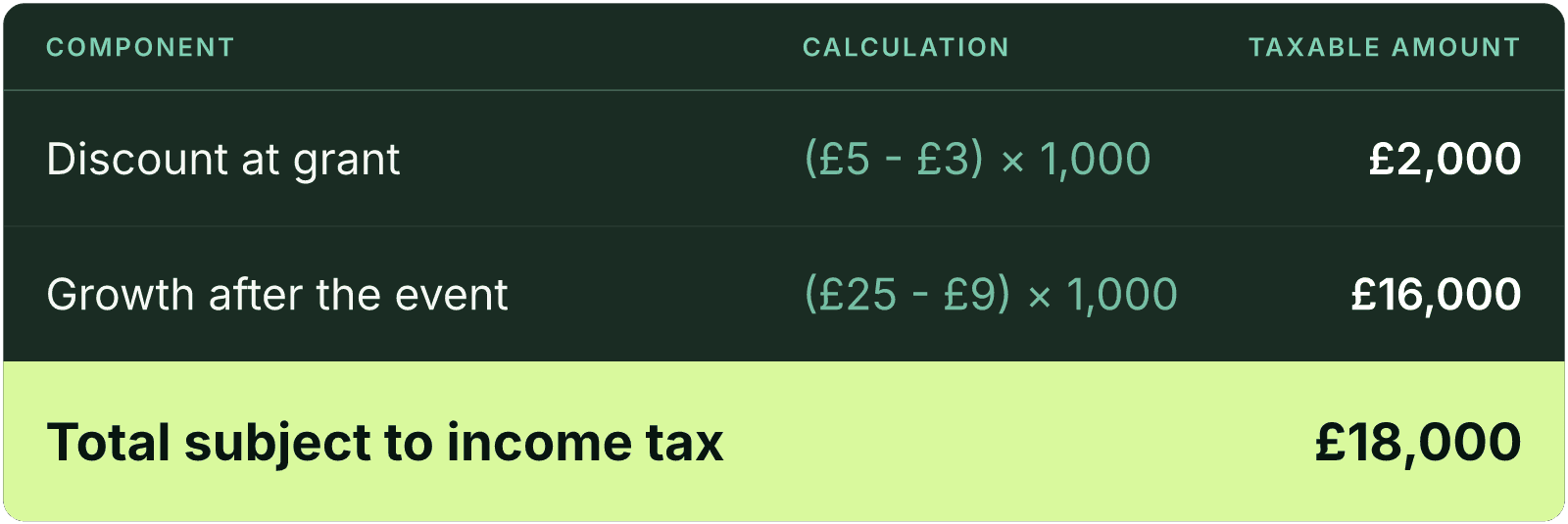
HMRC's own example makes the mechanics concrete. The market value of each share at grant is £5 and the exercise price is £3. The holder has 1,000 shares. The market value immediately before the disqualifying event is £9, and on the exercise date it is £25.
[](https://www.409.ai/uploads/emi_disqualifying_events_90_day_exercise_window_hmrc_market_value_table_1_4c067e5235.png)
The growth from £3 to £9 a share, which happened before the event, is outside that charge. HMRC's manual says it falls to Capital Gains Tax instead. So the window protects one slice of value, the slice built up to the event, and exposes the slice built afterwards.
Read the table the way a finance lead would. Waiting after the event has a cost, and the cost is not the headline value of the shares. It is the growth since the event date. A company on a steep trajectory, such as one that has just signed a term sheet or won a large contract, has the most to lose from a slow decision.
The value nobody wrote down
Look at the middle line of the table. The market value immediately before the disqualifying event is the anchor for the whole charge. If the event is a resignation on a Tuesday in March, there is no board valuation for that Tuesday. The nearest document may be a valuation agreed with HMRC for a grant months earlier, or nothing at all.
That gap creates two problems. The employee, or the employer operating PAYE, has to put a number on the share price at a date that has not been valued. And that number can later be questioned. Two practical habits reduce the risk:
1. Keep a dated record of the value at every grant and at each material change. The method behind an agreed value, and the facts it relied on, are the best evidence of what the shares were worth in between. Our guide to [what an EMI valuation is and how HMRC agrees it](https://www.409.ai/articles/what-is-an-emi-valuation-umv-amv-hmrc-val231-agreed-before-grant) explains the unrestricted and actual market value distinction, and what a funding round does to an agreed value. 2. Value the shares when an event is foreseeable. A planned restructuring, a share capital change or a sale process gives you weeks of notice. A valuation at that date turns a later argument into a document.
The same logic applies to the new route for liquidity. A trading window under PISCES raises its own exercise-date questions, which we cover in [the PISCES and EMI amendment piece](https://www.409.ai/articles/pisces-emi-csop-options-april-2028-amendment-valuation).
Share capital changes and funding rounds
Founders often ask whether a funding round is a disqualifying event. HMRC's manual on alterations to share capital does not name rounds or new share classes. What it describes is narrower and turns on effect. An alteration to the rights attached to shares, or restrictions on them, is disqualifying if it affects the value of the shares and the scheme's requirements would no longer be met. A similar alteration is also caught if it increases the value of the shares and is either not made for commercial reasons or has increasing the value as one of its main purposes.
So the question is not "did we issue new shares?" It is "did we change rights or restrictions attached to shares that option holders will receive, and what did that do to their value?" The answer sits with the company's articles and the specific terms of the round. Take it to your tax adviser before signing, not after. A round that is purely commercial and leaves the scheme's requirements intact is a different case from an amendment that reshapes the rights of the ordinary shares under option.
A checklist before the events arrive
- **Know the clock.** Put a 90-day reminder against any event that has happened, with the date the shares were last valued.
- **Check vesting against the window.** An option that cannot be exercised inside 90 days gets no relief for that reason alone.
- **Write leaver terms that match the rule.** A leaver provision that allows exercise within the window protects both sides.
- **Review the working time condition each tax year.** It is tested at the year end, so part-time moves and unpaid leave deserve a look in March.
- **Plan deal structure with replacement options in mind.** Whether control passes through a reorganisation or a 51% subsidiary structure changes whether the event happens.
- **Keep valuations current.** Our note on [the 2026 EMI rules](https://www.409.ai/articles/emi-share-options-2026-uk-rules-hmrc-valuation) covers the limits and the HMRC valuation that underpins the scheme, and the [CSOP guide](https://www.409.ai/articles/csop-share-options-2026-uk-hmrc-valuation) is useful where a company runs both plans.
What to take from this
A disqualifying event is a date, a 90-day window and a share price. The first two are easy to track. The third is the one that moves the tax bill, and it is the one most companies cannot produce on request. If your next hire, resignation or term sheet could start the clock, get the value of the shares on paper before it does, and keep the HMRC manual references next to it.
This article describes HMRC's published guidance for general information. It is not tax advice for a specific option holder or company.