Financial Reporting
Marking a Euro-Priced Position in a Dollar Fund at Year-End
For the CFO of a US-dollar fund holding a euro or sterling startup: building the December 31 ASC 820 mark, which exchange rate to use and how to split the gain.
By 409.AI Team - 2026-11-16
# Marking a Euro-Priced Position in a Dollar Fund at Year-End
If you are the CFO or controller of a US-dollar venture fund that owns a German, French or UK startup, your December 31 mark has two moving parts: what the company is worth in its own currency, and what that currency is worth in dollars. Auditors test both. LPs usually see only the sum, and in a year when the euro or sterling moves a few cents, the sum can tell a story the company never earned.
This piece walks through how that mark is built under ASC 820, which exchange rate belongs in it, how to split the gain between the company and the currency, and what your financial statements have to say about the choice.
Two measurements, in a fixed order
A fund that reports in dollars measures a euro-denominated share at fair value in euros first, then translates that euro amount at the exchange rate on the measurement date. The order matters. Fair value is the exit price in the security's own market, and for preferred shares of a German GmbH that market prices in euros. The translation is a separate, mechanical step.
KPMG's foreign currency handbook (June 2026) puts it plainly for equity securities measured at fair value: the fair value is remeasured at the current exchange rate, and the measurement of the security "is a fair value measurement issue, and not an ASC Topic 830 measurement issue." Topic 830 gives you the rate. ASC 820 gives you the value.
The rate itself is defined in Topic 830 as the rate at which the item could be settled at that date, generally the market spot rate ([KPMG Handbook: Foreign currency, section 3.013](https://kpmg.com/kpmg-us/content/dam/kpmg/frv/pdf/2026/foreign-currency.pdf)). In practice, your valuation policy should name the source and the time of day (a published closing fix, say), and every foreign position in the portfolio should use the same one. An auditor who finds the euro positions at one rate and the sterling positions at a rate pulled from a different source a few hours later will ask why, and "the spreadsheets were built by different people" is not an answer.
A worked example
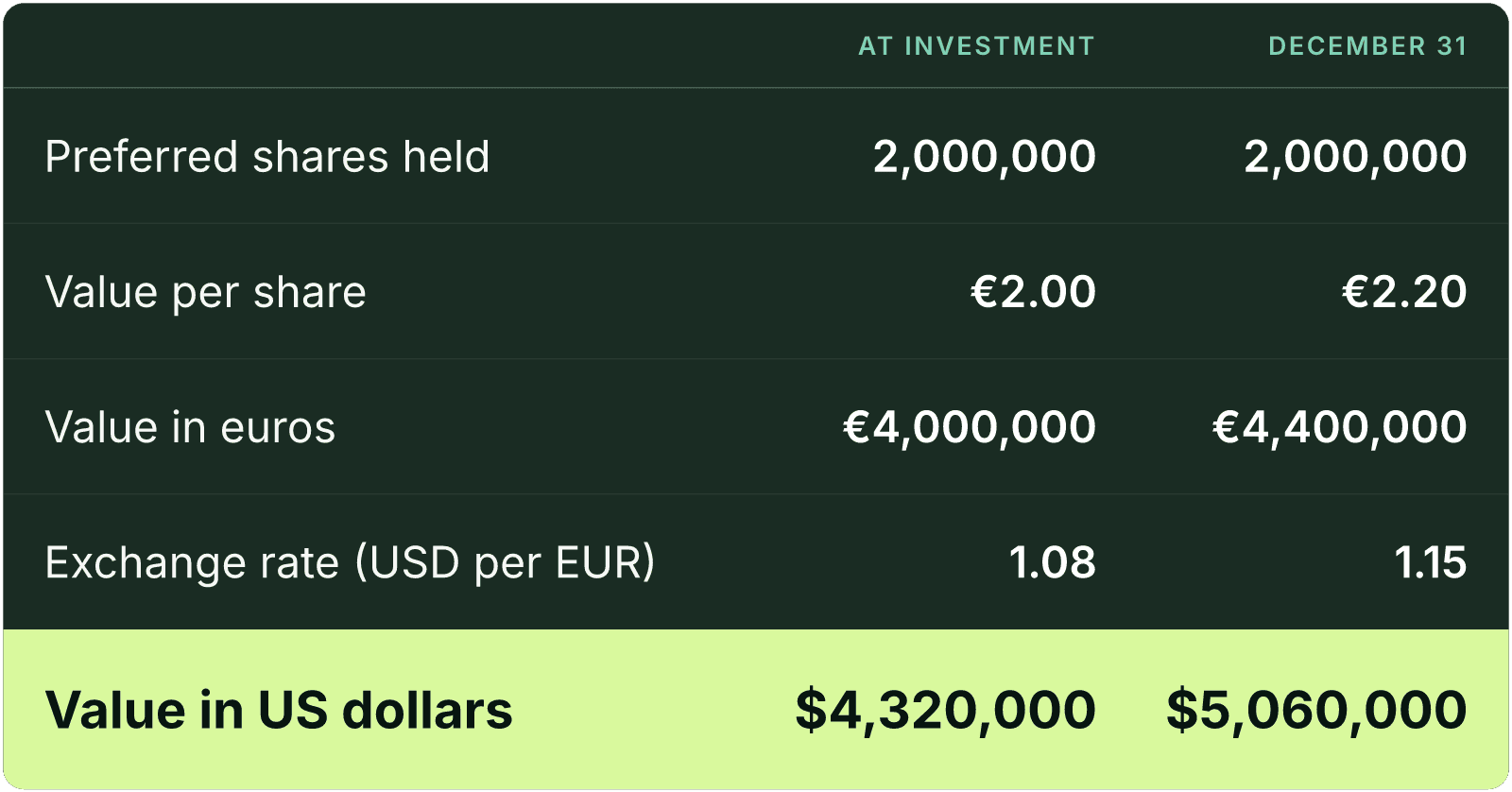
Take an illustrative position. The fund led a Series A in a German software company: 2,000,000 preferred shares at €2.00, €4,000,000 in all, on a day when one euro bought $1.08. The fund booked a cost of $4,320,000.
At December 31, the valuation team rolls the mark forward in euros, using European peer multiples and the company's euro revenue, and lands on €2.20 a share. Say the euro now buys $1.15 (an assumed rate for the example, not a forecast).
[](https://www.409.ai/uploads/dollar_fund_level_3_mark_foreign_currency_portfolio_company_asc_820_946_830_year_end_table_1_d6e44b3390.png)
The schedule of investments shows $5,060,000 and an unrealized gain of $740,000. The company grew its value by 10% in euros. The dollar gain is about 17%. Roughly seven of those points came from the currency.
Splitting the gain: what the rules allow
Investment companies follow ASC 946-830. For most foreign currency items, such as cash held in euros, a receivable from a sale or an unsettled payable, Section 946-830-45 requires the fund to identify and report the currency part separately from the market part. Gains and losses on the investments themselves are the exception: paragraph 946-830-45-4 and the AICPA's Investment Companies guide permit a fund not to disclose separately the portion of the change in fair value of investments that comes from exchange rates. A fund that does split it can follow the illustrations in Appendix F of that guide ([KPMG Handbook: Foreign currency, section 3.084](https://kpmg.com/kpmg-us/content/dam/kpmg/frv/pdf/2026/foreign-currency.pdf)).
So you have a policy choice, and it should be made once and written down, not decided quarter by quarter depending on which way the euro went.
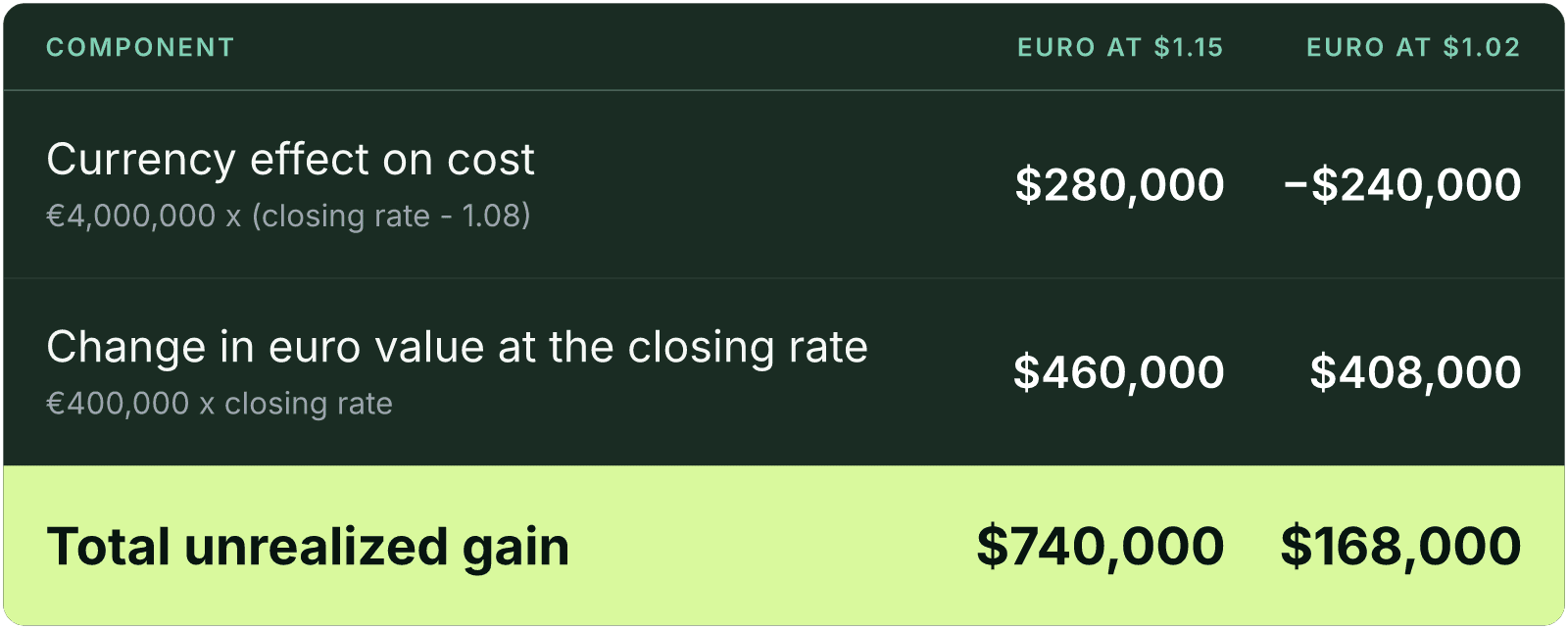
One common way to split the gain is to measure the currency effect on the original euro cost, and the market effect on the euro change in value, translated at the closing rate. Here are both directions the euro could have moved, with the company's €2.20 value held constant:
[](https://www.409.ai/uploads/dollar_fund_level_3_mark_foreign_currency_portfolio_company_asc_820_946_830_year_end_table_2_aba7de3340.png)
Same company, same year, same €2.20 mark. In one case the fund reports a gain of $740,000; in the other, $168,000. If your LP letter says the German position "performed strongly," the first column overstates the company, and the second column undersells it. A split, even one you show only in the LP report rather than the audited footnotes, keeps the conversation about the company honest.
Where foreign positions go wrong
Mixing currencies inside the valuation
The most common error happens before translation. A team calibrates the entry price to a revenue multiple in euros, then at year-end translates the company's revenue into dollars and applies a multiple from a set of US peers. The mark now moves with the exchange rate twice: once through the translated revenue and again when the result is converted. Keep every input of the valuation in the security's currency, euro revenue against euro-listed or euro-converted peer multiples, and translate once, at the end. The same rule holds for an income approach: euro cash flows take a euro discount rate. If you want a refresher on carrying the entry calibration forward, see our piece on [calibrating peer multiples to your entry price](https://www.409.ai/articles/peer-multiples-fund-level-3-mark-calibrate-entry-price-asc-820) and the one on [rolling a mark forward when the last round is old](https://www.409.ai/articles/stale-round-fund-level-3-mark-asc-820-calibrated-roll-forward-no-new-price).
Reading the share terms for the currency of the preference
Not every foreign company prices its preferred stock in local currency. Some non-US companies issue preferred shares with a liquidation preference stated in dollars while their revenue, costs and peers are in euros or pounds. Read the articles of association: the currency of the preference decides the currency of the waterfall. A dollar preference on a euro business means the payout to your class and the equity value beneath it are measured in different currencies, and your scenario model has to convert at each exit scenario, not only at the end. Our walkthrough of [why a Series A position is not worth its purchase price](https://www.409.ai/articles/fund-mark-junior-preferred-liquidation-waterfall-asc-820-latest-round-price) shows the waterfall mechanics that this sits on top of.
Netting a hedge into the mark
If the fund bought a euro forward to protect the position, that forward is its own instrument, measured at its own fair value, usually with observable inputs. It does not reduce the Level 3 mark of the shares, and it should not be hidden inside it. The shares and the hedge are separate units of account, as are the [loan, warrant and preferred a fund can hold in one company](https://www.409.ai/articles/fund-multiple-securities-one-portfolio-company-unit-of-account-asc-820-loan-warrant-preferred).
Forgetting the cash and the receivables
The election to leave currency inside investment gains does not reach everything. Euro cash at the fund, an escrow receivable from a European exit: these are foreign currency items whose exchange differences 946-830-45 asks you to identify and report separately. Funds that set up the investment policy carefully sometimes leave these on a different footing by accident.
What the year-end file should hold
For each foreign position, an auditor reviewing your Level 3 marks will usually want to retrace four things:
1. The fair value in the security's currency, with its own support: the calibration, the peers, the forecast, all in that currency. 2. The exchange rate, its source, the time it was taken and evidence that every foreign position used the same fix. 3. The translation arithmetic, tying to the schedule of investments. 4. If you split the gain, the method, applied the same way as last year.
That file also feeds the Level 3 roll-forward in your footnotes. When currency is not split, the exchange effect sits inside the unrealized gains line of the roll-forward, and your accounting policy note says so. When it is split, the policy note describes the method. Either way the [Level 3 footnote](https://www.409.ai/articles/asc-820-level-3-footnote-private-fund-asu-2018-13-nonpublic) has to match what the file shows. If an outside firm values the positions, the auditor will also test how that firm's work was reviewed, which we covered in [what the auditor tests about an outside specialist](https://www.409.ai/articles/fund-valuation-firm-sas-143-auditor-tests-management-specialist-file).
Why the currency matters beyond the mark
A dollar gain is a dollar gain to the carry waterfall. If the GP's accrued carried interest is computed on a hypothetical liquidation at reported NAV, a strong euro raises the accrual as surely as a strong quarter at the company does, and a weak euro the following year reverses it. Funds with a meaningful share of non-US positions should expect the [carried interest accrual](https://www.409.ai/articles/carried-interest-accrual-hypothetical-liquidation-fund-marks) to move with exchange rates, and should be ready to explain that movement to LPs who read the change in accrued carry before anything else.
The same goes for the fund's own performance figures. An IRR built from dollar NAVs blends company performance with currency performance. That is correct for a dollar fund; it is the return its LPs actually earned. But when an LP asks why the European sleeve outperformed, the honest answer may be "the euro," and the split above is how you show it.
The takeaway
Mark the foreign company in its own currency, with inputs in that currency, then translate once at a spot rate your policy names and every position shares. Decide, in writing, whether you will report the currency part of investment gains separately, and keep the other foreign currency items on the separate footing 946-830-45 requires. Then, before the LP letter goes out, run the split anyway: if more than a few points of a position's gain came from the exchange rate, say so.
If your portfolio has non-US positions and you want the euro or sterling marks built and documented for the December 31 audit, our [ASC 820 portfolio valuation](https://www.409.ai/products/asc-820) is scoped per portfolio and quoted on a call.