Financial Reporting
Deferred Revenue in a Purchase Price Allocation: Why the Haircut Is Gone
For the CFO who bought a subscription business: ASU 2021-08 ended the deferred revenue haircut in a purchase price allocation. Here is what it does to goodwill.
By 409.AI Team - 2026-11-11
# Deferred Revenue in a Purchase Price Allocation: Why the Haircut Is Gone
If your company closed the acquisition of a subscription business this year, the deferred revenue on the opening balance sheet is probably much larger than the deal team's model assumed. That's not an error in the allocation. It's ASU 2021-08, and for a private acquirer with a calendar year end, December 31, 2026 is the third audit cycle it governs.
The update changed one line of the purchase price allocation that used to be a reliable source of upside: the deferred revenue "haircut". This article is for the CFO or controller who signed the closing and the auditor who will read the allocation at year end. It covers what the rule now says, what it does to goodwill and to the first year of revenue after close, and where deal documents written for the old answer can now give the wrong one.
What the rule used to do
Under ASC 805, almost everything acquired in a business combination is measured at fair value on the acquisition date. Before 2021-08, contract liabilities followed that rule too. The FASB described the result in its basis for conclusions (BC13): when a customer has prepaid, the fair value of the remaining obligation "will often be lower than the contract liability balance that is recorded by the acquiree," because the selling and marketing effort to win the contract was already spent before the deal.
In practice, the fair value was built bottom-up: the cost of fulfilling what's left of the contract (hosting, support, account management), plus a normal profit margin on that effort. For a software business with high gross margins, that figure was often a fraction of the book balance. The difference was the haircut, and two things followed from it. The acquirer's goodwill came out lower, and the acquired contracts produced less revenue after close than they would have without a sale. In a deal closed in early December, a customer who had prepaid $120,000 for the year in November might generate $30,000 of post-close revenue for the buyer instead of the $110,000 still on the seller's books.
There was a recognition question as well. U.S. practice leaned on EITF Issue 01-3 and recognised a contract liability only where the acquiree had a legal obligation. Topic 606 talks about performance obligations instead, and the two concepts don't always agree.
What ASU 2021-08 requires
The [update](https://storage.fasb.org/ASU%202021-08.pdf) adds contract assets and contract liabilities to the list of exceptions from fair value measurement in ASC 805. New paragraph 805-20-30-28 is the core of it: "An acquirer shall measure the contract assets and contract liabilities of the acquired contract as if the acquirer had originated the acquired contract."
In most deals that means carrying over the seller's own Topic 606 balance. The FASB said as much: if the acquiree prepared GAAP financial statements, the acquirer should "generally" end up with the same contract assets and liabilities the acquiree recorded. The exceptions are a target that doesn't follow GAAP, errors found in its revenue accounting, and policy differences the acquirer conforms. In those cases the acquirer goes back to the contracts: it identifies the performance obligations and allocates the transaction price on a relative standalone selling price basis as of contract inception.
Two practical expedients ease that rework (805-20-30-29). An acquirer may look at the aggregate effect of all modifications before the acquisition date rather than unwinding each one, and it may determine standalone selling prices at the acquisition date rather than at inception. They are elected deal by deal, applied to every contract in that deal, and disclosed: which expedients were used and, to the extent reasonably possible, a qualitative assessment of their effect (805-20-50-5).
The effective dates are the reason this still matters. Public business entities applied the update to fiscal years beginning after December 15, 2022. All other entities applied it to fiscal years beginning after December 15, 2023, prospectively to business combinations on or after that date. A private calendar-year acquirer has used it for every deal since January 1, 2024.
The same deal, before and after
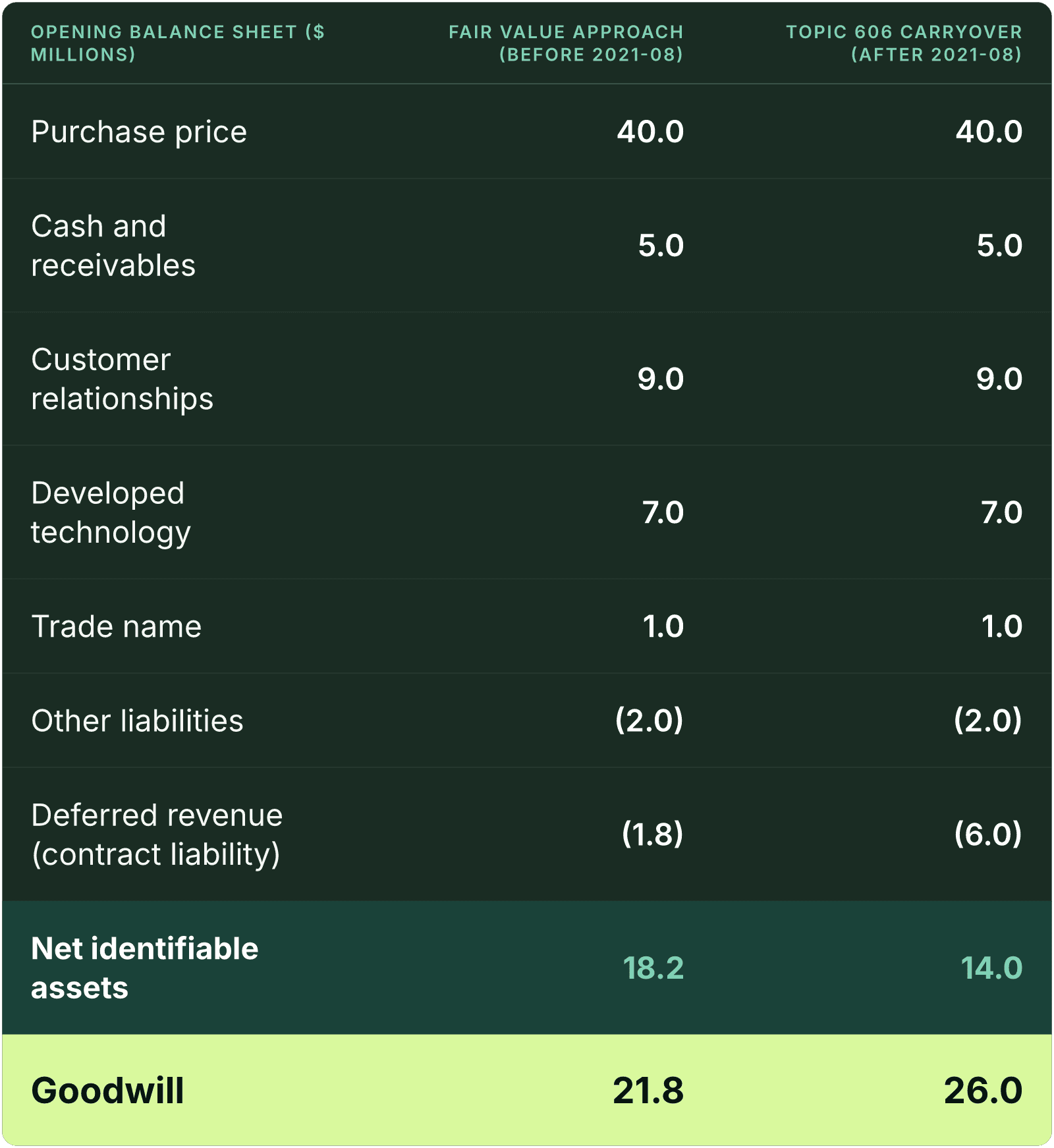
Take a buyer that pays $40 million for a SaaS company with $6 million of deferred revenue on its closing balance sheet, mostly annual subscriptions paid upfront with about six months left to run. Under the old approach, the valuation team would have priced the remaining obligation at the cost to serve it plus a margin: say $1.5 million of hosting and support plus 20% for a fair profit on that work, or $1.8 million. Under 2021-08 the liability is the seller's own $6 million. Deferred taxes are left out to keep the arithmetic visible.
[](https://www.409.ai/uploads/deferred_revenue_purchase_price_allocation_asu_2021_08_haircut_goodwill_table_1_3ccb6799f6.png)
Every other line of the allocation is unchanged. The $4.2 million that used to fall out of the liability now lands in goodwill, which the FASB itself expected: the board noted that the increase in contract liabilities "will generally be recognized in goodwill" (BC41). For a private company that hasn't elected goodwill amortisation, that is $4.2 million more of an asset that never runs off the balance sheet and has to survive every [impairment test](https://www.409.ai/articles/goodwill-impairment-private-company-asc-350).
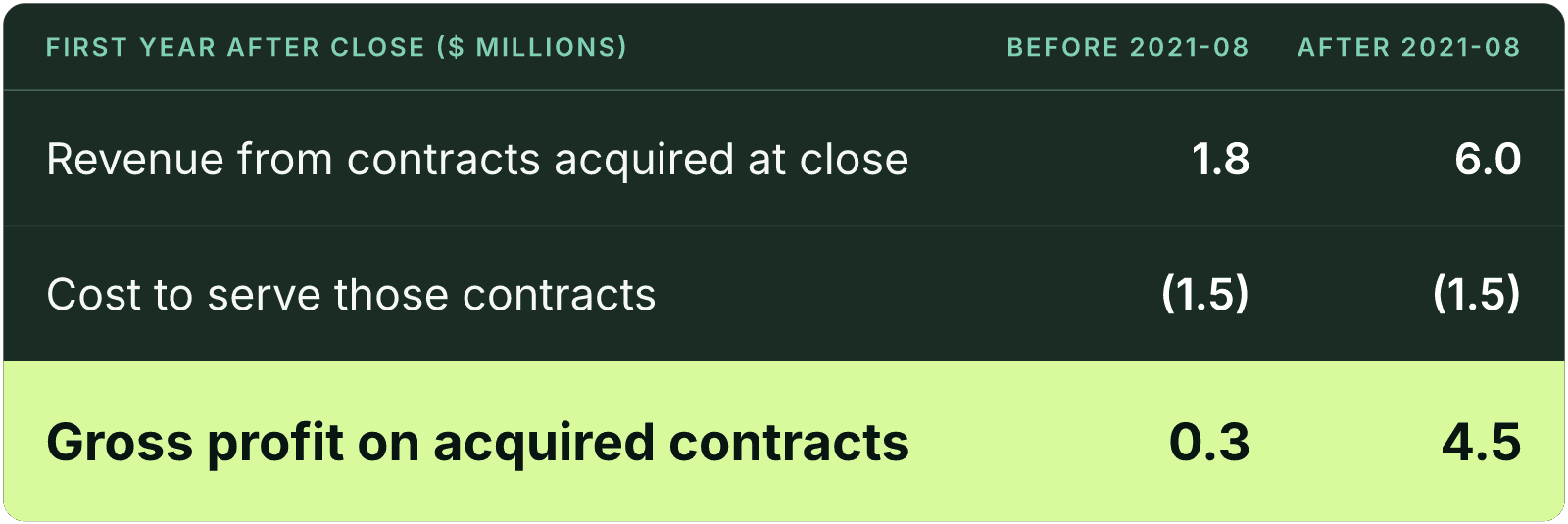
The income statement moves the other way. Here is what the acquired contracts contribute in the months after close, with the same $1.5 million of cost to serve them in both cases.
[](https://www.409.ai/uploads/deferred_revenue_purchase_price_allocation_asu_2021_08_haircut_goodwill_table_2_af5599bc6c.png)
The old haircut produced a revenue dip in the first quarters after a deal that analysts learned to adjust for. Now the acquired book flows through as if nothing had happened. One FASB member, Christine Botosan, dissented on exactly this point, warning that carryover could overstate post-acquisition revenue and invite companies to "buy revenues". The board's answer was that Topic 606 ties revenue to performance after the close, so the revenue reported is revenue earned by delivering the service.
Where the deal documents can now be wrong
The accounting changed. Many deal templates didn't. Three places are worth a read with your counsel and your auditor before the year-end close, because each was often drafted with the haircut in mind.
Revenue and EBITDA earnouts. Some sellers of subscription businesses negotiated an add-back for the deferred revenue write-down, so that the buyer's purchase accounting couldn't depress the earnout metric. Under 2021-08 there is usually no write-down to add back. If the clause still adds one, read whether it now adds revenue that GAAP already counts. And if the earnout simply says "revenue determined under GAAP consistently applied", the seller now gets the full acquired book in the measurement period, which may not be what the buyer priced.
The working capital peg. Deferred revenue is a liability in most net working capital definitions, and that negotiation is about cash, not about the opening balance sheet of the acquirer. The accounting change doesn't move the peg. What it does change is the conversation: a buyer's model that assumed $1.8 million of deferred revenue in the opening balance sheet no longer matches the books, and any covenant or budget built from that model inherits the gap.
Board and lender reporting. A covenant package or board pack that used "acquired revenue net of the purchase accounting adjustment" needs a new definition. The adjustment isn't there to subtract.
What the auditor will test in the allocation
For a deal closed in 2026, expect the year-end review of the allocation to spend time on four questions.
First, can the acquirer rely on the seller's Topic 606 accounting? A target with audited GAAP statements is the easy case. A target with tax-basis or cash-basis books, or with errors found in diligence, means the acquirer rebuilds the contract liability from the contracts themselves, and the auditor tests that work.
Second, were the practical expedients used, and are they disclosed? The disclosure is required by 805-20-50-5 whenever an expedient is elected.
Third, are off-market terms still recognised separately? The update leaves this alone. If an acquired contract is priced below or above market, the acquirer still records an intangible asset or liability for the difference, alongside the contract liability.
Fourth, does the customer relationship valuation hang together with the new liability? Customer relationships are still measured at fair value. The FASB said the higher contract liability balance "should not affect how entities consider which underlying assets contribute to fulfilling contract liability obligations" (BC41), so the multi-period excess earnings model used for the customer intangible shouldn't change its contributory asset charges just because the liability grew. An allocation that also has to [reconcile its IRR, WACC and the return on goodwill](https://www.409.ai/articles/purchase-price-allocation-reconcile-irr-wacc-wara-goodwill-return-asc-805) will show the larger goodwill balance in that reconciliation too.
Two related points. The tax basis of deferred revenue follows the tax rules, not 2021-08, so the book and tax gap on this liability feeds into the [deferred taxes in the allocation](https://www.409.ai/articles/deferred-tax-liability-purchase-price-allocation-stock-deal-goodwill-asc-805) and through them into goodwill. And the rule is U.S. GAAP only: IFRS 3 still measures acquired contract liabilities at fair value, which the FASB acknowledged as a new difference between the two frameworks (BC24 and BC45). A group that reports under both will carry two numbers.
Before the 2026 year-end close
If you closed an acquisition of a subscription business this year, put the closing deferred revenue balance next to the number in the deal model and the number in your draft allocation. If the allocation shows a fair value figure well below the seller's balance, ask why: unless the target's revenue accounting couldn't be relied on, 2021-08 points to the seller's 606 balance. Then read the earnout and covenant definitions against that number.
For the allocation itself, our [purchase price allocation](https://www.409.ai/products/purchase-price-allocation) is a flat-fee ASC 805 report built for the auditor's file, and our guide to [what auditors test in a purchase price allocation](https://www.409.ai/articles/purchase-price-allocation-cost-asc-805-what-auditors-test) walks through the rest of the review. For the full sequence of a deal's opening balance sheet, start with [how an acquisition gets split into intangibles and goodwill](https://www.409.ai/articles/asc-805-purchase-price-allocation-startup-acquisition).
The haircut used to make an acquisition look smaller in the first year and goodwill look lighter on the balance sheet. For a private calendar-year acquirer, neither has been true since January 2024, and the deal paperwork should say the same thing the books do.