Financial Reporting
Customer Concentration in a Small Business Valuation
How one big customer lowers what your company is worth, and how an appraiser prices it, for owners, CPAs, brokers and lenders facing a loan, buyout or sale.
By 409.AI Team - 2026-10-20
# Customer Concentration in a Small Business Valuation
If one customer sends you a third of your revenue, a buyer, a lender or an appraiser will notice before they finish reading your income statement. Customer concentration is one of the first things a valuation reader checks, and it can move the number more than most owners expect. It comes up when a bank wants an appraisal for a loan, when partners buy each other out, in a divorce or an estate, and when the business is for sale.
This article is for owners of small private companies and the CPAs, attorneys, brokers and lenders who work with them. It explains why concentration lowers value, the two ways an appraiser can put it into the math, and what you can do about it before anyone asks. It is general information, not tax or legal advice, and every figure in the examples is made up.
Why a big customer is a valuation problem
Value rests on the earnings a buyer expects to receive in the future. A business with 200 small customers loses a little when one leaves. A business with one customer at 30% of revenue can lose a third of its sales on a single phone call, and the cost base does not shrink at the same pace. Rent, payroll and equipment stay. The earnings that vanish are mostly profit.
The IRS framework for valuing closely held companies, [Revenue Ruling 59-60](https://www.irs.gov/pub/irs-lbi/S%20Corporation%20Valuation%20Job%20Aid%20for%20IRS%20Valuation%20Professionals.pdf), never uses the words customer concentration. It does tell the appraiser to weigh the company's earning capacity and the condition and outlook of the business and its industry. The Treasury regulation on unlisted stock, [26 CFR 20.2031-2(f)](https://www.law.cornell.edu/cfr/text/26/20.2031-2), lists the company's position in its industry and its management among the relevant factors. A customer base that depends on one buyer goes straight to both: how reliable are the earnings, and how exposed is the company's position?
We walk through the eight factors in the ruling in [our guide to Revenue Ruling 59-60](https://www.409.ai/articles/revenue-ruling-59-60-small-business-valuation-eight-factors). Concentration is not a ninth factor. It is a fact that changes how you read the earnings factor.
How much concentration is too much
There is no official line. You will hear rules of thumb from brokers and lenders, such as a single customer above 10% of revenue or the top five above 25%. Treat them as prompts for a closer look, not as findings. A 40% customer on a five-year contract with a high cost of switching is a different risk from a 15% customer who buys on purchase orders and could move to a competitor next month.
What an appraiser asks instead:
- How long has the customer stayed, and is there a written contract with a term and a renewal date?
- How hard is it for the customer to switch? Specialised parts, integrated software and a personal relationship raise the cost of leaving. A commodity does not.
- How much profit does the revenue carry? Revenue from a customer who negotiates hard may contribute little.
- Who holds the relationship? If it sits with the owner, the concentration risk and the [key person discount](https://www.409.ai/articles/key-person-discount-small-business-valuation-owner-dependence) overlap, and the appraiser has to avoid counting the same risk twice.
- How fast could the business replace the revenue? A business with a full pipeline recovers faster than one that has not pitched a new account in three years.
Two ways to put it into the numbers
Appraisers generally handle concentration in one of two places. Willamette Management Associates, an independent valuation firm, describes both in a July 2026 article, [Measuring Customer Concentration Risk in Valuations](https://www.insights.willamette.com/resources/perspectives-insights/perspectives-2026-07/measuring-customer-concentration-risk.html).
Adjust the cash flows
The first route builds the risk into the forecast. The appraiser models a probability that the customer leaves, or a slower growth path, and values the lower expected earnings. It matches how the risk would actually hit the business. The weakness is that the odds are a judgment call, and the appraiser has to be able to support them.
Adjust the rate or the multiple
The second route leaves the forecast alone and charges for the risk in the discount rate, as an extra company-specific premium, or in the multiple applied to earnings. Willamette describes a way to estimate the premium by asking what rate would produce the same value as a customer-loss scenario. It stresses that this gives a reference point, not a fixed premium for a given level of concentration, and that the analyst still needs judgment.
The one rule both routes share is not to charge twice. If the forecast already assumes the customer leaves, the rate should not add a premium for the same event.
A worked example
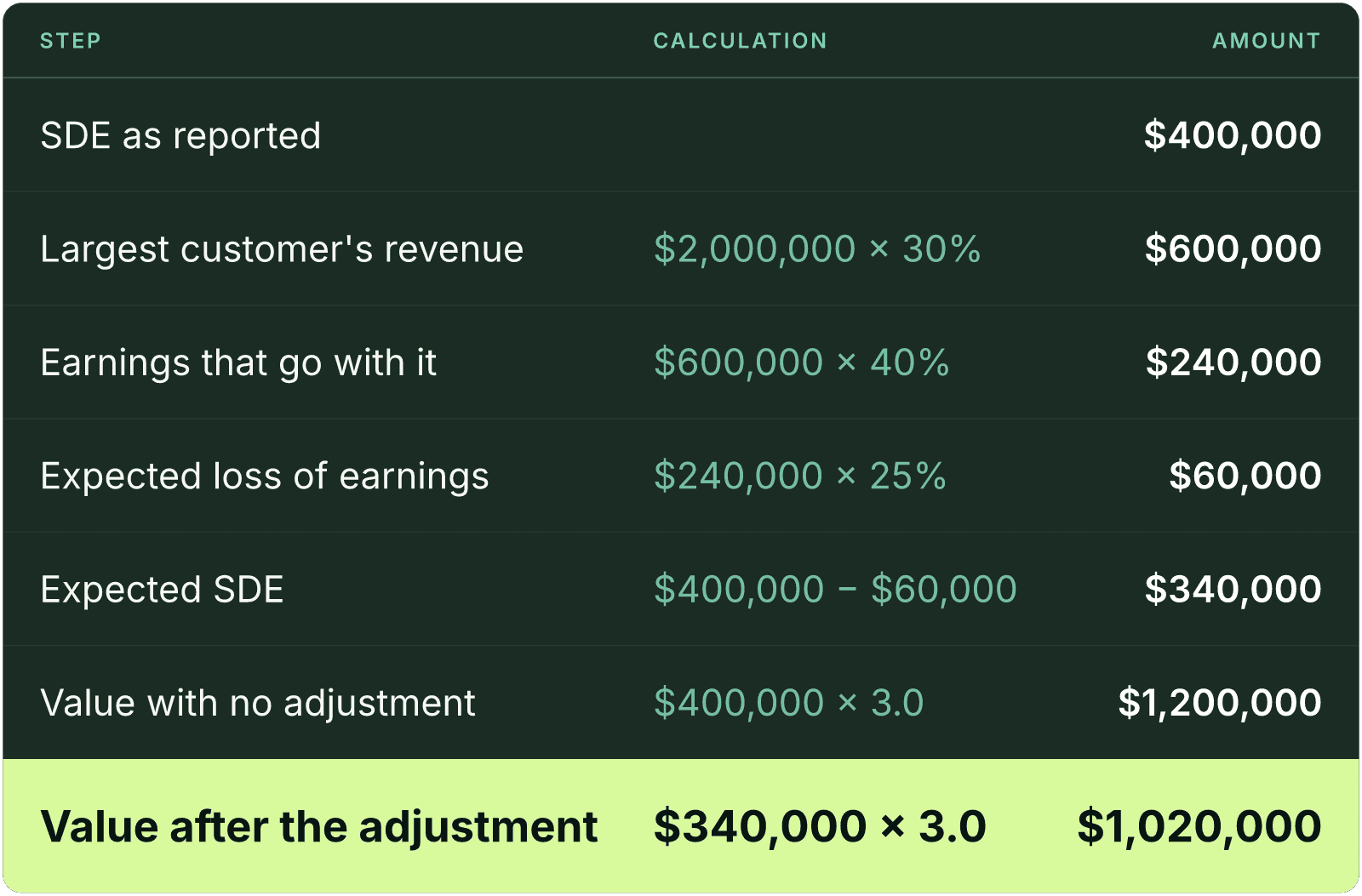
Take a distribution company with $2,000,000 of annual revenue and seller's discretionary earnings (SDE) of $400,000. If you are new to that measure, [our article on owner compensation and add-backs](https://www.409.ai/articles/owner-compensation-add-backs-small-business-valuation-sde-ebitda) explains how it is built. Comparable sales suggest a multiple of 3.0 times SDE. The largest customer buys $600,000 a year, 30% of revenue, and about 40 cents of each dollar of that revenue is profit before the owner's pay.
Here is the cash flow route with an assumed 25% chance that the customer leaves in the next two years.
[](https://www.409.ai/uploads/customer_concentration_small_business_valuation_largest_customer_risk_table_1_98410e150b.png)
The adjustment takes $180,000, or 15%, off the value, even though the customer is still there. If the customer did leave, SDE would fall to $160,000 and the same multiple would give $480,000. Willamette notes that the effect is not linear: losing a larger share of revenue takes a disproportionately larger share of value.
The point of the example is the method, not the percentages. An appraiser who finds a long contract, a high cost of switching and a documented relationship with several people at the customer would use a smaller probability. One who finds a verbal agreement and an owner who is the only contact would use a larger one.
Where concentration shows up
The same facts get read differently depending on who is asking.
For an SBA 7(a) or bank loan, the lender cares about whether cash flow will cover the debt. A single customer that could end it is a repayment risk, and the appraisal will reflect it. Our piece on [SBA SOP 50 10 8 and business valuation](https://www.409.ai/articles/sba-sop-50-10-8-1-business-valuation-change-of-ownership) covers when a lender needs the appraisal at all.
For a partner buyout, the gap between a seller who wants full credit for the big customer and a buyer who wants it discounted is a common source of dispute. The [standard of value](https://www.409.ai/articles/partner-buyout-fair-market-value-vs-fair-value-small-business-standard-of-value) your agreement names decides what the appraiser may consider.
For a divorce or an estate, the concern is more often whether the customer relationship belongs to the business or to the owner as a person, which affects what is counted at all. See our article on [personal and enterprise goodwill in a divorce](https://www.409.ai/articles/divorce-business-valuation-personal-vs-enterprise-goodwill-small-business).
What to do before an appraisal
You cannot change the past three years, but you can change what an appraiser finds.
1. Put the largest relationships in writing. A contract with a term, a renewal date and a notice period is evidence an appraiser can use. 2. Add contacts. If the customer's purchasing, operations and finance staff all know your team, the relationship is not one person deep. 3. Document replacement. A list of proposals, a rising number of new accounts and a sales process that does not depend on the owner all support a lower probability of loss. 4. Know your numbers by customer. Revenue and gross profit for each of your top ten customers, for three years, is the first thing a careful appraiser or buyer will ask for. 5. Tell the appraiser. A concentration that comes out in management interviews is better received than one found in the ledger.
None of this changes the arithmetic of a single large customer, but each item moves the probability of loss, and the probability is where the dollars come from.
The takeaway
When one customer carries a large share of your sales, expect a buyer or appraiser to value the business on earnings after the risk, not on the earnings as reported. Ask which of the two methods your appraiser is using, check that the risk is counted once, and bring the contract and the by-customer numbers with you. If you need an independent opinion for a loan, a buyout, an estate or a sale, the [409.AI SMB valuation](https://www.409.ai/products/smb-valuation) is reviewed by a valuation expert and starts from $899.