Equity
Current Value Method in a 409A: When It Is the Right Allocation
Why the current value method can understate common stock in a 409A, with a worked example, and the two cases where founders should see an appraiser to use it.
By 409.AI Team - 2026-10-16
# Current Value Method in a 409A: When It Is the Right Allocation
If you are comparing two 409A reports, or reading your first one, you may notice that the common stock value in one is far lower than in the other for what looks like the same company. Often the difference is not the enterprise value. It is the allocation method, the step that divides the company's equity value among preferred stock, common stock and options. The current value method (CVM) is the simplest of those methods, and the one most likely to produce a common stock value that is too low for a company with real upside.
This guide is for a founder or startup finance lead who wants to know what CVM assumes, why it understates common stock once a company has a future, and the two situations where a careful appraiser still picks it.
What the current value method does
A 409A valuation has two parts. First the appraiser estimates what the whole equity of the company is worth. Then the allocation step splits that number among the share classes, because a share of Series Seed preferred and a share of common stock carry different rights even when they sit in the same company.
The AICPA's valuation guide for privately held company equity issued as compensation describes three families of allocation methods: the current value method, the option pricing method and the probability-weighted expected return method. We cover the last two, and their hybrid, in [our guide to 409A allocation methods](https://www.409.ai/articles/409a-allocation-methods-opm-pwerm-backsolve).
CVM works like a sale today. The appraiser takes the equity value, runs it through the liquidation waterfall as if the company were sold on the valuation date, and pays each class what its contract says it would receive. Preferred stock takes its liquidation preference first, or converts to common if conversion pays more. Common stock gets whatever is left.
The key word is *today*. CVM looks at a single outcome at a single date. It does not model the chance that the company is worth far more in three years, and it does not model the chance that it is worth nothing. Our article on [liquidation preferences and the waterfall](https://www.409.ai/articles/liquidation-preferences-waterfall-common-stock-exit) explains the payout order that CVM relies on.
Why CVM understates common stock
Common stock in a venture-backed company behaves like a call option. It pays nothing until the preferred stack is covered, and it pays a lot if the company grows well beyond that stack. A fair value for common has to include the value of that upside, even in the scenarios where the company is worth less than the stack today.
CVM gives common stock no such option value. If the equity value today does not clear the preferences, common gets close to zero, however promising the business. If it clears them, common gets exactly the residual, with no credit for what happens next.
A worked example shows the size of the gap. Take a company with these terms:
- 12,000,000 shares of common stock, with options treated as outstanding for simplicity.
- 8,000,000 shares of Series Seed preferred, bought at $1.00 a share, so $8,000,000 invested, with a 1x non-participating liquidation preference.
- An estimated equity value of $10,000,000 on the valuation date.
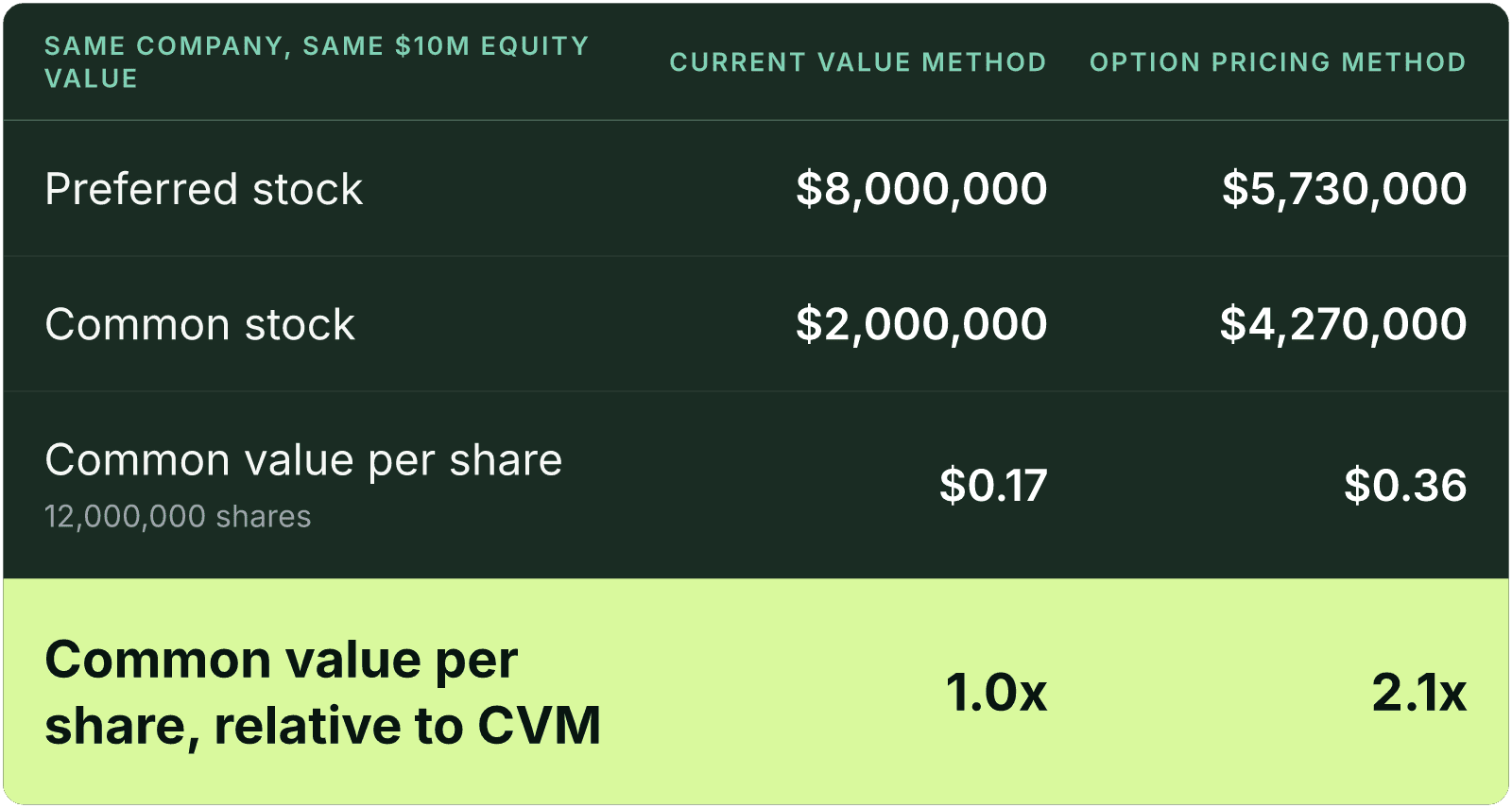
Under CVM, the preferred holders compare two payouts. Converting to common would give them 8/20 of $10,000,000, or $4,000,000. Taking the preference gives them $8,000,000. They take the preference, and common stock receives the remaining $2,000,000, or about $0.17 a share.
Now compare the option pricing method on the same cap table, using illustrative inputs: a three-year time to a liquidity event, 70% volatility and a 4% risk-free rate. The breakpoints are $8,000,000, where the preference is covered, and $20,000,000, where the preferred would convert. Between them, every extra dollar goes to common. Above $20,000,000, common holds 12/20, or 60%, of each extra dollar. Pricing those slices as options gives common stock about $4,270,000, or about $0.36 a share, before any discount for lack of marketability.
[](https://www.409.ai/uploads/current_value_method_409a_allocation_when_right_table_1_e7c6e2da0f.png)
The inputs are illustrative, not a benchmark, and the OPM figures move with volatility and time to exit. The direction does not move. With a large preferred stack and a company that is worth less than that stack today, CVM hands common stock the leftovers, and OPM credits it with the chance of a much better outcome. The 409A strike price follows the common value, so the same company could carry a strike near $0.17 under one method and near $0.36 under another, before the marketability discount described in our [DLOM guide](https://www.409.ai/articles/discount-lack-marketability-dlom-409a-valuation).
Why a low number is not a safe number
A lower strike price feels like a gift to employees. For the company it is a risk. The regulation that governs the safe harbor, Treas. Reg. §1.409A-1(b)(5)(iv)(B), asks for a reasonable valuation method applied reasonably, and a method that ignores obvious upside is hard to defend as reasonable. You can read the rule in the [eCFR text of §1.409A-1](https://www.ecfr.gov/current/title-26/section-1.409A-1).
If an option is later found to have been granted below fair market value on the grant date, it can fall under Section 409A, and the holder faces income inclusion plus additional tax on the amount. Our article on [the safe harbor versus a qualified appraiser](https://www.409.ai/articles/409a-safe-harbor-price-vs-qualified-appraiser) covers how that protection works.
There is a second audience. Auditors and, for a company heading toward an IPO, SEC reviewers compare option strike prices with later prices and ask why they moved. That is the cheap stock question, and a CVM valuation for a company with a real business is an easy one to challenge. See our piece on [the AICPA guide update and cheap stock](https://www.409.ai/articles/aicpa-cheap-stock-guide-2026-update-409a-valuation).
The two situations where CVM still fits
CVM is not a bad method. It is a narrow one. The AICPA guide treats it as appropriate when the company's value is realistically a function of today's facts and not of future outcomes. In practice that comes down to two cases.
The company has not really started. If there is no priced round, no meaningful operations and no product, the equity value is mostly the cash in the bank, and nobody can credibly forecast a range of outcomes. The preferred stack may not exist yet either. A newly formed company that has only issued founder shares and has not raised money is the usual example. Here an option model adds precision that does not exist. If this is your situation, read our guide to [your first 409A before the first option grant](https://www.409.ai/articles/first-409a-valuation-pre-revenue-startup-before-first-option-grant).
The company is close to liquidation or sale. When a sale or wind-down is imminent and the price is known or nearly known, the waterfall at that price is the best estimate of what each class will receive. Time to exit is months, not years, so there is little option value left to price. A company that signed a term sheet for an acquisition is an example, and the grant-date value of an option will also depend on the deal terms, as we describe in [option cash-outs, escrow and earnouts](https://www.409.ai/articles/option-cash-out-acquisition-escrow-earnout-section-409a).
Outside those two cases, a seed or Series A company with a working product, customers or a priced round should usually see OPM, a hybrid or a probability-weighted method instead.
How to read your own report
Open the allocation section and look for three things.
1. The method named. If it says current value method, find the sentence explaining why. A good report states the facts that make CVM appropriate, such as the absence of a priced round or an imminent sale. 2. The consistency with the facts you gave. If you told the appraiser about a signed Series A term sheet and the report still allocates by CVM, ask why. 3. The size of the preferred stack against the equity value. A stack larger than the equity value pushes common close to zero under CVM, which is exactly the situation where the method does the most damage.
Our [walkthrough of a 409A report](https://www.409.ai/articles/decoding-a-409a-valuation-report-walkthrough) shows where each of these sits in the document.
The takeaway
Ask one question of any 409A that uses CVM: is this company worth only what it would fetch if sold today? If the honest answer is no, because you have a product, a team and a plan that depends on the next three years, the method is understating common stock, and the strike price built on it is a risk you carry. If the answer is yes, because the company is days old or a sale is signed, CVM is the correct and simplest tool. The method itself is not the issue. The facts have to match it.
If you want a second opinion on the allocation in a report you already hold, or a 409A built on an allocation method your facts support, see [409.AI's 409A valuation](https://www.409.ai/products/409a).