Tax
CSOP Options From a US Parent: How a Delaware Startup Grants Them to UK Staff
For the CFO of a Delaware startup with UK staff: why CSOP options use the parent's shares, which value sets the price, and the £60,000 limit in dollars.
By 409.AI Team - 2026-11-17
# CSOP Options From a US Parent: How a Delaware Startup Grants Them to UK Staff
You run finance at a Delaware C-corp with a UK subsidiary, and the London team is growing. Your US equity plan already grants options, but to a UK employee an ordinary US option is an unapproved option: the gain at exercise is taxed as employment income. If EMI is out of reach, a Company Share Option Plan (CSOP) can take that income tax off the table. Doing it from a US parent raises three questions most guides skip: whose shares the options are over, which valuation sets the exercise price, and how a dollar grant is tested against a sterling limit.
The options have to be over the parent's shares
Schedule 4 to ITEPA 2003 says which shares a CSOP can use. [Paragraph 16](https://www.legislation.gov.uk/ukpga/2003/1/schedule/4/part/4) allows ordinary shares of the company that set up the scheme or of a company that controls it. Paragraph 17 then requires those shares to be listed on a recognised stock exchange or to be shares in a company that is not under the control of another company.
That second test decides the structure. HMRC's manual says an unlisted subsidiary [cannot use its own shares](https://www.gov.uk/hmrc-internal-manuals/employee-tax-advantaged-share-scheme-user-manual/etassum43220), because subsidiaries give the most scope to manipulate share values, but it may use its parent's shares whether or not the parent is listed. For a venture-backed Delaware parent that no other company controls, the scheme shares are the parent's common stock.
In practice the parent sets up the scheme and brings the UK subsidiary in as a constituent company of a [group scheme](https://www.gov.uk/hmrc-internal-manuals/employee-tax-advantaged-share-scheme-user-manual/etassum41120). Where the CSOP is a sub-plan or schedule to a wider US plan, HMRC treats the sub-plan as the scheme, together with the option documents, the board resolution, the company's constitution and any side agreements. Two things follow. The parent's board decides who gets options. And anything in the US plan that conflicts with Schedule 4, such as a cash alternative, has to be kept out of the UK sub-plan.
Check the control test before you draft. A parent controlled by a corporate investor, a holding company or a corporate trustee fails paragraph 17, and HMRC reads [control](https://www.gov.uk/hmrc-internal-manuals/employee-tax-advantaged-share-scheme-user-manual/etassum43230) by looking up the whole shareholding ladder, not only at the largest holder.
Why EMI is often closed to a US group
EMI is the better scheme when it is available, and our [guide to the 2026 EMI rules](https://www.409.ai/articles/emi-share-options-2026-uk-rules-hmrc-valuation) covers the limits that rose on 6 April 2026. The catch for a US group is that EMI tests the whole group. The headcount limit of fewer than 500 full-time equivalents [counts every employee](https://www.gov.uk/hmrc-internal-manuals/employee-tax-advantaged-share-scheme-user-manual/etassum52070) of the company and its qualifying subsidiaries, wherever they work. The £120 million [gross assets limit](https://www.gov.uk/hmrc-internal-manuals/employee-tax-advantaged-share-scheme-user-manual/etassum52060) is applied to the group as a whole. At least one group member must carry on a qualifying trade through a [UK permanent establishment](https://www.gov.uk/hmrc-internal-manuals/employee-tax-advantaged-share-scheme-user-manual/etassum52080), and excluded activities such as receiving royalties and licence fees can sink the trade test.
A Series C company with 450 engineers in the US and 60 in London fails the headcount test, even though the UK team is small. CSOP has no headcount, gross assets or trading test. Its constraints are the share rules above, the eligibility rules for employees and directors, and the £60,000 limit per employee. Our [CSOP guide](https://www.409.ai/articles/csop-share-options-2026-uk-hmrc-valuation) covers the scheme's wider rules.
Two valuations, two tests, one exercise price
Your US grants already rest on a 409A valuation. Under the Treasury regulations, an option avoids section 409A only if the [exercise price can never be less than the fair market value](https://www.law.cornell.edu/cfr/text/26/1.409A-1) of the stock on the grant date. An independent appraisal dated no more than 12 months before the grant is presumed reasonable. Our note on the [409A safe harbor](https://www.409.ai/articles/409a-safe-harbor-price-vs-qualified-appraiser) explains what earns that presumption.
The CSOP test is a UK test. The exercise price must not be [manifestly less than market value](https://www.gov.uk/hmrc-internal-manuals/employee-tax-advantaged-share-scheme-user-manual/etassum44130) at grant, and market value means the price the shares might reasonably fetch in the open market under section 272 of the Taxation of Chargeable Gains Act 1992. For unlisted shares, [section 273](https://www.legislation.gov.uk/ukpga/1992/12/section/273) assumes the buyer has all the information a prudent buyer would reasonably require. HMRC recommends that scheme rules for unlisted shares require the value to be [agreed with Shares and Assets Valuation](https://www.gov.uk/hmrc-internal-manuals/employee-tax-advantaged-share-scheme-user-manual/etassum44180) (SAV) before grant. SAV usually lets an agreed value stand for about 30 days.
So the same share of common stock is measured twice, under different definitions, by different people, with very different shelf lives: up to 12 months for the 409A presumption, about a month for an SAV agreement. Neither answers the other's question. Our [CSOP valuation primer](https://www.409.ai/articles/what-is-a-csop-valuation-unrestricted-market-value-hmrc-sav-agreed-before-grant) walks through what SAV agrees and how. On the US side, [409A value and fair market value](https://www.409.ai/articles/409a-valuation-vs-fair-market-value) are not the same thing either.
Setting the price: the higher number wins
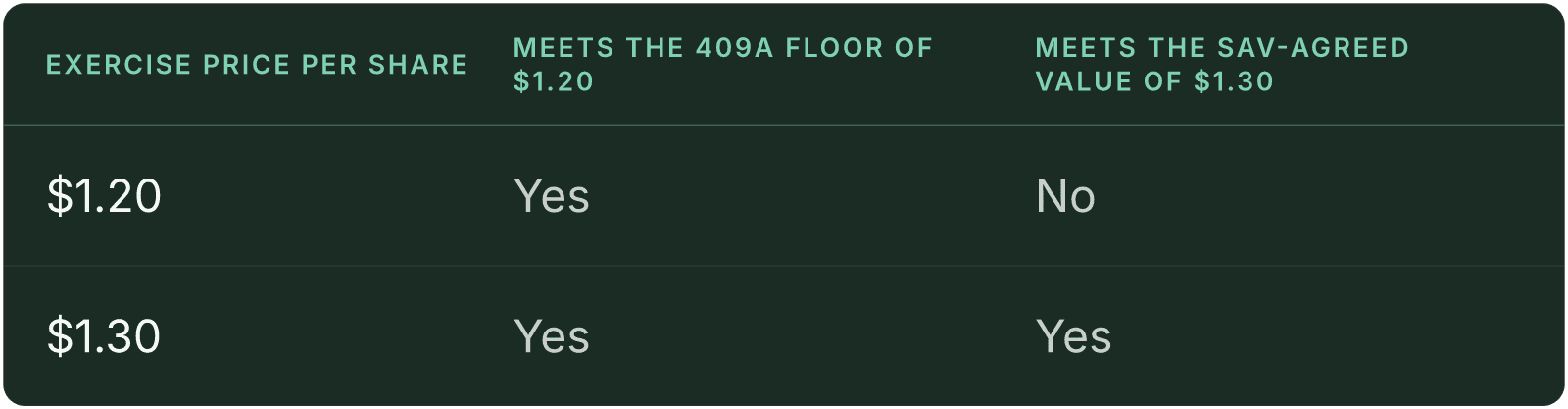
Say your latest 409A puts common stock at $1.20 a share, and SAV agrees a market value of $1.30 for a grant on 15 March. The figures are illustrative.
[](https://www.409.ai/uploads/csop_us_parent_company_uk_employees_409a_hmrc_market_value_exercise_price_table_1_d5c374d1ec.png)
A price of $1.20 satisfies the US rules but sits below the value HMRC agreed. If an option is granted below market value, HMRC's manual says it was not granted under Schedule 4 and the [section 524 relief](https://www.gov.uk/hmrc-internal-manuals/employee-tax-advantaged-share-scheme-user-manual/etassum44180) does not apply. Price the UK grant at $1.30 and both tests are met. If SAV had agreed $1.10 instead, $1.20 would clear both tests and would be the price. Either way, the price is the higher of the two figures on the grant date.
The price can be stated in dollars. HMRC accepts an exercise price [in another currency](https://www.gov.uk/hmrc-internal-manuals/employee-tax-advantaged-share-scheme-user-manual/etassum44110), though the annual return asks for the sterling equivalent alongside it.
The £60,000 limit in a dollar plan
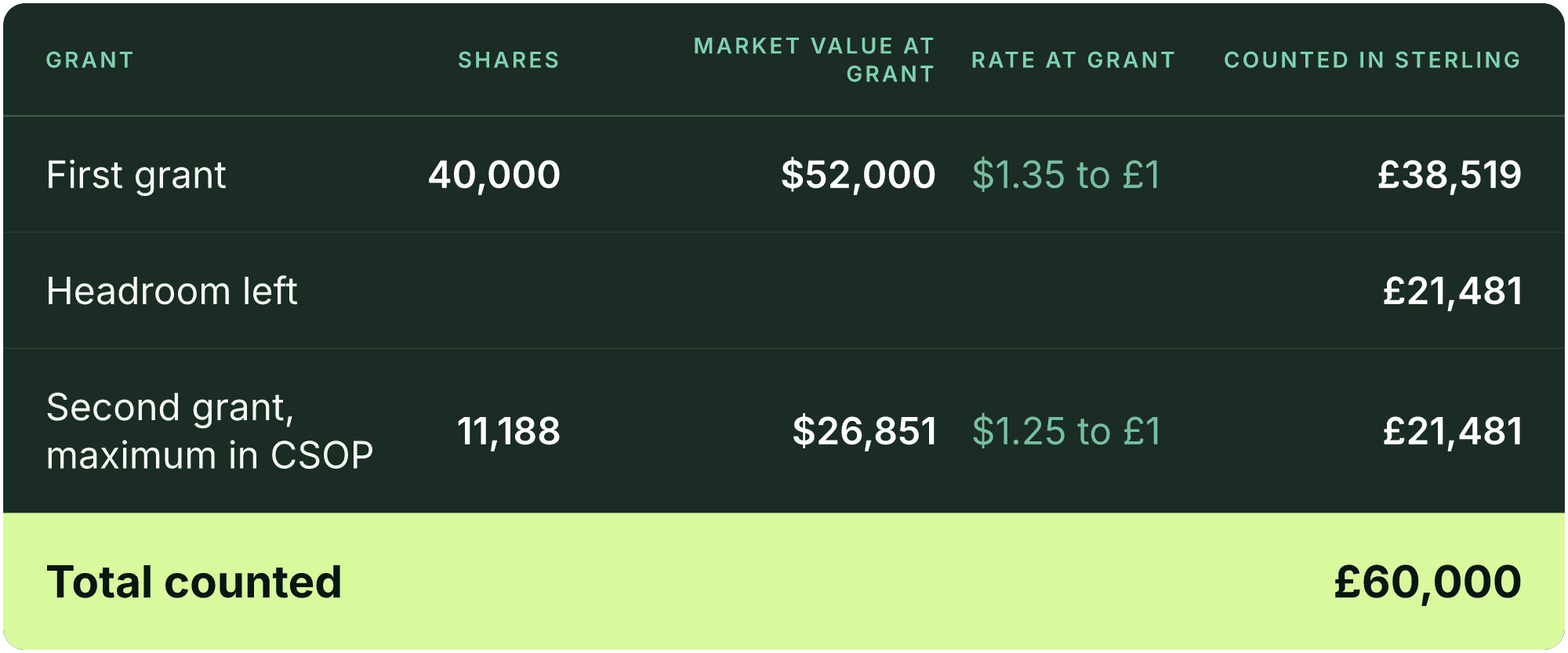
The limit counts the market value of shares under an employee's unexercised CSOP options, measured at each grant and never recalculated. For a dollar-priced share, HMRC converts the market value into sterling at the [exchange rate on the date of grant](https://www.gov.uk/hmrc-internal-manuals/employee-tax-advantaged-share-scheme-user-manual/etassum41190), and that conversion is not revisited when the exchange rate moves before a later grant.
Take a UK engineer granted 40,000 options when the agreed value is $1.30 and $1.35 buys £1. A year later, after a Series A, the board wants to grant 20,000 more at an agreed value of $2.40, with $1.25 to the pound. Both rates are illustrative.
[](https://www.409.ai/uploads/csop_us_parent_company_uk_employees_409a_hmrc_market_value_exercise_price_table_2_6a086f9f2d.png)
Only 11,188 of the 20,000 new options fit inside the limit. The remaining 8,812 can still be granted under the US plan, but as unapproved options, so their gain at exercise is taxed as employment income. The limit also counts unexercised CSOP options under any scheme of an [associated company](https://www.gov.uk/hmrc-internal-manuals/employee-tax-advantaged-share-scheme-user-manual/etassum41180), so a second plan elsewhere in the group shares the same £60,000. If the company also grants EMI, unexercised CSOP options count towards the employee's [£250,000 EMI limit](https://www.gov.uk/hmrc-internal-manuals/employee-tax-advantaged-share-scheme-user-manual/etassum41230) too.
What the employee gets, and when
A CSOP option exercised [between three and ten years after grant](https://www.gov.uk/hmrc-internal-manuals/employee-tax-advantaged-share-scheme-user-manual/etassum48150) carries no income tax on exercise. Earlier exercise keeps the relief only in the cases the scheme provides for: a good leaver exercising within six months of leaving, certain company events, or exercise within 12 months of death. When the shares are later sold, the gain above the exercise price falls into capital gains tax rather than income tax. Our article on [CSOP options in a takeover](https://www.409.ai/articles/csop-options-takeover-cash-exercise-rollover-hmrc-agreed-market-value) covers what a sale of the parent does to the three-year clock.
In the example above, if the parent is sold for $10 a share after year four, the 40,000 shares priced at $1.30 carry a gain of $8.70 a share inside capital gains tax. The 8,812 unapproved options from the second grant do not: their $7.60 spread over the $2.40 price is employment income at exercise.
The paperwork a US parent tends to miss
Notification. A scheme is a Schedule 4 CSOP only once HMRC has been [notified](https://www.gov.uk/hmrc-internal-manuals/employee-tax-advantaged-share-scheme-user-manual/etassum41130), with a declaration that it meets the requirements. The deadline is 6 July after the end of the tax year of the first grant. Miss it, and the scheme counts only from the tax year in which notice is given.
Restrictions. The option documents must [state the restrictions](https://www.gov.uk/hmrc-internal-manuals/employee-tax-advantaged-share-scheme-user-manual/etassum43290) on the shares and point the employee to where they sit. For a Delaware parent, look at the transfer and market stand-off provisions in the plan, the bylaws and the stockholder agreements. A general reference to "the company's documents" is not enough.
Timing. Order matters. Get the 409A first, submit to SAV, then grant inside SAV's window while the 409A is still current. A priced round, a signed term sheet or a sale approach can end both before their dates run out. Our piece on [409A trigger events](https://www.409.ai/articles/409a-valuation-frequency-how-often-should-you-get-one) covers the US side.
The takeaway
A CSOP from a Delaware parent works only if the options are over the parent's own shares. The exercise price is the higher of the 409A value and the value SAV agreed, on the grant date. Each grant is converted into sterling at that day's exchange rate and tested against £60,000. Plan the US and UK valuations as one sequence, so both are current on the grant date, and the London team's options can carry the relief CSOP is designed to give. If you need the UK side valued, that is what our [CSOP valuation](https://www.409.ai/products/csop-valuation) is for, and the [409A](https://www.409.ai/products/409a) sits beside it.