Tax
CSOP Options in a Takeover: Cash Exercise, Rollover and the Value HMRC Must Agree
UK founders and CFOs with CSOP options in a sale: when an exercise inside three years stays tax-free, how a rollover works, and the value HMRC must agree.
By 409.AI Team - 2026-11-10
# CSOP Options in a Takeover: Cash Exercise, Rollover and the Value HMRC Must Agree
If you run a UK company with a Company Share Option Plan and a buyer has just sent heads of terms, the options your team holds are about to face a test the scheme rules were written for, and most people at the table have never read them. A CSOP option is tax-advantaged when it is exercised between three and ten years after grant. A sale rarely waits that long. What happens to an option granted 20 months ago depends on three things you can check now: whether the buyer pays cash or shares, what your scheme rules allow, and whether the replacement options, if any, carry a market value HMRC has agreed.
This piece is for the founder, CFO or company secretary of a CSOP company in a sale process, and for the adviser running the employee side of the deal. It covers the statutory routes, the conditions that decide whether an early exercise is tax-free, and the valuation that a rollover needs before anyone signs.
The normal rule, and why a sale breaks it
Section 524 of the Income Tax (Earnings and Pensions) Act 2003 removes the income tax charge on exercise when the option is [exercised on or after the third anniversary of grant and no later than the tenth](https://www.legislation.gov.uk/ukpga/2003/1/section/524). HMRC's own summary on GOV.UK puts it the same way: buy the shares [between 3 and 10 years after being offered them](https://www.gov.uk/tax-employee-share-schemes/company-share-option-plan) and there is no Income Tax or National Insurance on the difference between the price paid and the value.
Inside three years, the same section gives two exits. One is a good leaver: injury, disability, redundancy, retirement, a TUPE transfer, or the employing company leaving the group, with the option exercised within six months of leaving. The other is a company event, and that is the one a sale triggers. Our [CSOP guide](https://www.409.ai/articles/csop-share-options-2026-uk-hmrc-valuation) explains why a company picks CSOP in the first place; this article starts where the buyer arrives.
The windows Schedule 4 lets your rules open
A CSOP scheme can only do what its rules say, and the rules can only say what [Schedule 4, paragraph 25A](https://www.legislation.gov.uk/ukpga/2003/1/schedule/4/paragraph/25A) permits. The scheme may allow exercise within six months after:
- a person obtains control through a general offer for the whole issued ordinary share capital, once any condition of the offer is satisfied;
- the court sanctions a scheme of arrangement under section 899 or 901F of the Companies Act 2006;
- a non-UK company reorganisation arrangement becomes binding on the shareholders.
It may also allow exercise for as long as a buyer is bound or entitled to squeeze out minority shareholders under sections 979 to 985 of the Companies Act 2006.
Two shorter windows sit around those dates. The rules may treat an exercise in the 20 days before the event as made inside the window, provided the exercise is treated as having no effect if the event does not happen within 20 days. And because a private company's shares stop being eligible CSOP shares once another company controls it ([paragraph 17](https://www.legislation.gov.uk/ukpga/2003/1/schedule/4/paragraph/17) requires shares in a company not under another company's control, unless listed), the rules may allow exercise up to 20 days after control passes despite that. In practice, for a private target bought by a company, the 20 days after completion is often the last tax-advantaged moment.
If your rules were drafted before these provisions existed, or copied from a template that left them out, the window may simply not be there. Read the rules before the deal timetable is set, not after.
Early exercise for cash: tax-free only when four facts line up
Exercising inside three years through a company-event window is not automatically tax-free. Section 524(2E) adds conditions, and each one is a fact your file should be able to show:
1. The holder receives cash and nothing else for the shares. A share-for-share offer, or cash plus loan notes, fails this test. 2. The offer had not been made when the decision to grant the option was taken. 3. No arrangements were in place or under consideration for the offer at that date. The statute defines arrangements to include any plan or understanding, whether or not legally enforceable. 4. If your rules allow a rollover, no rollover was open to the holder that would have prevented the cash exercise. Choosing cash when an exchange was on offer takes the exercise outside the exemption.
An anti-avoidance test applies on top: tax avoidance cannot be a main purpose of the arrangements under which the option was granted or exercised.
Condition 3 is the one that catches companies. An option granted three months before a sale, while a banker was already shopping the business, is the textbook failure. Board minutes that record when sale discussions started, and grant decisions dated before them, are worth more than any argument made later.
What each route costs the employee
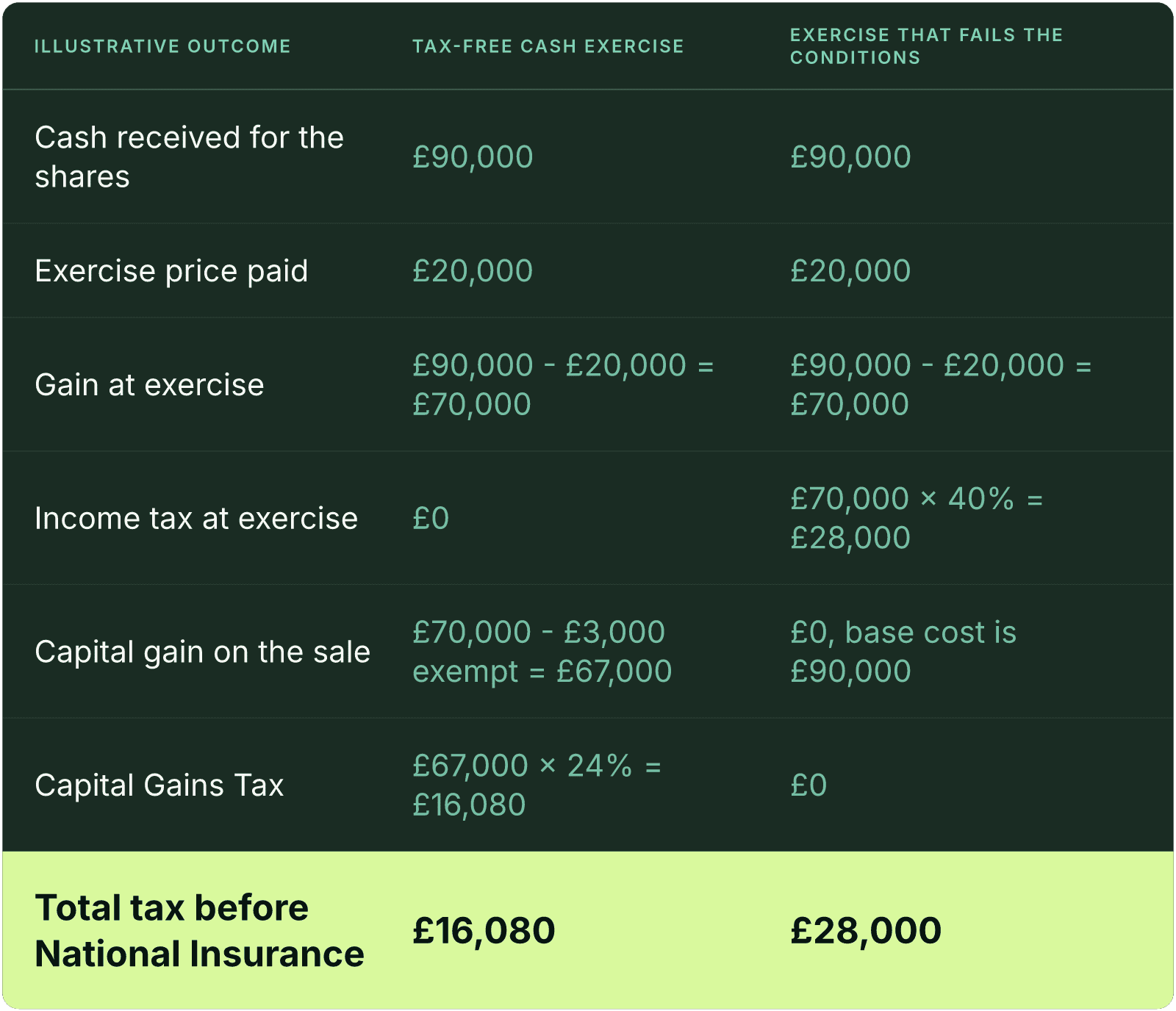
Here is an illustrative grant: 10,000 options at £2.00 a share, the market value agreed at grant on 1 March 2025. A buyer acquires the company in November 2026, less than three years later, at £9.00 a share in cash. The employee is a higher-rate taxpayer whose income keeps the gain inside the 40% band.
[](https://www.409.ai/uploads/csop_options_takeover_cash_exercise_rollover_hmrc_agreed_market_value_table_1_6820b32d76.png)
The [Capital Gains Tax rates](https://www.gov.uk/capital-gains-tax/rates) used are those GOV.UK publishes for 2026 to 2027: 24% for a higher-rate taxpayer, with a £3,000 annual exempt amount. When the conditions fail, the gain is employment income, and if the shares count as readily convertible assets the employer may also have to put it through PAYE with National Insurance, which widens the gap further.
The difference is £11,920 on one employee's grant before National Insurance. Multiply it across the option pool and it becomes a line the buyer's tax adviser will raise in diligence.
The rollover route: new options over the buyer's shares
Where the buyer pays in shares, or wants to keep the team on equity, [paragraph 26](https://www.legislation.gov.uk/ukpga/2003/1/schedule/4/part/6) lets the holder release the old options in exchange for new options over the acquiring company's shares. HMRC's manual is plain that this is always by agreement: a [mandatory exchange is not acceptable](https://www.gov.uk/hmrc-internal-manuals/employee-tax-advantaged-share-scheme-user-manual/etassum45120), and the old options may instead lapse if either side declines. The agreement must be made within six months of control passing, of court sanction or of a non-UK arrangement becoming binding, or while squeeze-out rights last.
The prize is continuity. [Paragraph 27](https://www.legislation.gov.uk/ukpga/2003/1/schedule/4/paragraph/27) treats the new options as granted when the old ones were, so the three-year clock keeps running from the original grant date. The price is that the new options must be equivalent:
- the new shares must themselves meet the CSOP share conditions in paragraphs 16 to 18;
- the options must be exercisable in the same manner, under the scheme as it stood before the release;
- the total market value of the shares under option must be substantially the same immediately before and immediately after the exchange;
- the total exercise price must be substantially the same.
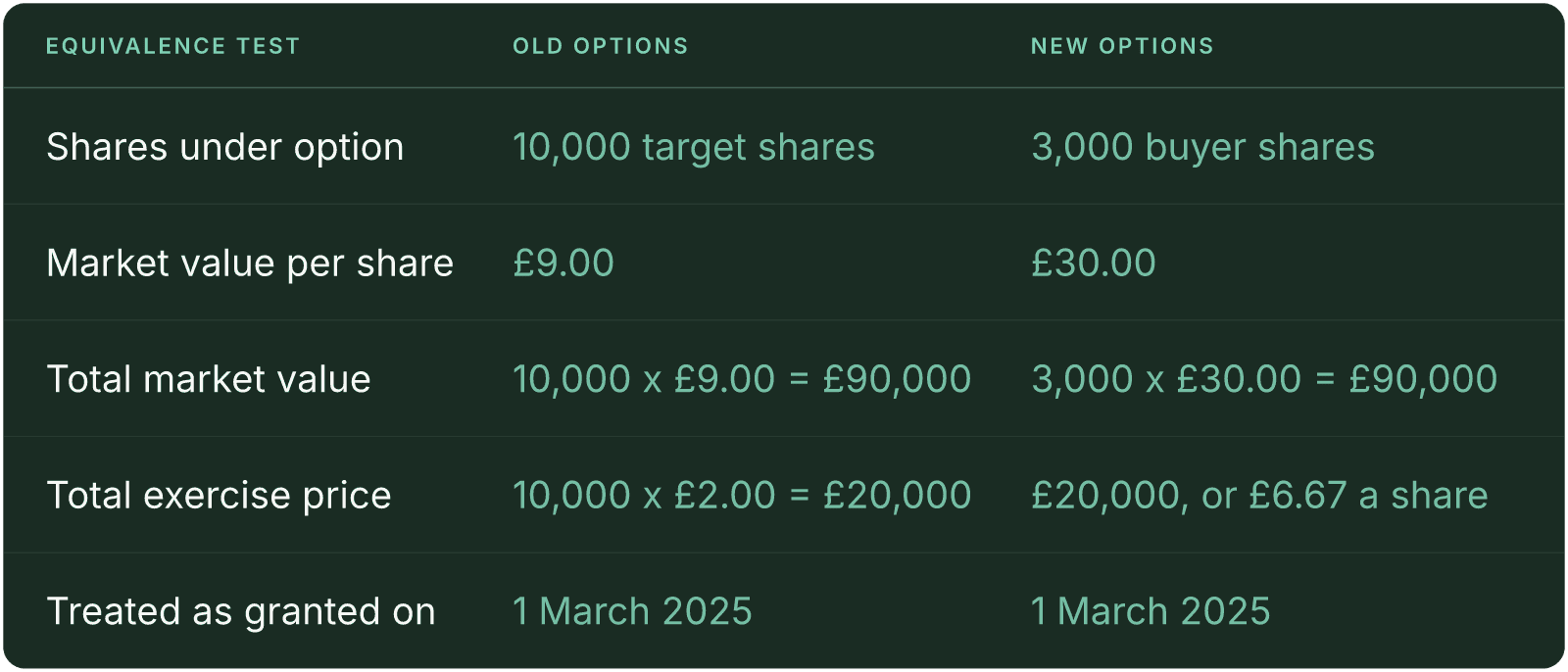
Take the same employee. Their 10,000 options are over target shares worth £9.00, a total market value of £90,000 and a total exercise price of £20,000. If the buyer's shares are worth £30.00, the exchange gives options over 3,000 buyer shares, and the £20,000 total price becomes £6.67 a share (rounded from £6.6667).
[](https://www.409.ai/uploads/csop_options_takeover_cash_exercise_rollover_hmrc_agreed_market_value_table_2_f33927fe9a.png)
The employee keeps the same £70,000 of built-in value and can exercise tax-free from 1 March 2028, three years after the original grant.
The value in the rollover is the one HMRC has to agree
Every figure in that second table rests on two market values, and paragraph 27(8) requires them to be [determined using a methodology agreed by HMRC](https://www.gov.uk/hmrc-internal-manuals/employee-tax-advantaged-share-scheme-user-manual/etassum45230). The one shortcut is narrow: where both companies are listed on a recognised stock exchange and the offer is share for share, the offer price can stand as market value without HMRC's agreement. AIM does not count. When either company is private, or the offer includes a mandatory cash element, HMRC's Shares and Assets Valuation team must consider the proposal.
The manual describes SAV's usual practice: it agrees values based on the date option holders receive their offer letters, holds them for 21 days, and expects all options to be exchanged on one date. That fixes the order of work. The valuation of the target's ordinary shares and of the buyer's shares goes to SAV before the offer letters go out, and the exchange date sits inside the 21 days.
Two valuation points come up every time. First, restrictions are ignored: the market value is measured as if the shares carried no restriction, the same unrestricted basis the original grant used, which our article on [what a CSOP valuation is](https://www.409.ai/articles/what-is-a-csop-valuation-unrestricted-market-value-hmrc-sav-agreed-before-grant) explains. Second, the deal price per ordinary share is not automatically the market value of an ordinary share. Preferences, earn-outs and escrowed consideration all sit between the headline price and what one ordinary share is worth, and SAV will ask how the number was built.
If your team also holds EMI options, the timing differs: EMI has its own disqualifying events and its own 90-day window, set out in our piece on [EMI disqualifying events](https://www.409.ai/articles/emi-disqualifying-events-90-day-exercise-window-hmrc-market-value). US readers with option holders on both sides of the Atlantic will find the American equivalent in our article on the [Section 424(a) ratio test for rolled-over options](https://www.409.ai/articles/stock-options-acquisition-rollover-section-424a-ratio-test).
What to settle before the heads of terms are signed
Four things, in order. Read your scheme rules and confirm which paragraph 25A windows and whether a paragraph 26 exchange they include. Pull the board minutes for every grant in the last three years and set them beside the date sale discussions began, because that comparison decides condition 3. Ask the buyer early whether it will offer replacement options, since an offered rollover closes the tax-free cash route for anyone who declines it. And if a rollover is on the table, commission the valuation of both share prices in time to agree them with SAV before the offer letters go out.
A [CSOP valuation](https://www.409.ai/products/csop-valuation) that HMRC agreed at grant fixed the starting point of every option you issued. In a takeover, the agreed value at exchange decides whether that starting point survives the deal.