Tax
CSOP Options When an Employee Leaves: Good Leavers, the Three-Year Rule and the Tax Bill
For UK companies running a CSOP: when a leaver can still exercise tax-free, the six-month good leaver window, and the share value a taxed early exercise needs.
By 409.AI Team - 2026-11-23
# CSOP Options When an Employee Leaves: Good Leavers, the Three-Year Rule and the Tax Bill
An employee with Company Share Option Plan (CSOP) options hands in their notice 18 months after the grant. If you're the founder, CFO or people lead at a UK company, you now have two questions on your desk: can they still exercise, and if they do, who pays income tax on what? The answer turns on three things: why they left, when they exercise, and what the shares are worth on that day.
This article is for the company that already runs a CSOP and is now dealing with its first leavers. If you're still deciding whether CSOP fits, start with our [CSOP guide](https://www.409.ai/articles/csop-share-options-2026-uk-hmrc-valuation). Here we stay with the leaver.
The rule that decides everything: three years from grant
The CSOP tax break lives in section 524 of the Income Tax (Earnings and Pensions) Act 2003. It removes the income tax charge on exercise when one of two conditions is met. [Condition A](https://www.legislation.gov.uk/ukpga/2003/1/section/524) is that the option is exercised on or after the third anniversary of grant and no later than the tenth. Condition B covers exercise inside three years, and only for a good leaver.
Notice what Condition A doesn't ask. It doesn't ask whether the holder is still employed. It asks that the exercise falls in the three-to-ten-year window and happens in accordance with the scheme rules. So the reason someone left matters to their tax only when they exercise before the third anniversary. After it, a leaver who still holds a live option under the rules exercises with the same relief as someone who stayed.
That shifts the real question to your plan rules. Schedule 4 gives a CSOP holder no statutory right to exercise after leaving. [Paragraph 24](https://www.legislation.gov.uk/ukpga/2003/1/schedule/4/paragraph/24) only says the scheme *may* allow it. Whether a leaver keeps their option, for how long, and on whose decision, is whatever your rules say.
Who counts as a good leaver
Section 524(2B) lists the good-leaver reasons. The holder must have ceased to be in qualifying employment because of:
- injury, disability, redundancy or retirement;
- a transfer of their employment under the TUPE Regulations 2006; or
- in a group scheme, their employing company ceasing to be controlled by the scheme organiser.
And they must exercise within six months of the day they left. Miss the six months and Condition B is gone, even for a textbook redundancy.
HMRC's user manual fills in each term. Redundancy carries its [Employment Rights Act 1996 meaning](https://www.gov.uk/hmrc-internal-manuals/employee-tax-advantaged-share-scheme-user-manual/etassum44340), with no room for the board to decide otherwise. Injury is undefined, so it is [for the company to determine](https://www.gov.uk/hmrc-internal-manuals/employee-tax-advantaged-share-scheme-user-manual/etassum44320), usually by a board decision under the rules. Retirement has no statutory definition either: since Finance Act 2013 the rules no longer need a retirement age, and the manual says a company with a retirement policy should apply it, apply it consistently, and never treat a departure as [retirement solely to gain the tax advantage](https://www.gov.uk/hmrc-internal-manuals/employee-tax-advantaged-share-scheme-user-manual/etassum44350).
One drafting point catches companies out. HMRC's practice is that rules which allow exercise on leaving must give a [clear right to exercise, or not, in each good-leaver case](https://www.gov.uk/hmrc-internal-manuals/employee-tax-advantaged-share-scheme-user-manual/etassum44310). A rule that only says "any other reason, at the board's discretion" doesn't meet Schedule 4, because the good leavers would then sit under discretion. Discretion is fine for everyone else.
Death is its own case
If a holder dies, [paragraph 25](https://www.legislation.gov.uk/ukpga/2003/1/schedule/4/paragraph/25) lets the scheme allow exercise for 12 months from the date of death. The manual adds that the personal representatives or the beneficiaries may exercise, that the 12 months applies even where it runs past the tenth anniversary, and that there is [no income tax on that exercise even inside three years](https://www.gov.uk/hmrc-internal-manuals/employee-tax-advantaged-share-scheme-user-manual/etassum42210). Like every leaver provision, it exists only if your rules include it.
The same leaver, four outcomes
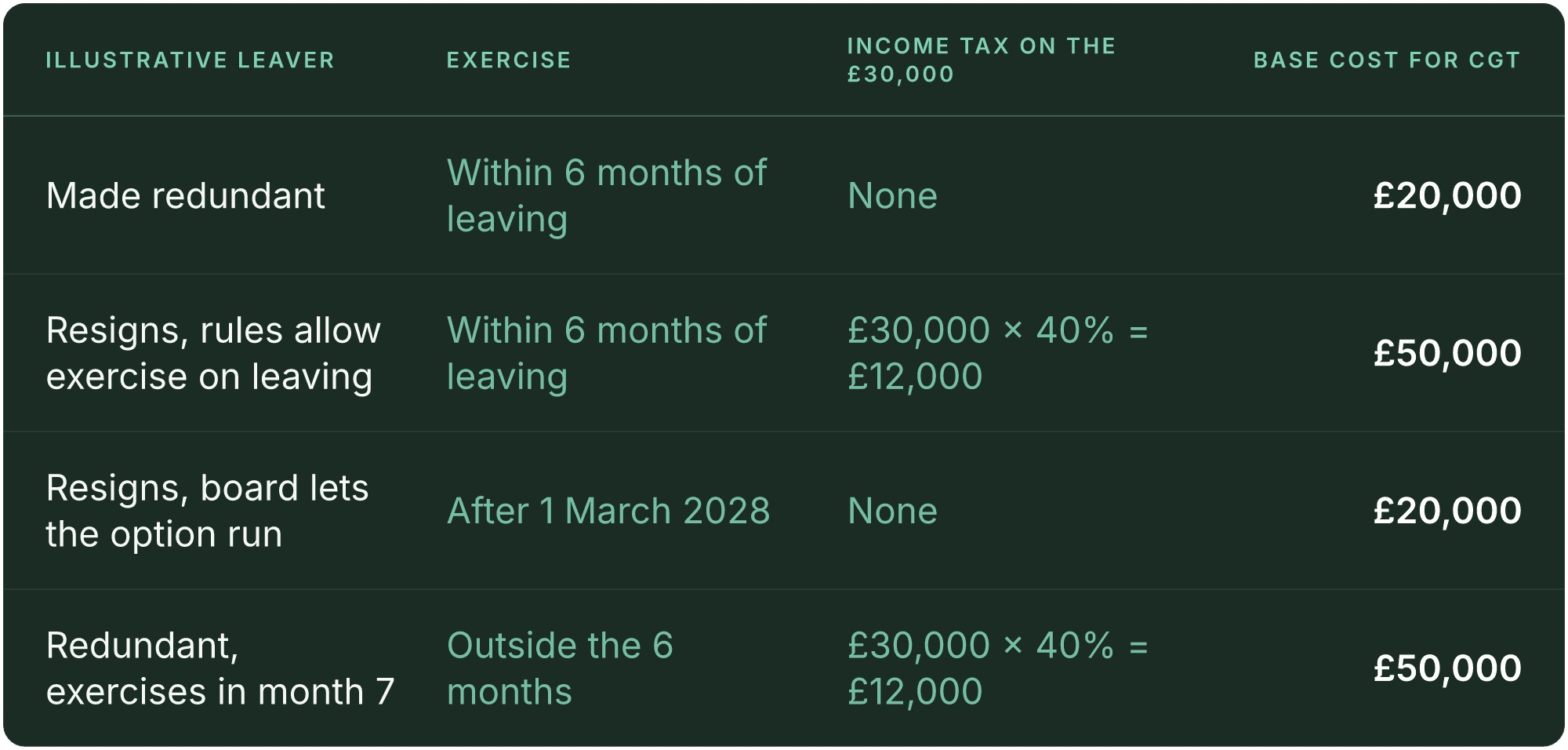
Take an illustrative grant. On 1 March 2025 an employee receives CSOP options over 10,000 ordinary shares at £2.00, the market value at grant. They leave on 30 September 2026, about 19 months in, and the shares are worth £5.00 a share when they exercise. That's a gain of £3.00 a share, £30,000 in total.
[](https://www.409.ai/uploads/csop_options_employee_leaves_good_leaver_three_year_rule_income_tax_market_value_table_1_3cfad796b4.png)
The tax figure assumes a higher-rate taxpayer at 40%. Two rows are worth a second look.
The third row is the one most companies don't consider. If your rules let the board keep a resigning employee's option alive past the third anniversary, Condition A applies on exercise and the income tax disappears. That's a commercial choice about leavers, not a tax trick, and many companies prefer to lapse unvested options of people who resign. But it should be a decision you make on purpose, with the tax effect in view.
The fourth row is the costly one. The same redundancy, exercised a month late, carries the same £12,000 as a resignation. The six-month window should sit in every leaver letter.
In the taxed rows, the capital gains base cost is the £20,000 paid plus the £30,000 already charged to income tax, which [section 119A of the Taxation of Chargeable Gains Act 1992](https://www.legislation.gov.uk/ukpga/1992/12/section/119A) adds so the same gain isn't taxed twice. In the relieved rows the base cost is the price paid, and the whole gain from £2.00 falls into capital gains tax on sale.
When a taxed exercise needs a valuation
Every relieved exercise rests on one number agreed long ago: the market value at grant, the figure our [CSOP valuation explainer](https://www.409.ai/articles/what-is-a-csop-valuation-unrestricted-market-value-hmrc-sav-agreed-before-grant) covers. A taxed exercise needs a second number, the market value of the shares on the exercise date, because that's what the income tax charge is measured on.
For a listed company that's a quoted price. For a private company it's a valuation, and three facts make it harder than the grant valuation was.
First, nobody asked HMRC in advance. The grant value can be agreed with Shares and Assets Valuation before the options are granted. The exercise value of a bad leaver usually isn't on anyone's calendar, and HMRC [withdrew its post-transaction valuation check for employment income from 1 April 2016](https://www.gov.uk/hmrc-internal-manuals/shares-and-assets-valuation-manual/svm105055). The figure on the return is supported by whatever evidence the company and the employee hold, and HMRC can question it later.
Second, the date is fixed by the leaver, not by your valuation cycle. If the last valuation was before a funding round, a trading change or an approach from a buyer, it no longer describes the shares. Our article on [EMI disqualifying events](https://www.409.ai/articles/emi-disqualifying-events-90-day-exercise-window-hmrc-market-value) shows the same problem on the EMI side: a tax charge measured at a date nobody valued.
Third, who pays depends on the shares. If the shares are [readily convertible assets under section 702](https://www.legislation.gov.uk/ukpga/2003/1/section/702), for example because trading arrangements exist for them, the employer runs the charge through PAYE and Class 1 National Insurance is due; HMRC's National Insurance manual says Class 1 arises on an [early CSOP exercise when the shares are readily convertible](https://www.gov.uk/hmrc-internal-manuals/national-insurance-manual/nim06809). If they are not, the employee reports the gain on their Self Assessment return. Either way, someone has to put a figure on the shares at that date and stand behind it. Whether the readily convertible test applies to your shares is a question for your tax adviser before the exercise, not after.
Death raises the same question from the other side. The manual's own example measures the beneficiaries' later capital gain against the [market value of the option at the date of death](https://www.gov.uk/hmrc-internal-manuals/employee-tax-advantaged-share-scheme-user-manual/etassum42210), so the estate needs a value at that date too.
A takeover is a different exit
When the whole company is sold, the holder usually hasn't left at all, and the sale has its own route in paragraph 25A and section 524(2E), with conditions on when the options were granted and what the holder receives. Our article on [CSOP options in a takeover](https://www.409.ai/articles/csop-options-takeover-cash-exercise-rollover-hmrc-agreed-market-value) walks through it. The good-leaver test above covers a holder whose own employment ends while the company carries on.
If your CSOP is over a US parent's shares, the same leaver rules apply to the UK holder, and the exercise value is still a UK market value. The [US parent article](https://www.409.ai/articles/csop-us-parent-company-uk-employees-409a-hmrc-market-value-exercise-price) explains why a 409A doesn't answer that question.
What to do before your next leaver
Read your rules against the six good-leaver reasons and check each one carries a clear right to exercise or not. Decide your policy for people who resign: lapse, a short window, or the option kept to the third anniversary. Put the leaving date and the six-month deadline in every leaver letter. And when a holder will exercise inside three years without a good-leaver reason, get the shares valued at the exercise date, because that figure sets the employee's income tax and possibly your PAYE.
If you need the grant value agreed with HMRC, or a value at an exercise date, a [CSOP valuation](https://www.409.ai/products/csop-valuation) from 409.AI starts at $3,499.
The three-year anniversary is the date that matters. Before it, the reason for leaving and a six-month clock decide whether £30,000 of gain is tax-free or taxed at 40%; after it, the only questions are what your rules allow and what the shares are worth.