Education
Conclusion of Value or Calculated Value: What You Are Buying When You Order a Business Valuation
Owners and CPAs: a valuation engagement ends in a conclusion of value, a calculation engagement in a calculated value. Know which you order before you compare.
By 409.AI Team - 2026-10-27
# Conclusion of Value or Calculated Value: What You Are Buying When You Order a Business Valuation
You asked three firms to value your company and got three quotes that do not line up. One is a fraction of another, and the cheapest one never says what the final document will be called. If you own a small private company, or you are the CPA, attorney or broker beside an owner who needs a number for a lender, a buy-sell agreement or a partner buyout, the gap between those quotes usually comes from one decision: which of two engagement types you are ordering.
The AICPA standard that governs valuations by its members defines two. A valuation engagement ends in a *conclusion of value*. A calculation engagement ends in a *calculated value*. The names sound close. The documents are not interchangeable, and the wrong one can be refused by the person you ordered it for.
The two engagements in the standard's own words
The rule sits in the AICPA's Statement on Standards for Valuation Services, paragraph .21. It says there are two types of engagements to estimate value, that the valuation engagement "requires more procedures" than the calculation engagement, and that the type is established in the understanding with the client. You can read the full text in the [AICPA standard](https://mn.gov/boa/assets/AICPA%20Statement%20on%20Standards%20for%20Valuation%20Services_tcm1233-764403.pdf) as hosted by the Minnesota Board of Accountancy. The copy is a 2015 print of the statement, so check the AICPA's current edition for any later change before you quote it in a contract.
In a valuation engagement, the analyst is free to apply the approaches and methods they judge appropriate. They decide how much weight the earnings, the assets and the market evidence deserve, and they express the result as a conclusion of value, either a single amount or a range.
In a calculation engagement, you and the analyst agree in advance on the approaches and methods the analyst will use and on the extent of the procedures. Those procedures are more limited than in a valuation engagement. The result is a calculated value, again a single amount or a range.
That difference in who decides the method is the heart of it. In the first case the analyst owns the judgment. In the second you have narrowed it, and the report says so.
What the paper says on the cover
Both engagements produce a written report, but the standard gives each its own type. Paragraph .48 lists three:
- A **detailed report** for a valuation engagement.
- A **summary report** for a valuation engagement, an abridged version of the detailed one. Whether you get detailed or summary depends on the level of reporting detail you agreed to.
- A **calculation report** for a calculation engagement.
Each report may be used only for its own kind of engagement. A calculation report cannot carry a conclusion of value, and a detailed or summary report cannot carry a calculated value.
The calculation report also has to tell the reader what it is not. Under paragraph .76, it must state that a calculation engagement does not include all of the procedures required for a valuation engagement, and that had a valuation engagement been performed, the results may have been different. The standard's sample wording says "might have been different." Either way, the first thing a lender, a judge or a co-owner reading that page learns is that this number was produced with limited procedures.
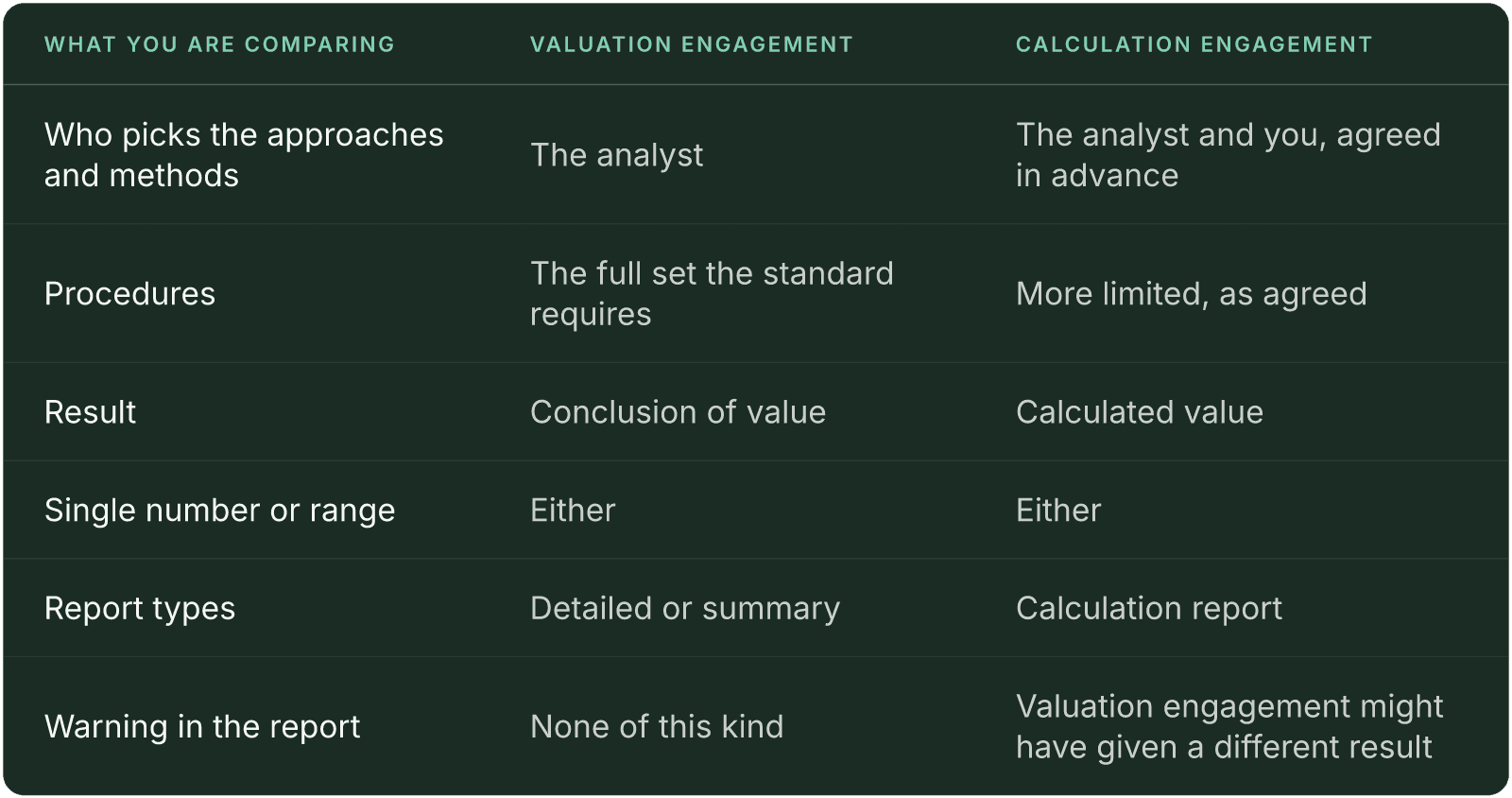
Here is how the two compare side by side.
[](https://www.409.ai/uploads/conclusion_of_value_vs_calculated_value_valuation_vs_calculation_engagement_small_business_table_1_e801fb6931.png)
The table is the whole difference in one place. The first two rows decide the work, the last three decide what you hold at the end.
Why the scope drives the price
Quotes for the same company can differ because they describe different work. Paragraph .21 says the valuation engagement calls for more procedures. More procedures mean more analyst time spent on your financial statements, your tax returns, your industry and your risk, and a report that explains each choice. A calculation engagement stops where you and the analyst agreed it would stop.
So a lower quote is not necessarily a better price for the same thing. It may be a fair price for less. Before you compare, put the same question to every firm: is this a valuation engagement or a calculation engagement, and which report will I receive?
Paragraph .17 gives you the list of what that written understanding should contain at a minimum: the nature, purpose and objective of the engagement, your responsibilities, the analyst's responsibilities, the assumptions and limiting conditions, the type of report, and the standard of value. Paragraph .12 adds that the scope includes the intended use of the report and its users. If a quote is silent on the report type, ask for it in writing. The same understanding is where the standard of value gets fixed. If your agreement says fair market value and the other side expects fair value, the [partner buyout article on the standard of value](https://www.409.ai/articles/partner-buyout-fair-market-value-vs-fair-value-small-business-standard-of-value) explains why that gap can move the price.
A worked example
Take a plumbing company owned by two partners. Partner B wants out. The buy-sell agreement says the price is "the value of the company as determined by an independent business appraiser." This is an illustration, not a real client.
Partner A orders the cheapest quote, which turns out to be a calculation engagement: Partner A and the analyst agreed on one method and one year of earnings. The calculation report comes back with a calculated value of $900,000. It carries the paragraph saying a valuation engagement might have produced a different number.
Partner B's attorney reads that paragraph and points out two things. The agreement asks for the value as determined by an appraiser, and this report is a calculation built on a method Partner A helped choose. The report itself says the result could have been different. Whether the agreement is satisfied is a question for the attorneys and the contract, not for the appraiser. But Partner A has now paid for a document that invites the argument, and may pay again for the engagement that should have come first. A conclusion of value, with the analyst's own method and reasoning, would have given both sides a number that someone with professional judgment stood behind.
None of this makes the calculation engagement a bad product. If the two owners genuinely agree on the method, for instance a quick check of a price they both already accept, a calculated value fits and costs less. The failure comes from ordering it without knowing what the other party will accept.
Who decides which one you need
You do not pick in a vacuum. The person who will rely on the number usually sets the requirement, and that person is not the appraiser. Ask three parties, in this order.
The lender. For an SBA 7(a) loan that finances the change of ownership of a business, the lender's rules decide what valuation it accepts, including who may sign. We walked through the credential list and the October 1, 2026 change in [the SBA SOP 50 10 8.1 article](https://www.409.ai/articles/sba-sop-50-10-8-1-business-valuation-change-of-ownership). The SOP names who may sign the valuation, but the engagement type the lender will take is for the lender to say. Ask for it in writing before you sign the engagement letter.
The attorney who drafted the buy-sell agreement or who represents the other partner. Read the valuation clause for the words it uses: appraisal, independent appraiser, fair market value, fair value, formula. If the clause does not say which engagement qualifies, that is worth settling before the trigger event. [The buy-sell agreement and Section 2703 article](https://www.409.ai/articles/buy-sell-agreement-price-section-2703-family-business-estate-tax) covers how the price clause is read when the IRS looks at it.
The court or the other side, in a divorce or an estate matter. An opposing expert will test the work. A conclusion of value with its reasoning on the page gives them something to test. Our [divorce valuation article](https://www.409.ai/articles/divorce-business-valuation-personal-vs-enterprise-goodwill-small-business) shows the kind of judgment calls, such as personal and enterprise goodwill, that a full engagement documents. The standard also exempts reports for certain controversy proceedings from its reporting rules (paragraph .50), so when a case is in front of a tribunal, ask your attorney what the court expects instead of assuming this page decides it.
A short list to send before you compare quotes
1. Is this a valuation engagement or a calculation engagement? 2. What will the report be called: detailed, summary or calculation report? 3. Which standard of value, which valuation date and which premise (going concern or otherwise) does the quote assume? 4. Who are the intended users of the report, and what restrictions on use will it carry? 5. Does the report give a single amount or a range? 6. Which standard does the analyst follow? The AICPA statement binds AICPA members. Other credential bodies publish their own standards, so ask.
Question 1 and question 2 should be answered in one sentence each. If a firm needs a paragraph, you have learned something about the firm.
What to do this week
Call whoever will read the number first, whether that is the lender, the partner's attorney or the CPA preparing the return, and ask which engagement type and which report they will accept. Then send that answer to every firm you are collecting quotes from. You will find the quotes line up much better, because you will finally be comparing the same work.
If you need a fair market value report for a loan, a buy-sell or a partner buyout, [409.AI's small-business valuation](https://www.409.ai/products/smb-valuation) starts from $899. And if you are still sorting out what drives the number itself, [the piece on which years of earnings an appraiser uses](https://www.409.ai/articles/which-years-of-earnings-small-business-appraisal-weighted-average-trend) is a good place to continue.