Financial Reporting
Changing Your Fund's Valuation Provider at Year End: The Bridge and the Footnote
Fund CFOs replacing a Level 3 valuation provider before December 31: how ASC 820 treats a change in technique, the footnote, and the bridge your auditor wants.
By 409.AI Team - 2026-11-16
# Changing Your Fund's Valuation Provider at Year End: The Bridge and the Footnote
If you are the CFO or controller of a venture or growth-equity fund and you have decided that a new firm will value your Level 3 positions at December 31, the hard part is not picking the firm. It is explaining to your auditor, in February, why a position the old provider marked at $12.0 million on September 30 now sits at $10.5 million, and how much of that move is the company and how much is the new firm's method.
ASC 820 has a clear answer for the accounting. It says much less about the file. This article covers both: what the standard does with a change in technique, what the footnote has to say, and what to write into the new provider's engagement so the year-end audit doesn't turn into a reconciliation project.
Why Q4 is when funds switch
Provider changes cluster at year end for practical reasons. The annual audit is the one moment when every mark is tested, so a fund that was unhappy with turnaround, documentation or how a prior mark held up under questioning tends to act before the December 31 work starts. A new fund administrator, a first external audit, or an SEC exam finding on the valuation process can force the same decision.
The timing creates a specific risk. The September 30 marks were set under one firm's methods. The December 31 marks will be set under another's. If nobody separates the two effects, the quarter-on-quarter change in every position becomes one unexplained number, and the auditor has to pull it apart for you.
What ASC 820 says about a change in technique
ASC 820 expects consistency. Paragraphs 820-10-35-25 and 35-26 ask a reporting entity to apply its valuation techniques consistently, and allow a change in a technique, or in how it is applied, when the change results in a measurement that better represents fair value. PwC's fair value guide (section 4.4, updated July 2026) lists the usual reasons: new markets develop, new information becomes available, information previously used is no longer available, techniques improve, or market conditions change. A change in how much weight each technique receives when several are used counts too.
The accounting consequence is in the same passage. In [PwC's words](https://viewpoint.pwc.com/dt/us/en/pwc/accounting_guides/fair_value_measureme/fair_value_measureme__9_US/chapter_4_concepts_u_US/44_valuation_approac_US.html), "Revised valuations resulting from a change in the valuation technique or its application are accounted for as a change in accounting estimate," affecting the current period and future periods. There is no restatement of the September 30 marks. The difference runs through the fund's unrealized gain or loss for the period in which the new technique is first applied.
Two points follow for a fund changing firms.
First, a new provider is not by itself a change in technique. If the new firm applies the same approach your policy already describes (say, a market approach calibrated to the last round, rolled forward with peer multiples), the mark simply moves with its inputs. A change in technique is a change in method: moving from a calibrated backsolve to a weighted blend with a revenue-multiple method, adding a scenario analysis for a company close to an exit, switching an option pricing model, or changing the weights between methods.
Second, "better represents fair value" is the test the change has to pass, and it is your fund's judgment, not the provider's. The memo that supports the December 31 marks should say, position by position where it applies, why the new technique is the better measure now. "The new firm prefers it" is not a reason an auditor will accept.
What the footnote has to say
ASC 820-10-50-2(bbb) requires, for recurring and nonrecurring Level 2 and Level 3 measurements, a description of the valuation techniques and inputs used, and, where there has been a change in valuation approach or technique, disclosure of the change and the reason for making it. PwC's financial statement presentation guide ([FSP 20.3.2.1](https://viewpoint.pwc.com/dt/us/en/pwc/accounting_guides/financial_statement_/financial_statement___18_US/chapter_20_fair_valu_US/203_disclosure_US.html)) adds two practical limits that matter to a private fund:
- The change is disclosed **by class of instrument**, not for each investment.
- A fund may limit the disclosure to changes from its **established valuation policy**. If the policy already contemplates both techniques (for example, a recent transaction price when one exists and an income approach when none does), moving between them is not a disclosed change.
That second point is the reason to read your valuation policy before the new firm starts work. If the policy names the techniques the new provider plans to use and the circumstances for each, most position-level changes are applications of the policy, and the footnote stays short. If the policy is silent, the change belongs in the footnote, and the policy probably needs an update approved before year end. [What a private fund's Level 3 footnote must say](https://www.409.ai/articles/asc-820-level-3-footnote-private-fund-asu-2018-13-nonpublic) covers the rest of the disclosure set and the relief a nonpublic entity gets.
The bridge: separating the company from the method
Here is the piece the standard does not prescribe and your auditor will want anyway. Our recommendation: ask the new provider for a position-by-position bridge from the old provider's September 30 mark to its own December 31 mark, with the movement split into two lines. One line is what the inputs did. The other is what the change in technique did.
The way to get that split is to run the prior technique at December 31 with December 31 inputs. That intermediate number is the mark the old method would have produced at year end. Everything between the September 30 mark and that number is the company and the market. Everything between that number and the final mark is the method.
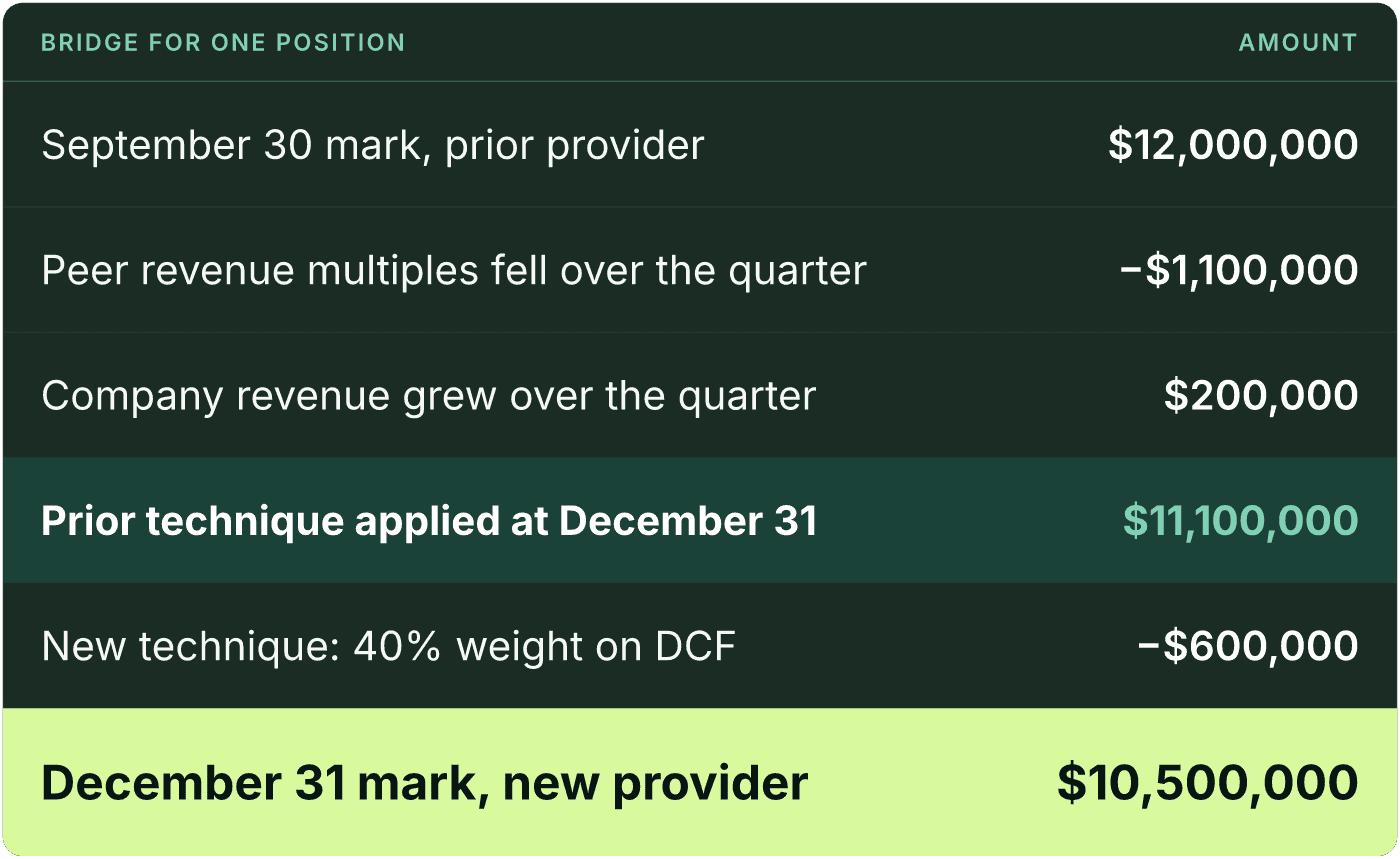
An illustrative example. A fund holds Series B preferred in a software company. On September 30 the old provider marked it at $12.0 million, calibrated to the round and rolled forward with peer revenue multiples. At December 31 the new firm keeps the calibrated market method but also weights a discounted cash flow at 40%, because the company has now published a two-year plan the fund has tested against actuals.
[](https://www.409.ai/uploads/change_fund_valuation_provider_year_end_asc_820_change_in_estimate_bridge_footnote_table_1_ef74f33bdb.png)
The $900,000 drop in the first block would have happened with either firm. The $600,000 in the second block is the change in estimate, and it is the number the "better represents fair value" memo has to defend. Without the bridge, the auditor sees a $1.5 million decline and has to ask which part is which. With it, the questions go to the right line.
A bridge also protects the fund in the other direction. If the new technique produces a higher mark, the auditor will look harder at it, not less, because an upward change in method at the same time as a change in provider can look like shopping for a number. A clean split that shows most of the increase came from inputs is the best answer to that question.
What to write into the new provider's scope
Asking for the bridge after the fieldwork has started is expensive. Put it in the engagement letter, together with the things that make it possible.
1. The prior file. The new firm needs the old provider's September 30 reports, including the models and the inputs, not only the summary values. Check your old engagement letter for who owns the models and request them before the relationship ends. 2. The bridge itself. Position by position, September 30 to December 31, with the input effect and the technique effect on separate lines, and the prior technique re-run at December 31 for every position where the technique changed. 3. The reason for each change. A short paragraph per changed position, written against the "better represents fair value" test, that your valuation committee can adopt as its own. 4. Calibration at entry. For positions bought during the year, the calibration of the new technique to the transaction price. Our guide to [calibrating peer multiples to your entry price](https://www.409.ai/articles/peer-multiples-fund-level-3-mark-calibrate-entry-price-asc-820) shows what that looks like. 5. The specialist file. Credentials, independence and the work papers your auditor will ask for about a new management's specialist. [What the auditor tests about an outside specialist](https://www.409.ai/articles/fund-valuation-firm-sas-143-auditor-tests-management-specialist-file) lists them. 6. The calendar. A draft date that leaves time for your committee and for the auditor before the deadline that binds you. For an adviser relying on audited financials under the custody rule, that is typically 120 days after year end; [back-planning from April 30](https://www.409.ai/articles/custody-rule-120-day-audit-deadline-fund-year-end-marks) sets the dates.
Scope also drives the quote. ASC 820 work is priced on the number of positions, their complexity and how often they are marked, so a first engagement that includes a bridge for every position is larger than a steady-state quarter. [How a fund buys its first Level 3 valuation](https://www.409.ai/articles/how-fund-buys-first-level-3-valuation-asc-820-scope-quote-december-31-file) walks through what a firm needs before it can quote.
What the auditor will look at
Under the auditing standard on accounting estimates (SAS 143, effective for periods ending on or after December 15, 2023), the audit team assesses the fund's process for making estimates and may look back at how prior-period estimates turned out. A [Texas Society of CPAs summary](https://www.tx.cpa/news/todays-cpa-magazine/current-issue/article/may-june-2024/2024/05/10/cpe--sas-143---new-guidance-on-auditor-s-responsibilities-relating-to-accounting-estimates) notes that such a retrospective review "is not intended to call into question judgments about previous-period estimates," but a difference can lead the auditor to question management's process. A change of provider puts exactly that question on the table: if the old marks were wrong, why, and what changed in the process?
The bridge answers it with evidence instead of narrative. If most of the movement is input-driven, the old marks held up and the process changed for other reasons (turnaround, documentation, coverage). If the technique line is large, the memo explains why the new measure is better, and your [valuation policy](https://www.409.ai/articles/fund-valuation-policy-asc-820-audit-sec-exam) shows the committee approved it. Either way, keep the old provider's reports in the file; a later [back-test of marks against exit prices](https://www.409.ai/articles/back-testing-fund-marks-exit-prices-asc-820-disposition-analysis) will use both.
The takeaway for this year end
Before the new firm opens a model, do three things: read your valuation policy against the techniques the new firm will use, get the old provider's September 30 models into your hands, and write the position-by-position bridge into the engagement letter. ASC 820 treats the switch as a change in estimate with no restatement, and the footnote may be one sentence or none. The bridge is what turns a provider change from an audit finding into a footnote.
409.AI values Level 3 portfolios for funds and scopes each engagement by positions and frequency; the [ASC 820 valuation page](https://www.409.ai/products/asc-820) describes the work.