Financial Reporting
CEIV Is Gone: What to Ask a Valuation Firm About Its Level 3 Work File
Fund CFOs choosing a provider for December 31 Level 3 marks: the CEIV is gone; ask which documentation framework the work file follows under the 2026 VPF draft.
By 409.AI Team - 2026-11-23
# CEIV Is Gone: What to Ask a Valuation Firm About Its Level 3 Work File
If you're the CFO of an emerging venture or private equity fund picking a valuation firm for your December 31 marks, you have probably read a few biographies by now. Some still list the CEIV, the Certified in Entity and Intangible Valuations credential built for fair value work in financial reporting. That credential was discontinued in 2023. The framework that sat behind it has not gone away. It has been rewritten, and the rewrite is a better scoping tool for your first audit than any letters after a name.
In September 2026 the AICPA, the American Society of Appraisers and RICS published the [Valuation Performance Framework (VPF) exposure draft](https://assets.ctfassets.net/rb9cdnjh59cm/2azhNx16Sfoni1J7WQxHzp/fcd379fccccd595c8e48799cfb610525/Valuation_Performance_Framework_Exposure_Draft.pdf), subtitled "Documentation Guidance to Support Fair Value Measurements for Financial Reporting". Comments are open [until December 22, 2026](https://www.aicpa-cima.com/news/article/aicpa-asa-and-rics-seek-public-comment-on-proposed-valuation-performance-framework). It is a draft and its wording can change. But it already tells you what a supportable fair value file looks like, which is exactly what you're buying.
What happened to the CEIV and the MPF
The CEIV came out of the SEC's comments in 2011 and 2013 on how fragmented the valuation profession was. Alongside it, the profession issued the Mandatory Performance Framework in January 2017 (MPF 2017), the first document to say how much work goes into a fair value analysis and what the file must contain. Appendix I of the VPF draft sets out the history: adherence to MPF 2017 was mandatory only for CEIV holders, but many firms doing US GAAP fair value work adopted it anyway. After the credential was discontinued in 2023, the original stakeholders backed an update. The VPF is that update, re-issued under a new name and meant as best practice for outside firms and in-house valuation staff alike.
So the useful question has moved. It used to be "does anyone on the team hold the CEIV?" Now it's "which documentation framework does your work file follow, and can you show me?"
Which framework covers a fund's positions
Here is the part most provider conversations skip. The VPF's own scope (paragraph 1.4) is fair value measurements of businesses, business interests, intangible assets, inventory and contract liabilities. Most of what a venture or growth fund holds, though, is a set of financial instruments: preferred shares, convertible notes, SAFEs, warrants, loans.
For those, the draft points to a second document. The Financial Instruments Performance Framework (FIPF), issued by the AICPA in 2019 for its CVFI credential, sets scope of work and documentation for financial instruments. Paragraph 1.14 of the VPF says a professional valuing financial instruments should adhere to the FIPF, and the introduction says the FIPF's documentation guidance may be used together with the VPF when appropriate, because the two share the same general principles.
For a fund CFO that means a good answer to "which framework?" usually names both: the FIPF for the instruments themselves, and the VPF for the parts that are really business valuation (the enterprise value behind a preferred share, the discount rate in a DCF, the multiples) plus the new sections described below. A firm that answers with neither has told you something too.
The three parts of the file your auditor will lean on
Your auditor's valuation specialist tests your provider's work as part of the audit (we covered how in our piece on [what the auditor tests about an outside specialist](https://www.409.ai/articles/fund-valuation-firm-sas-143-auditor-tests-management-specialist-file)). The more of the file that specialist can rely on, the fewer questions come back in February. Three parts of the VPF draft map directly onto what gets tested.
The work file must stand on its own
The Guiding Documentation Principle (section 5) says the file should be clear enough that an experienced professional who was not on the engagement can understand the key inputs, the methods, the outputs and how they support the conclusion. Paragraph 5.6 asks the file to identify each key assumption, who developed it (management, the provider, a specialist) and why it was used. Source documents that point the other way, contrary evidence, belong in the file too, with an explanation of how they were weighed.
That last point matters for a fund. If a portfolio company sold a small block on the secondary market below your mark, a file built this way shows it and explains it, instead of leaving your auditor to find it.
Calibration has to be documented, not asserted
Section 6.1.1 says calibration is required when the entry price was fair value and the same position is measured at fair value later, and it gives portfolio investments as the typical example. The file should document the rationale for the calibrated inputs at entry and at each later date, and the reason for any change in method. If you have read our guide to [calibrating peer multiples to your entry price](https://www.409.ai/articles/peer-multiples-fund-level-3-mark-calibrate-entry-price-asc-820), this is the same discipline, now written down as a documentation baseline.
Internal consistency and reconciliation (section 6.4)
This section is new compared with MPF 2017, and it reads like a list of audit comments. Among its items: reconcile to observable indications of value and calibrate where relevant; check that the currency of the forecast matches the currency of the discount rate; reconcile a DCF result with transaction prices for the same interest, secondary prices included; compare with previous measurements of the same position and watch trends in key assumptions across recurring valuations; and explain any contrary evidence. Paragraph 6.4.3 asks the file to document how each of these was addressed.
One item deserves a worked example. Item (j) says that when value indications diverge significantly, a simple average should not be used by default.
A worked example: two methods that disagree
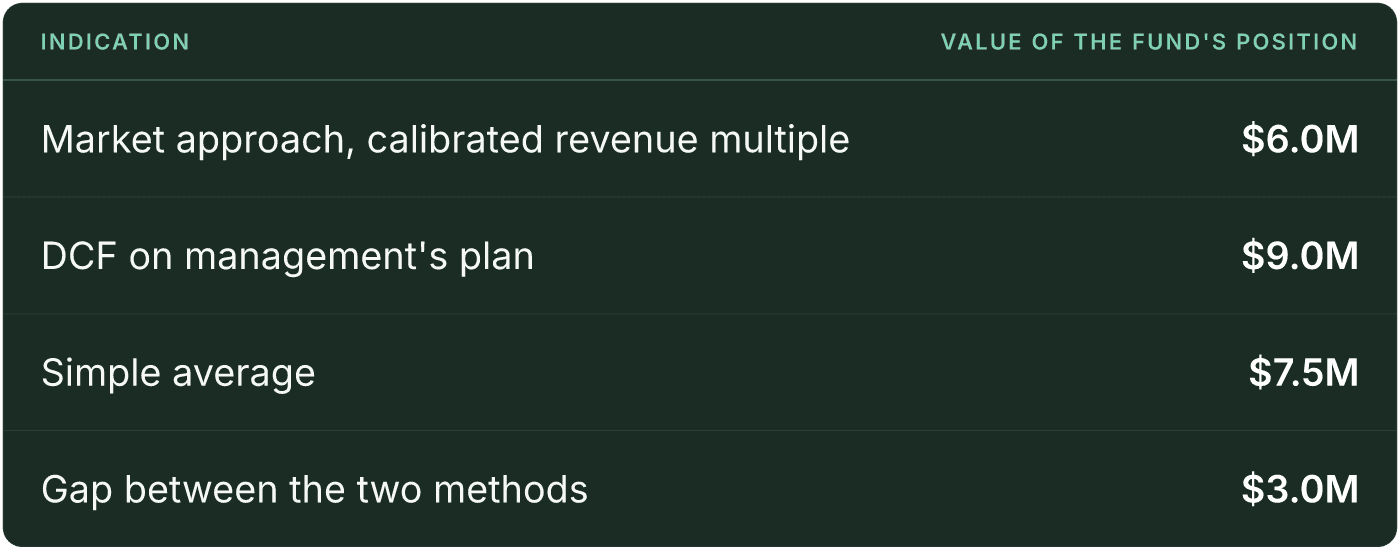
Say your fund holds Series A preferred in a software company. The provider runs a market approach on revenue multiples and a DCF on management's plan. The table below shows what happens when the two are split down the middle.
[](https://www.409.ai/uploads/ceiv_discontinued_vpf_exposure_draft_fund_level_3_valuation_provider_work_file_table_1_799d3ceef8.png)
A $3.0 million gap on a $6.0 million indication is 50%. Under section 6.4 that gap is contrary evidence, not a rounding question. The provider should go back to the inputs: is the plan optimistic against the company's history (our piece on [haircutting a portfolio company's plan](https://www.409.ai/articles/management-forecast-fund-level-3-mark-asc-820-haircut-plan-back-test) shows how to test that), or are the peer multiples stale? The $7.5 million average may even land in the right place, but a file that reaches it by averaging gives your auditor nothing to rely on. A file that explains why one method carries more weight does.
AI and technology tools (section 7)
Section 7 is the other new piece. The draft notes that firms are exploring AI for research, data gathering, data input, analysis and report writing, and it says the valuation professional stays fully responsible for the conclusion and cannot hand any of it to a tool. The work file should let an experienced reviewer see how far the tools were used, what procedures checked their data, process or output, and what judgment supported relying on them. The checking should be in proportion to the reliance. Disclosure in the engagement letter and the report follows regulation, professional guidance, the client contract and firm policy, and the draft calls this an evolving area.
409.AI drafts its reports with AI and has valuation experts review and certify each one, so this is a question we expect to be asked, and you should ask every firm on your shortlist. An answer like "we use software, but we review it" isn't documentation. Ask to see where the file records it.
Questions to put to every provider
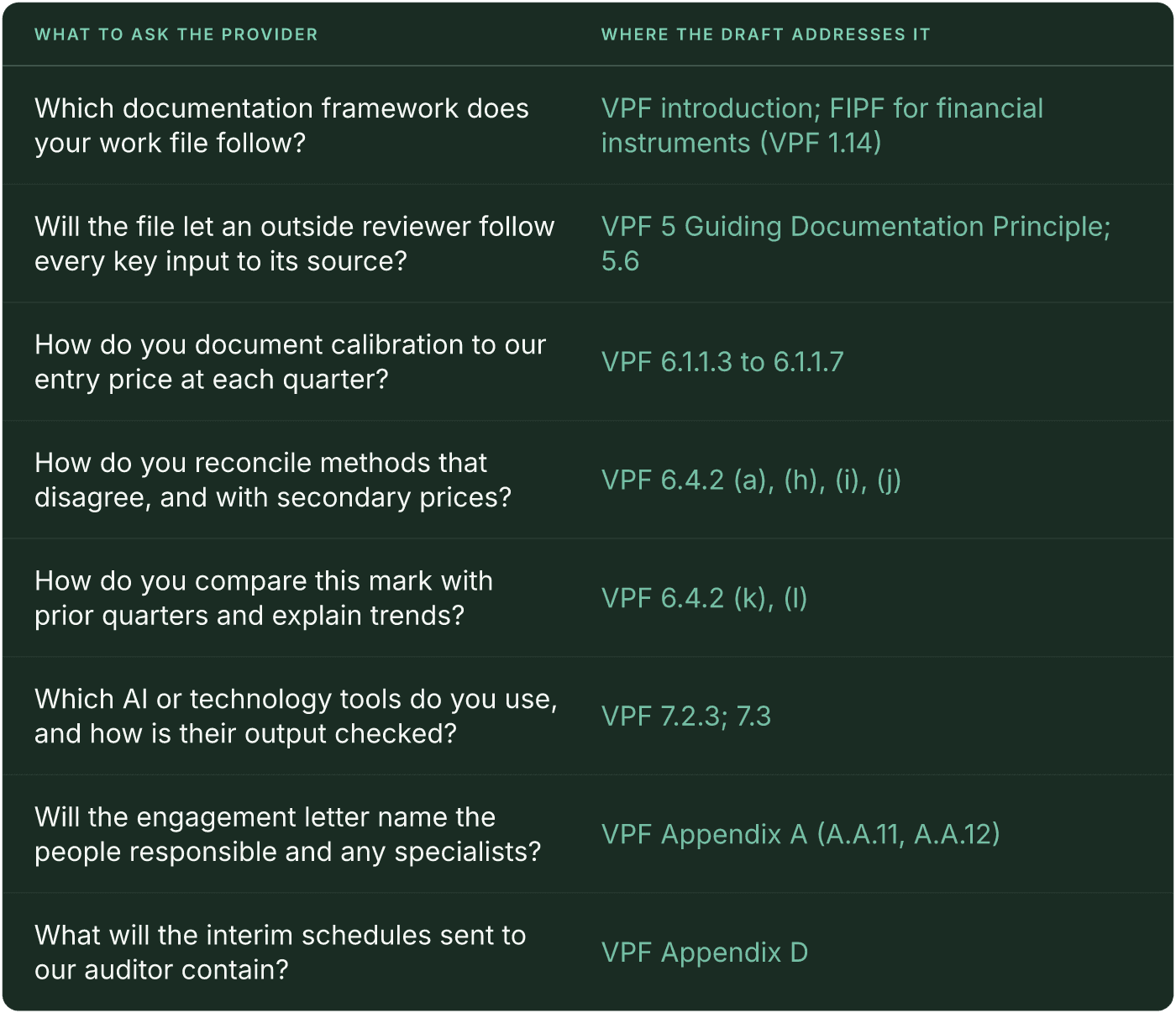
Use the list below in your scoping call and your engagement letter. The right-hand column tells you where in the draft the expectation comes from, so you can check the answer.
[](https://www.409.ai/uploads/ceiv_discontinued_vpf_exposure_draft_fund_level_3_valuation_provider_work_file_table_2_47950db77f.png)
None of these questions needs a credential to answer. They need a provider whose file is built for review. Pair them with the practical items in our guide to [how a fund buys its first Level 3 valuation](https://www.409.ai/articles/how-fund-buys-first-level-3-valuation-asc-820-scope-quote-december-31-file) (positions, documents, the audit calendar) and you have a scope your auditor can plan around. If your marks are currently computed by your administrator or in-house, the same list applies: the VPF says it is best practice for internal valuation staff as well (Appendix E), and our comparison of [administrator, in-house and independent marks](https://www.409.ai/articles/fund-level-3-valuation-administrator-in-house-independent-firm-sec-exam-file) covers the trade-offs.
What to do before you sign
Send the eight questions to each firm on your shortlist this week and ask for a redacted sample of interim schedules, not just a sample report. Read the sample against section 6.4: can you see a reconciliation to the entry price, a comparison with the prior quarter and an explanation of any gap between methods? If you can't find them in a sample, you won't find them in February either.
If you'd like to see how we scope a fund's December 31 file, our [ASC 820 portfolio valuation](https://www.409.ai/products/asc-820) page explains the engagement and you can book a call there.