Education
Cash-Free, Debt-Free: Why Your Sale Price Is Not the Check You Get
A cash-free, debt-free price is not the check you receive. Owners with an LOI see how debt, debt-like items and working capital turn a $4M price into $3.6M.
By 409.AI Team - 2026-11-03
# Cash-Free, Debt-Free: Why Your Sale Price Is Not the Check You Get
You signed a letter of intent for $4,000,000. At closing, the wire that lands in your account is $3,592,000. The buyer didn't renegotiate, and nothing went wrong with the business. The LOI said "on a cash-free, debt-free basis," and those five words turn the headline into a starting point.
This article is for the owner of a profitable small business with a signed or pending LOI, and for the CPA or business broker who reviews the price mechanics before the purchase agreement is drafted. It walks from the headline number to the cash that reaches you, one step at a time, and ends with the list of items worth defining before anyone writes a contract.
What "cash-free, debt-free" means
A cash-free, debt-free price is an enterprise value: the price of the business itself, separate from the cash it holds and the money it owes. It does not say the company can have no cash or no debt. Orrick's deal lawyers explain it as a way to [isolate the negotiated price from any cash, which would raise it, and any debt or debt-like items, which would lower it](https://www.orrick.com/en/tech-studio/insights/What-Does-Cash-Free-Debt-Free-Mean). In practice the seller gets an upward adjustment for cash on hand and a downward adjustment for debt at closing.
In a small deal, the cash part is often handled more simply. The owner takes the cash out before closing, or the agreement pays for it dollar for dollar. Either way the result is the same: the cash is yours, and the buyer pays for the business without it.
The debt part is where owners get surprised. The buyer isn't taking over your loans. They're paying you for a business that is free of them, so every dollar you owe lenders is paid from your proceeds at closing, usually straight to the lender by the closing agent.
From the headline to the check
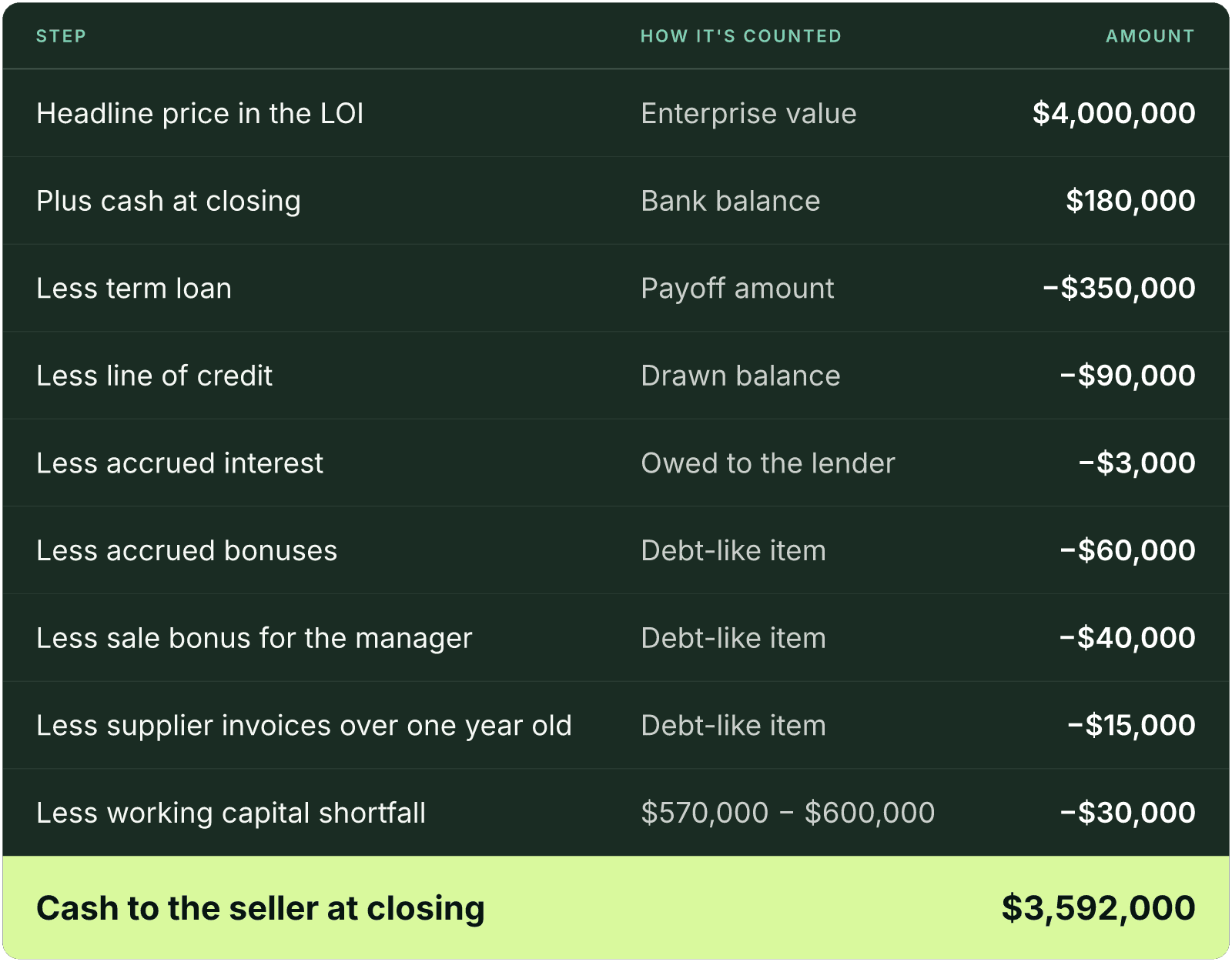
Here is a worked example. A small services company has an LOI at $4,000,000. On the closing date it has $180,000 in the bank, a term loan of $350,000, a line of credit drawn for $90,000 and $3,000 of accrued interest. It also owes $60,000 in accrued bonuses, a $40,000 sale bonus promised to its operations manager, and $15,000 in supplier invoices that are more than a year old. The peg for working capital is $600,000, and the company delivers $570,000. All figures are illustrative.
[](https://www.409.ai/uploads/cash_free_debt_free_small_business_sale_price_to_closing_proceeds_table_1_adde080e24.png)
The check is $408,000, or 10.2 percent, below the headline. The gap has three parts: $443,000 of borrowed money and interest, $115,000 of items that are not loans at all, and a $30,000 working capital shortfall, less the $180,000 of cash you keep. $145,000 of that never touched a lender. None of it is a penalty. It is the price of delivering the business free of what the buyer would otherwise inherit.
The point of the table is the order of the steps. An owner who prices the sale in their head as "four million" and then plans taxes, a new home or a retirement account on that number is short by the time the money arrives.
Debt-like items: liabilities that act like loans
The deduction owners rarely see coming is the debt-like item. These are liabilities that aren't borrowed money but that the buyer treats as one, because they will have to pay them after closing for a period the seller operated. BDO's transaction advisors list the usual candidates: [accounts payable aged over one year, bonuses and accrued profit sharing, change-in-control payments and transaction-related liabilities](https://www.bdo.com/insights/advisory/importance-of-net-working-capital-nwc-in-m-a). Like working capital, they carry a dollar-for-dollar effect on the price.
Orrick adds that the list is a negotiated term and not a fixed one. Pre-closing taxes, deferred revenue (often the long-term part), and employee-related accruals such as severance can all be pulled into the category. The reason is simple. A buyer wants the price not to be diluted by liabilities it takes on, and every item on the list is a place where the buyer and the seller disagree about who earned the obligation.
Look at your own balance sheet for these:
- **Bonuses and commissions earned this year but paid next year.** If the business pays year-end bonuses in January and closes in November, most of the year's bonus pool is owed for work done under your ownership.
- **Payments triggered by the sale itself.** A promised sale bonus or a change-in-control payment exists only because of the deal, so the buyer will want it deducted.
- **Your own deal costs.** Broker fees, legal fees and accounting fees for the sale are yours. If the company is billed for them and they're unpaid at closing, they come off the price.
- **Taxes for periods before closing.** Taxes owed for the time you owned the company can count as debt-like. How your sale is taxed is a separate question for your CPA. Our article on [how Form 8594 splits the price](https://www.409.ai/articles/form-8594-asset-allocation-small-business-sale) covers the allocation side.
- **Customer deposits and deferred revenue.** The customer paid you, you kept the cash, and the buyer now owes the work. Some agreements count the full balance as debt-like, some only the long-term part, and some count none of it.
- **Stale payables.** Invoices you haven't paid in over a year look like a loan from a supplier.
- **Owner and family balances.** Money the company owes you, or a relative, usually gets settled or removed before closing.
If seller financing is part of the deal, the structure changes the cash you receive on closing day. We looked at what that note is worth in [seller financing a business sale](https://www.409.ai/articles/seller-financed-business-sale-note-value-installment-sale-imputed-interest).
One liability, one list
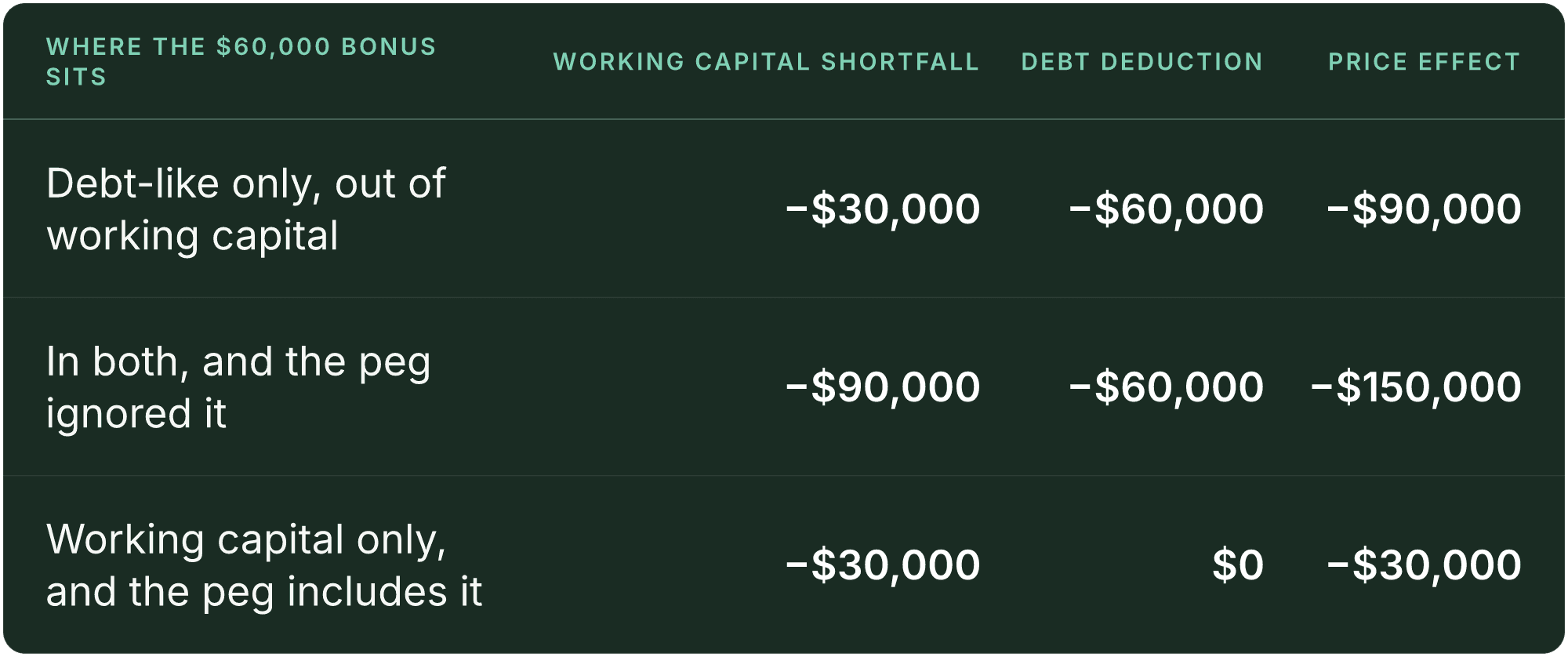
The most expensive mistake in this part of the contract is counting the same liability twice. Working capital is defined as current assets minus current liabilities, with cash and debt taken out. A bonus accrual is a current liability, so it sits in working capital unless the agreement says otherwise. If the agreement also lists accrued bonuses as debt-like, the buyer deducts it once as debt and again when the working capital shortfall is measured.
In our example, take the $60,000 bonus accrual, and compare three ways to write the same agreement.
[](https://www.409.ai/uploads/cash_free_debt_free_small_business_sale_price_to_closing_proceeds_table_2_fc3dd81177.png)
Against the $30,000 base shortfall, the same bonus costs the seller $60,000, $120,000 or nothing more, in the table's order, depending only on wording. The third row isn't automatically fair, because the peg is lower by $60,000 and the buyer has chosen that trade. The second row is the one to refuse: the peg was built without the accrual, the closing balance sheet includes it, and the debt list takes it a second time.
The rule is easy to say and easy to put in a contract. A liability appears in the debt-like list or in working capital, never in both, and the peg is built on the same definition the closing statement will use. The [working capital peg article](https://www.409.ai/articles/working-capital-peg-small-business-sale-closing-price-adjustment) walks through how the peg itself is set.
Cash is not always yours to keep
Owners hear "cash-free" and assume every dollar in the bank is theirs. Mostly it is, with two exceptions worth a conversation with the buyer.
The first is cash the business needs to run. A restaurant's till float, a customer's prepayment sitting in the account, or payroll funds already earmarked for the next Friday aren't free to sweep. Some agreements limit how much cash counts for the seller, so ask how the buyer defines it. The second is a business with so much surplus that the buyer hasn't priced it in. Our piece on [excess cash and non-operating assets](https://www.409.ai/articles/excess-cash-non-operating-assets-small-business-valuation-owner-balance-sheet) shows how an appraiser separates what the business needs from what it merely holds.
Why the headline was not the value
An LOI price usually comes from a multiple of earnings. Whether that multiple was applied to seller's discretionary earnings or to EBITDA changes the number, as we explained in [owner pay and add-backs](https://www.409.ai/articles/owner-compensation-add-backs-small-business-valuation-sde-ebitda). A multiple like those in [rule-of-thumb pricing](https://www.409.ai/articles/rule-of-thumb-multiples-vs-appraisal-small-business-valuation-sde) says nothing about what is on the balance sheet. That is why the cash-free, debt-free language exists: the earnings multiple prices the business, and the closing statement settles everything around it.
It also means the buyer's definition of debt-like items is a pricing lever. A buyer who agrees to your headline and then widens the list by $200,000 has changed the price as much as one who asked for a lower multiple, and has done it in a definition most owners read last.
What to define before the purchase agreement
Treat the LOI as the cheapest moment to fix these. Once the purchase agreement is drafted, the buyer's lawyers hold the pen.
1. Ask the LOI to say "debt-like items" means a named list. A phrase such as "and other items as agreed" is an open door. 2. Build your own closing walk now. Take last month's balance sheet and run the table above with your numbers. If the check is more than 5 percent under the headline, you want to know that before you commit to a move, a house or a payoff plan. 3. Pick the owner of each liability. For every accrual, decide whether it is debt-like or working capital, and confirm the peg uses the same choice. 4. Settle deal costs and sale bonuses on paper. Decide who pays your broker, your lawyer and any manager with a sale bonus, and whether the company's books carry them. 5. Ask for a sample closing statement as an exhibit. If both sides have signed a worked example with real account balances, a dispute after closing has a reference point. 6. Show your CPA the walk before you sign. The tax result depends on how the final price is split, and an adjustment after closing moves that split.
The headline is what a buyer will pay for the business. The check is what is left after the business is handed over without its debts, and those are different numbers by a margin you can estimate today. If you want an independent view of what your business earns and what it is worth before you negotiate, our [small business valuation](https://www.409.ai/products/smb-valuation) starts at $899.