Financial Reporting
Cash-Basis Books in a Small Business Valuation: Why Tax Return Earnings Need Adjusting
Cash-basis tax returns can misstate small business earnings. See how an appraiser converts to accrual, with a worked example, for owners, CPAs and lenders.
By 409.AI Team - 2026-10-21
# Cash-Basis Books in a Small Business Valuation: Why Tax Return Earnings Need Adjusting
If your accountant prepares your tax return on the cash method, the profit on that return can sit a long way from what the business actually earned. A bank asking for an appraisal, a partner buying you out, a divorce court or a buyer will all start from your financials. If those financials count cash when it moves instead of when it is earned, the appraiser has to rebuild them before any multiple is applied.
This article is for owners of small private companies and the CPAs, attorneys, brokers and lenders beside them. It explains what the cash method leaves out, how an appraiser converts the numbers, and what to hand over so the adjustment is quick and defensible. It is general information, not tax or legal advice, and every figure below is made up.
Why many small companies are on the cash method
The cash method is simple. Income counts when the money arrives and expenses count when the bill is paid. IRS Publication 538 describes the accrual method as the opposite: income is generally reported in the year it is earned and expenses are deducted or capitalized in the year they are incurred, [with the purpose of matching income and expenses in the correct year](https://www.irs.gov/publications/p538).
Not every company gets to choose. Under [Internal Revenue Code section 448](https://www.law.cornell.edu/uscode/text/26/448), a C corporation, a partnership with a C corporation partner and a tax shelter generally cannot use the cash method. There is an exception for a company whose average annual gross receipts for the three prior tax years stay under $25 million, a figure that is adjusted for inflation each year and rounded to the nearest million. Most owner-run businesses sit far below it, and an S corporation or a sole proprietorship was never caught by the rule in the first place.
Inventory adds a wrinkle. Publication 538 says that if an inventory is necessary to account for your income, you must use an accrual method for purchases and sales, with a small business exception that lets a qualifying company choose not to keep an inventory. A distributor can therefore file a return that looks cash-basis on its face while still carrying product costs.
None of this means the books are wrong. A cash-basis return is a legitimate way to measure taxable income. The trouble starts when that same document is used to measure value, because value depends on what the business earns over time, not on when customers happen to pay.
What the cash method hides
Three items move earnings between periods without changing what the business did.
Receivables. A contractor finishes $80,000 of work in December and gets paid in January. On a cash return, that income belongs to next year. The work was done this year, with this year's labor and materials.
Payables. If the company runs up $50,000 in unpaid supplier bills at year end, the cash return shows a better year than the accrual version, because the expense lands when the check clears.
Prepaid and deferred items. An annual insurance premium paid in December is deducted in full on the cash return, even though half of it covers the following year. Customer deposits taken before the work starts do the reverse: cash arrives, income is not earned yet.
The IRS framework for valuing closely held companies points at the same issue without using the words cash or accrual. [Revenue Ruling 59-60](https://www.irs.gov/pub/irs-tege/rr59-60.pdf) tells the appraiser to weigh earning capacity, and warns against mechanical shortcuts. It also asks for balance sheets and a look at working capital. Our walkthrough of [what the IRS weighs in your company's value](https://www.409.ai/articles/revenue-ruling-59-60-small-business-valuation-eight-factors) covers all eight factors. A cash return gives you neither a receivables balance nor a payables balance on its face, so the appraiser has to go find them.
A worked example
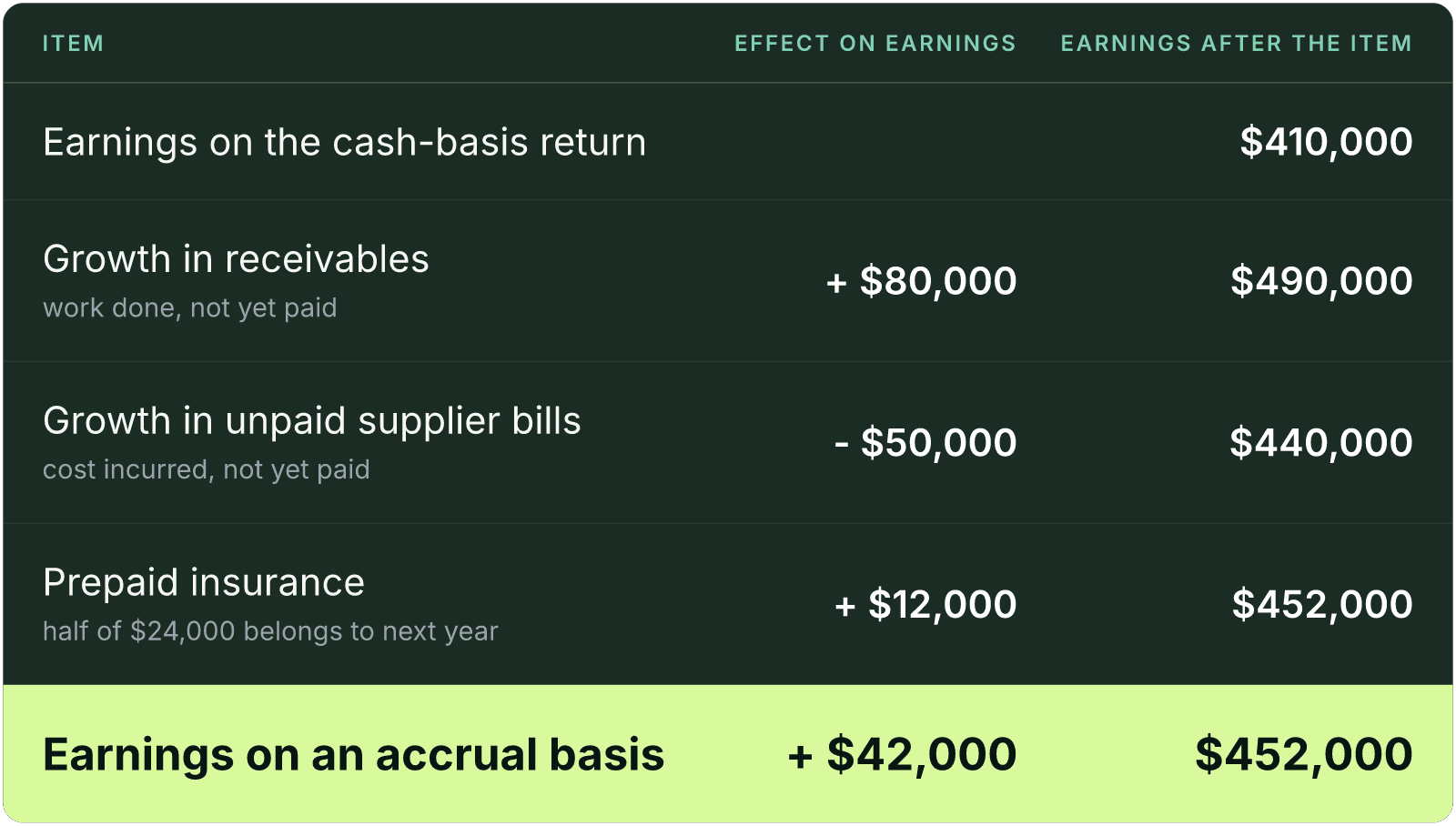
A plumbing company files on the cash method. Its tax return, after adding back the owner's pay and one-time items, shows $410,000 of earnings. The appraiser asks for the year-end receivables list, the unpaid supplier bills and the insurance schedule.
Receivables grew by $80,000 during the year because a large commercial job was billed in December. Unpaid supplier bills rose by $50,000. The owner paid a $24,000 annual insurance premium in December, and half of it covers the next year.
[](https://www.409.ai/uploads/cash_basis_vs_accrual_small_business_valuation_tax_return_earnings_table_1_a9b57628b2.png)
The accrual figure is $42,000 higher. If a market multiple of 3.0 times earnings applies, which is an assumption for the example, the cash-basis return understates value by $126,000. Read the same way in a year when receivables shrank, the adjustment would run the other direction and the return would overstate it.
That swing is why an appraiser will not apply a multiple to a cash return unannotated. Our piece on [owner pay, SDE and EBITDA](https://www.409.ai/articles/owner-compensation-add-backs-small-business-valuation-sde-ebitda) covers the first set of adjustments. The cash-to-accrual step belongs right beside it, and the two should be done in a consistent order so nothing is counted twice.
Growth hides the problem, and so does decline
A steady business with stable receivables and payables sees little difference between the two methods, because the year-start and year-end balances roughly cancel. The gap opens when the business is changing.
A fast-growing company usually shows more receivables at year end than at the start, so a cash return understates its earnings. A shrinking company collects old receivables while billing less, so the cash return can flatter a business that is sliding. A buyer or lender who sees only the cash-basis profit in the shrinking case is being shown a better picture than the facts support.
The same logic applies to a company that changed its collection habits, for example by moving from net-60 to net-15 terms or by offering a discount for early payment. Cash arrives sooner, a single year of cash-basis income gets a one-time lift, and nothing about the underlying earning power improved. Customer terms are also worth a look alongside [customer concentration](https://www.409.ai/articles/customer-concentration-small-business-valuation-largest-customer-risk), since one large slow-paying customer can distort receivables by itself.
If the company changes its method
Sometimes the move to accrual is not a valuation exercise but a tax one: the company outgrows the gross receipts test or takes on inventory. Publication 538 says a company that fails the test must change to an accrual method, and an accounting method change generally needs IRS approval through Form 3115.
The change carries a catch worth knowing about. The Form 3115 instructions describe a section 481(a) adjustment, spread over one tax year for a negative adjustment and over four tax years, the year of change and the next three, for a positive one. A positive adjustment means more taxable income is recognized as the old and new methods catch up. A buyer or lender reviewing the company should know whether a catch-up is still running, because it adds to future tax bills without adding to future cash earnings.
If a sale is planned, ask your CPA before the year of the sale rather than during it. The tax and legal calls on this are theirs, not an appraiser's.
What to bring to the appraiser
You can shorten the adjustment by assembling a handful of documents at the start:
- The last three tax returns, in full, and the year-to-date financials.
- An accounts receivable aging report and an accounts payable aging report as of each year end, and as of the valuation date.
- A schedule of prepaid expenses and of customer deposits or deferred revenue.
- Inventory counts and the method used to value them, if the company carries stock.
- A note on any change in customer payment terms or supplier terms in the last two years.
With those, the appraiser can rebuild accrual earnings for each year and see the trend instead of a single filing. Lenders have their own reasons to ask: the SBA's rule changes on change-of-ownership valuations, which we explain in [The $250,000 Exception Is Gone](https://www.409.ai/articles/sba-sop-50-10-8-1-business-valuation-change-of-ownership), put the valuation report between the buyer and the loan, so the earnings in it have to hold up under a lender's review.
The takeaway
Before you quote a profit figure to a buyer, a bank or a court, ask whether it came from a cash-basis return. If it did, get the receivables, payables and prepaid balances for the last three year ends and compare the two versions. The difference tells you how much of your headline earnings is timing, and it is a number the other side will find anyway. If you want a valuation report that starts from restated earnings rather than from the return, our [small business valuation service](https://www.409.ai/products/smb-valuation) works from exactly those inputs.