Tax
Converting to an S Corp: Why the Built-In Gains Tax Puts a Price on Your Valuation Date
Owners of a small C corporation weighing an S election: the section 1374 built-in gains tax turns your first-day business valuation into a corporate tax bill.
By 409.AI Team - 2026-10-13
# Converting to an S Corp: Why the Built-In Gains Tax Puts a Price on Your Valuation Date
If you own a C corporation and your CPA suggests an S election, the conversation usually starts with the tax rate on future profits. It should also include a question about the day you convert: what is the business worth on the first day of its first S year? That number can decide how much corporate-level tax you pay if you sell the company in the next five years, and nobody will ask for it until the sale is on the table.
This article is for the owner of a small private C corporation, and for the CPA, attorney or broker beside them, who is weighing an S election and might sell, merge or liquidate in the near term.
The tax that follows the business into the S election
A C corporation pays tax on its own income at 21 percent, and the owners pay tax again when profits come out as dividends. An S corporation usually avoids the first layer: income passes through to the owners' returns. That is the appeal.
Congress did not want a company to dodge the corporate layer by switching on the eve of a sale. Section 1374 of the Internal Revenue Code answers that. When a corporation that was once a C corporation sells an asset at a gain, the gain that built up while it was a C corporation can be taxed at the corporate level even though the company is now an S corporation. The statute imposes the tax "on the income of such corporation" and computes it by applying "the highest rate of tax specified in section 11(b)" ([26 U.S.C. § 1374](https://www.law.cornell.edu/uscode/text/26/1374)). Section 11(b) sets that rate at 21 percent of taxable income ([26 U.S.C. § 11](https://www.law.cornell.edu/uscode/text/26/11)).
Two terms carry the whole rule:
- The **recognition period** is the 5-year period beginning with the first day of the first taxable year for which the corporation was an S corporation.
- The **net unrealized built-in gain** is the amount by which the fair market value of the company's assets at the beginning of that first S year exceeds their adjusted tax bases at that time.
Gain recognized on selling assets inside the recognition period is taxed at the corporate level, up to the net unrealized built-in gain. Gain that arises after the conversion, above that ceiling, passes through to the owners in the usual way. An S corporation that has been an S corporation for every year of its existence is outside the rule altogether.
Where the valuation comes in
The ceiling is a valuation. The Treasury regulation describes it as the amount that would be realized if, on the first day of the recognition period, the company "had remained a C corporation and had sold all its assets at fair market value to an unrelated party that assumed all its liabilities" ([26 C.F.R. § 1.1374-3](https://www.law.cornell.edu/cfr/text/26/1.1374-3)). The regulation's own example lists goodwill, with a value of $250,000 and a basis of zero, as one of the assets in that hypothetical sale.
For a small business, that last point matters most. A bakery chain, a staffing firm or a machine shop often carries little on its tax balance sheet beyond equipment and receivables. Most of its worth sits in goodwill that has a tax basis of zero. Every dollar of value you assign to goodwill on day one is a dollar of built-in gain.
That makes the day-one figure an estimate with money attached. A low, supportable number shrinks the ceiling. A high number, or no number at all, leaves the ceiling to be argued about years later, by someone who has to reconstruct what the company looked like on a date that has long passed.
A worked example
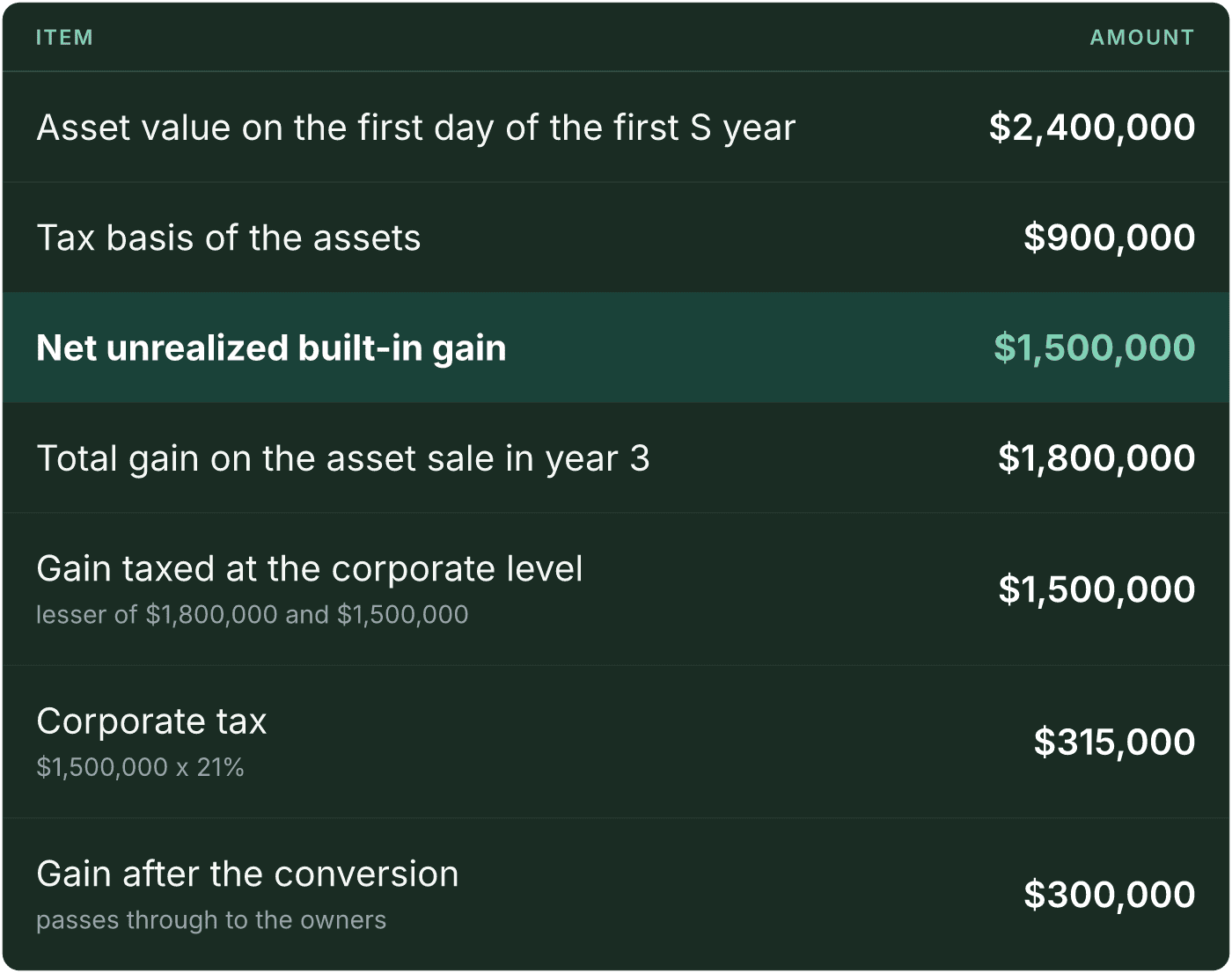
Take a C corporation that makes a calendar-year S election effective January 1. On that date, a valuation concludes that the company's assets, goodwill included, are worth $2,400,000 on a sale to an unrelated buyer who assumes the liabilities. The tax bases of those assets add up to $900,000. The net unrealized built-in gain is $1,500,000.
Three years later the owners sell the business's assets for a price that produces $1,800,000 of total gain over tax basis. Assume the company's taxable income for the year is large enough that it does not limit the computation. The table separates the part taxed to the corporation from the part that passes through.
[](https://www.409.ai/uploads/c_corp_to_s_corp_conversion_built_in_gains_tax_valuation_date_table_1_020a0b7c4f.png)
The $315,000 is paid by the corporation, and the owners still report the same gain on their personal returns. The corporate tax is not a replacement for the owner-level tax; it comes before it.
Now suppose a better-supported valuation had put the day-one value at $1,900,000. The net unrealized built-in gain becomes $1,000,000, and the corporate tax is $210,000. The difference is $105,000, which is 21 percent of the $500,000 gap between the two valuations. As long as the sale gain exceeds the ceiling, every $100,000 of day-one value costs $21,000.
The other direction deserves the same attention. A valuation set too low to save tax is a position that has to survive a challenge, and the regulation asks for fair market value to an unrelated buyer, not the number that produces the smallest tax. That is why the method matters. The same discipline described in [Revenue Ruling 59-60](https://www.409.ai/articles/revenue-ruling-59-60-small-business-valuation-eight-factors) applies: earnings, assets, comparable sales and the facts of the company.
Choosing the date and the method
Two dates sit close together and are easy to confuse.
The election is made "at any time during the taxable year and on or before the 15th day of the 3d month of the taxable year" for which it is to take effect. An election made after that deadline is "treated as made for the following taxable year" ([26 U.S.C. § 1362](https://www.law.cornell.edu/uscode/text/26/1362)). So a calendar-year company that files its election in April has not converted for this year. Its first S year, and the valuation date, move to the next January 1.
The valuation date is the first day of the first S year, set by the election. The appraisal can be performed later than that date, but it has to describe the company as it stood then, which is easier with records from that period than with memory from five years on. Your CPA decides when the election should be effective; the valuation follows the date.
On method, the usual building blocks for a small company apply. Market evidence from sales of similar businesses, an income approach built on normalised earnings, and a check against the asset side. Owner pay is the adjustment that moves the answer most; [how the add-back works](https://www.409.ai/articles/owner-compensation-add-backs-small-business-valuation-sde-ebitda) is worth reading before an appraiser asks for it. Because the result is an enterprise-level asset value, the work also needs a clean split between assets and liabilities, the same split a buyer uses in [Form 8594 allocations](https://www.409.ai/articles/form-8594-asset-allocation-small-business-sale).
What changes if you do not plan to sell
The built-in gains tax reaches sales of assets. If the company will keep operating for more than the recognition period, the exposure expires. For owners who will not sell for a decade, the day-one valuation may never be used. That is still a reason to write it down, because the facts are cheap to capture at conversion and costly to rebuild later, and because a sudden offer, a death or a partner dispute does not wait for the five years to end. The recognition-period clock matters in estate planning too: [Section 6166 deferral](https://www.409.ai/articles/section-6166-estate-tax-deferral-closely-held-business-valuation) and a buy-sell price both start from a business valuation of their own, and a day-one report gives them a reference point.
Several things this article does not decide. Whether an S election makes sense for your company depends on shareholder eligibility, the one class of stock rule and your state's treatment. A company that revokes or loses its election cannot elect again for five years without consent ([26 U.S.C. § 1362(g)](https://www.law.cornell.edu/uscode/text/26/1362)). Those are questions for your tax adviser. The valuation is the part with a deadline you can miss without noticing.
A short checklist before the election date
- Confirm with your CPA the first day of the first S year, using the filing deadline above.
- Ask whether a sale, merger or liquidation is possible within the next five years. If the answer is yes, a day-one valuation belongs in the plan.
- Gather the tax basis of each asset and the book figures for the same date.
- Commission the valuation as of the first day of the first S year, and keep it with the election papers.
- Revisit the exposure each year; the corporate-level tax runs out when the recognition period does.
If you want an independent figure for that date, [409.AI's small-business valuation](https://www.409.ai/products/smb-valuation) starts from $899 and delivers a draft in 24 hours, reviewed by a valuation expert. Whoever prepares it, the point is to have a supported number in the file before anyone is arguing about it.
The takeaway is small and specific. The S election costs a filing. The built-in gains tax is decided by a valuation dated the first day of the first S year, and the cheapest time to prepare it is before that day arrives.