Equity
Buying a Startup With Your Stock: What the Deal Does to Your 409A
Founders buying a startup with their own shares: why the merger price isn't your common value, and how one closing-date 409A sets grants, goodwill and expense.
By 409.AI Team - 2026-11-23
# Buying a Startup With Your Stock: What the Deal Does to Your 409A
If you're the founder or finance lead of a venture-backed company about to buy a smaller startup and pay for it mostly in your own shares, this is for you. The merger agreement will put a headline value on those shares, usually your last preferred price. That number is not what your common stock is worth, and three later decisions depend on getting the real one right: the strike price of every option you grant to the team you just hired, the purchase price your auditor books, and the compensation cost on any founder shares that vest after the close.
A stock-for-stock acquisition is one of the clearest material events a private company can have. Your current 409A was written about a company that no longer exists in the same shape.
Why your last 409A goes stale at the close
The Section 409A regulations don't list acquisitions by name. They set a general test. A value calculated earlier "is not reasonable as of a later date if such calculation fails to reflect information available after the date of the calculation that may materially affect the value of the corporation", and it's never reasonable once it was calculated for a date more than 12 months earlier ([26 CFR 1.409A-1(b)(5)(iv)(B)(1)](https://www.law.cornell.edu/cfr/text/26/1.409A-1)).
An acquisition paid in stock changes value in two directions at once. You add a business: its code, its customers, its people, maybe its cash. You also issue new shares, so every existing share owns a smaller slice of a bigger company. Which effect wins depends on the price you paid. If you bought something worth more than the shares you gave up, value per share goes up. If you overpaid, it goes down. Either way, a report dated before the deal can't tell you which.
That's why our list of [409A trigger events](https://www.409.ai/articles/409a-valuation-frequency-how-often-should-you-get-one) treats a step change in the business as a reason to refresh, even when the calendar says the old report still has months to run.
The period between signing and closing
The trickier window is the weeks between a signed merger agreement and the close. If the target is small next to your company, a signed deal may not move your common value much. If it's large, a signed agreement is exactly the kind of "information available after the date of the calculation" the regulation describes. A board that approves grants to existing employees in that window should be able to say why the deal doesn't change the number, or wait.
The headline price is not the fair value of the shares
Here's where a first-time acquirer can go wrong. The term sheet says "1.5 million shares, valued at $2.00 each, for a $3 million purchase price". The $2.00 is usually your last Series A price. It's a convenient way to agree on an exchange ratio. It isn't a measurement.
The shares you issue are almost always common stock, or a new series without the protections your investors negotiated. Common sits behind the liquidation preference, and it isn't marketable. That's the gap our post on [why a 409A sits below the post-money price](https://www.409.ai/articles/why-is-your-409a-valuation-lower-than-post-money-valuation) walks through.
The accounting doesn't use the headline either. Under ASC 805, consideration transferred is measured at fair value: the acquisition-date fair values of the assets the acquirer transfers, the liabilities it incurs to the former owners and the equity interests it issues, as Deloitte's roadmap sets out in its chapter on [measuring the consideration transferred](https://dart.deloitte.com/USDART/home/codification/broad-transactions/asc805-10/roadmap-business-combinations/chapter-5-measurement-goodwill-or-gain/5-3-measuring-consideration-transferred). Equity issued by the acquirer is measured at fair value as of the acquisition date under ASC 820 ([Deloitte, acquirer's equity securities issued as consideration](https://dart.deloitte.com/USDART/home/codification/broad-transactions/asc805-10/roadmap-business-combinations/chapter-5-measurement-goodwill-or-gain/5-5-acquirer-s-equity-securities)).
For a private acquirer, that fair value comes from the same kind of work a 409A does: an equity value for the combined company, allocated across the preferred and common classes, with a discount for lack of marketability. In most private-company files one valuation as of the closing date supports both the 409A and the purchase accounting. When an auditor finds two different values for the same common share on the same day, one for the purchase price and one for the strike of new grants, the next question is which one is wrong.
There's one exception worth knowing. When the deal exchanges only equity, ASC 805-30-30-2 lets the acquirer measure goodwill using the fair value of the target's equity instead, if that's the more reliable measure ([Deloitte, when consideration transferred is not reliably measurable](https://dart.deloitte.com/USDART/home/codification/broad-transactions/asc805-10/roadmap-business-combinations/chapter-5-measurement-goodwill-or-gain/5-10-when-consideration-transferred-is)). For one private startup buying another, neither side usually has a market price, so expect your auditor to want the reasoning written down.
Shares that vest on staying are pay, not purchase price
Acquisitions of small teams often pay the target's founders partly in shares that vest only if they stay. Those shares don't belong in the purchase price. ASC 805-10-55-25(a) treats a payment that's automatically forfeited when employment ends as compensation for services after the combination ([PwC Viewpoint, contingent payments to employees](https://viewpoint.pwc.com/dt/us/en/pwc/accounting_guides/business_combination/business_combination__28_US/chapter_3_employee_c_US/33_contingent_paymen_US.html)). It's expensed over the service period, and it's measured at the fair value of the stock, not the headline price.
The tax side runs on the same number. Shares tied to continued service generally fall under Section 83, which taxes their fair market value as they vest, unless the holder files an 83(b) election within 30 days and is taxed on the value at issuance instead. In a tax-free reorganization the analysis gets more involved, and the deal's tax counsel decides it. Either way the measure is fair market value, not the headline. Our guide to [restricted stock awards](https://www.409.ai/articles/restricted-stock-award-startup-409a-section-83-fair-market-value) covers that election.
A worked example
Illustrative numbers. Your company has 12,000,000 fully diluted shares. The Series A closed eight months ago at $2.00 of preferred, and your 409A as of March 31 puts common at $0.62.
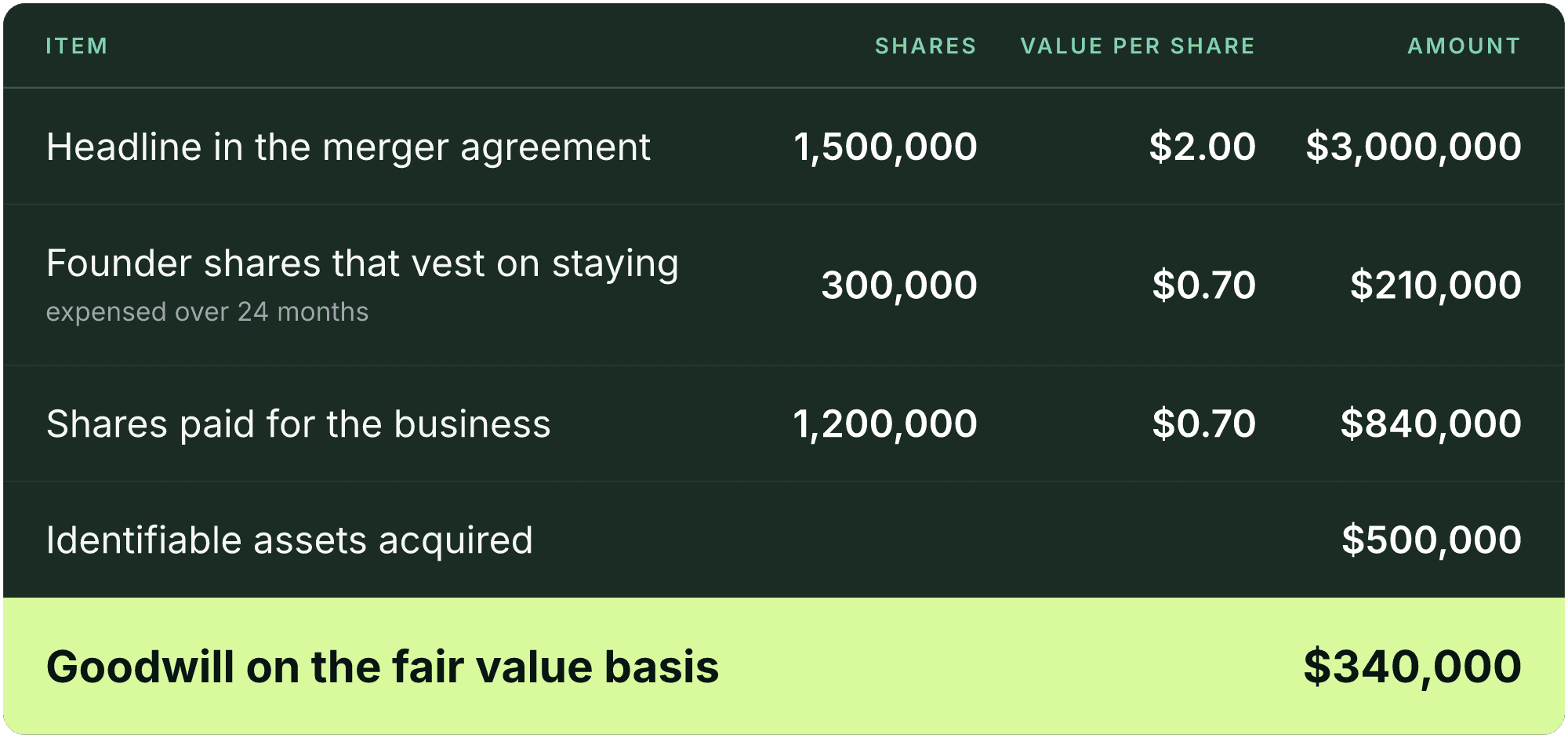
You buy a six-person startup for 1,500,000 new common shares. Of those, 300,000 go to its two founders and vest over 24 months, forfeited if they leave. The other 1,200,000 go to its shareholders outright.
You order a refreshed valuation as of the closing date. It values the combined company, allocates it, and lands at $0.70 a share of common: the target added more value than the dilution took away. A third party values the target's identifiable assets (its software and a small amount of cash) at $500,000.
[](https://www.409.ai/uploads/buying_startup_with_stock_409a_refresh_asc_805_fair_value_shares_issued_post_close_grants_table_1_7a7b621f48.png)
Booked at the headline, the same deal would carry $2,500,000 of goodwill ($3,000,000 less the $500,000 of identifiable assets) and no compensation cost. On the fair value basis, goodwill is $340,000 and $210,000 runs through the income statement as compensation, about $105,000 a year for two years. Those are very different first audited statements.
Now the grants. You promised the target's four engineers 200,000 options between them. If the board grants them at the March 31 value of $0.62, each option is $0.08 below the $0.70 the company itself used for the purchase price that same week. That's $16,000 of spread at grant across the four.
A spread at grant makes the options discounted. Under [26 U.S.C. § 409A(a)(1)](https://www.law.cornell.edu/uscode/text/26/409A), a non-compliant option can be taxed as it vests, with an additional 20% tax and interest, and the tax falls on the employees, not the company. Notice 2008-113 offers a repair if the strike is reset in time, which we cover in [correcting a discounted option](https://www.409.ai/articles/discounted-stock-option-correction-notice-2008-113). It's far easier to grant at the closing-date value in the first place.
Options the target already had
If the target's employees hold options, you'll either cash them out or replace them with options over your stock. Under [26 CFR 1.409A-1(b)(5)(v)(D)](https://www.law.cornell.edu/cfr/text/26/1.409A-1), a replacement avoids being treated as a new grant only if the holder's spread is no larger, and the ratio of strike to value no more favourable, than before. The [option rollover ratio test](https://www.409.ai/articles/stock-options-acquisition-rollover-section-424a-ratio-test) shows the arithmetic, and it needs a value for your shares at the close too.
The accounting splits those replacement awards. The part earned before the deal goes into the purchase price, and the rest is expense after it. Our post on [replacement options in an acquisition](https://www.409.ai/articles/replacement-options-acquisition-asc-805-consideration-transferred-postcombination-expense) walks through the split. It's one more place the closing-date value of your common appears.
What to line up before the close
The fix is mostly sequencing. Order the refreshed 409A so its valuation date is the closing date, or as close as practical, and give the provider the merger agreement, the target's financials and the share schedule. Ask that the report state the value of the common shares issued, so the same document supports the purchase accounting. Then hold the post-close grants until the board has the report, and date them on the day the board acts, as our post on the [option grant date](https://www.409.ai/articles/option-grant-date-board-approval-409a-strike-price) explains.
If the purchase accounting is still open, the [purchase price allocation](https://www.409.ai/articles/asc-805-purchase-price-allocation-startup-acquisition) for the target's intangibles comes next, and it starts from the consideration measured above. 409.AI's [409A valuation](https://www.409.ai/products/409a) starts at $899 with a draft in about 24 hours, and a [purchase price allocation](https://www.409.ai/products/purchase-price-allocation) can draw on the same closing-date work.
The takeaway
When you pay for a company in your own stock, the $2.00 in the merger agreement is a negotiating unit. The number that matters is the fair value of your common on the closing date, and it does three jobs at once: the strike of the grants you promised the new team, the purchase price on your balance sheet, and the expense on founder shares that vest. Get one valuation, dated at the close, and use it for all three.