Financial Reporting
Borrower Stopped Sending Financials? How a Fund Still Marks the Note
A portfolio company that owes your fund a note went quiet. What ASC 820 and the SEC staff's September 28 statement require of a fund CFO's year-end mark.
By 409.AI Team - 2026-10-23
# Borrower Stopped Sending Financials? How a Fund Still Marks the Note
A venture fund's controller opens the year-end file and finds a gap. A portfolio company that owes the fund a $2 million bridge note last sent financials in March. Two emails went unanswered. The note still sits in the Level 3 schedule at cost plus accrued interest, and the auditor's first request is the support for that number.
This article is for the fund CFO, controller or fund administrator who holds notes, venture loans or other debt of private companies and has to mark them when the borrower goes quiet. It also helps the auditor on the other side of the table. The short version: silence from the borrower does not pause the measurement. On September 28, 2026 the SEC's Chief Accountant and the Director of the Division of Investment Management said so in plain words, and the reasoning applies to any fund that reports at fair value.
What the SEC staff said, and what it did not
The [Statement on Fair Value Measurement and Disclosure Considerations for Private Assets](https://www.sec.gov/newsroom/speeches-statements/hohl-daley-statement-fair-value-measurement-disclosure-considerations-private-assets-092806) was written with private credit in mind. It is a staff statement. It adds no rule. It points back to ASC 820, ASC 946, Regulation S-X, Rule 2a-5 under the Investment Company Act and the PCAOB's existing auditing standards.
That matters for a fund that is not a registered investment company. The statement does not bind it directly. But ASC 820 binds every fund that reports its investments at fair value, and the statement shows how the SEC staff reads that standard for illiquid debt. An auditor who has read it will bring the same questions to your file. If you want the broader picture of the statement, we covered its calibration and NAV points in [the SEC staff statement on private asset fair value](https://www.409.ai/articles/sec-staff-statement-private-asset-fair-value-calibration-nav). This piece takes one narrow thread from it: what to do when information is late.
Three passages bear on the quiet borrower.
- "A lack of timely information does not relieve management of its responsibility to estimate fair value."
- Management should consider "the quantity, quality, and frequency of information that borrowers provide to lenders" and whether reporting arrangements give information "at an appropriate cadence."
- The staff wants "clear disclosure about PIK interest, including when and how it is recognized," and whether it is "a growing portion of reported income."
The first is the rule. The second is a prompt to look at your own documents, not the borrower's behavior. The third is the trap that often sits next to a silent borrower.
Fair value does not need the borrower's March financials
ASC 820 asks for the price a market participant would pay for the note on the measurement date. A market participant does not get the borrower's monthly package either. It prices the note from what is knowable: the terms, the last information, the borrower's sector, the rates and spreads on comparable credit, and what the silence itself suggests.
Silence is evidence, and a buyer would weigh it. A lender that cannot see a borrower's numbers would ask for more yield to hold the risk. That does not mean the note is worth less than cost by a fixed amount. It means the fund must show how it got from the last good information to the December 31 number, with inputs it can name.
A defensible file for a note with stale information usually holds five things:
1. The calibration: the yield that made the model equal the transaction price when the note was issued. 2. The last borrower data and its date, plus anything learned since from other sources (a lead investor, a board observer, a public filing, a customer, a website, hiring and funding news). 3. The market move since issue: how yields and spreads on comparable credit have changed. 4. The credit change the fund attributes to this borrower, with the reason. 5. The reporting history: what the loan documents require, what the borrower delivered, and what the fund did about the gap.
The staff statement is specific about the first: when unobservable inputs are used, the technique should be calibrated so that its result equals the transaction price at initial recognition, and later changes should come from changes in assumptions, not from unexplained shifts. For debt, calibration means solving for the discount rate at origination and carrying that rate forward as the starting point.
A worked example (illustrative)
Take a $2,000,000 bridge note issued at par on January 1, 2025. It matures on December 31, 2027 and pays 10% interest entirely in kind: the interest is added to principal each year and nothing is paid in cash until maturity. The fund's model solves for a 10% discount rate at issue, which returns exactly par. That 10% is the calibrated yield.
At maturity the note owes $2,000,000 x 1.10 x 1.10 x 1.10, or $2,662,000. At December 31, 2026 there is one year left, and the accreted balance is $2,420,000.
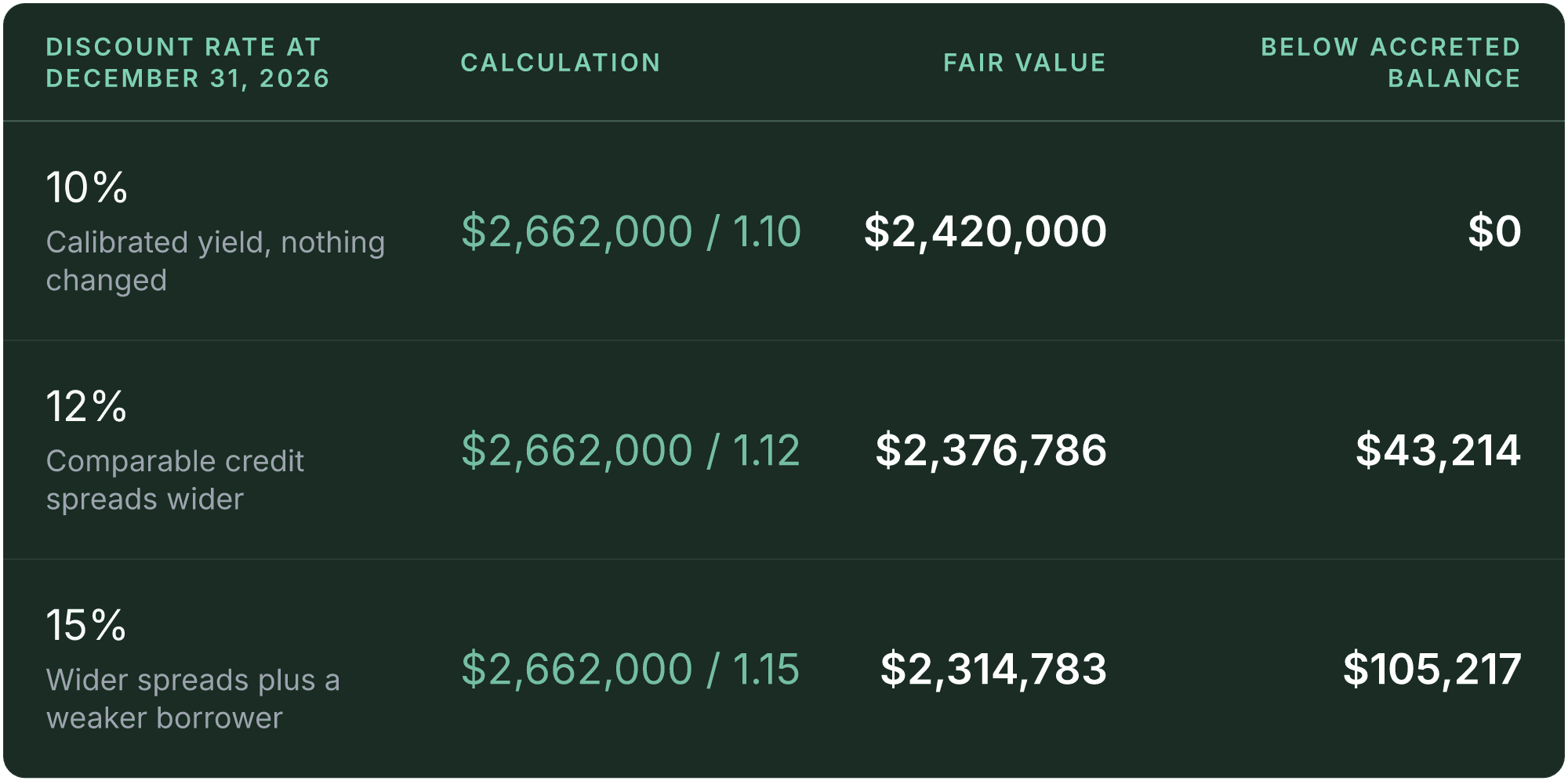
The table shows what the fund's mark looks like at three discount rates. The only thing that changes is the yield a market participant would require.
[](https://www.409.ai/uploads/borrower_stopped_reporting_fund_mark_pik_note_asc_820_sec_staff_statement_table_1_4ce72744c7.png)
The table shows how much of the answer sits in one input. Moving from 10% to 15% takes about $105,000 off a $2.4 million position, or roughly 4.3%. The fund does not pick the 15% because the borrower is quiet. It picks a yield it can explain in two parts: the market's move (the step from 10% to 12% in this example) and the borrower-specific premium (the step from 12% to 15%), with the evidence for each.
If the fund has real doubt about repayment in full, a single yield may not capture it. Then the file should add a scenario view: repayment at maturity, a restructuring, a sale of the company with the note repaid from proceeds, and a wind-down with a recovery of a stated percentage, each with a probability and a reason. We walked through that approach in [marking a distressed portfolio company with lender-first scenarios](https://www.409.ai/articles/fund-mark-distressed-portfolio-company-asc-820-scenarios-lender-first). The two methods should agree within a range you can defend. If the yield method says $2.31 million and the scenario method says $1.6 million, the file needs to explain the difference before the auditor asks.
The PIK trap sitting next to the silent borrower
In the example, the fund booked $220,000 of interest income in 2026 ($2,420,000 less $2,200,000), and none of it was cash. Suppose the fund's cash interest from its other notes was $180,000. Then $220,000 of $400,000 of income, or 55%, is capitalized interest on a borrower who has stopped reporting.
That is exactly the pattern the staff statement tells registrants to disclose: when and how PIK is recognized, and how large a part of reported income it is. It also lists the criteria management uses to classify investments as non-accrual. A fund can keep accruing income on a note it is marking down. Two numbers that disagree like that draw the auditor's attention.
So the file needs a decision on accrual, written down, before year-end. Either the fund keeps accruing because it expects repayment and can say why, or it stops accruing and records why. Whichever it picks, the income policy and the fair value mark should tell the same story. A note marked at a 15% yield while PIK income accrues at 10% for the full year looks inconsistent unless the file reconciles them.
What the auditor will test
The statement gives auditors the same instruction in the other direction. They are to apply professional skepticism, given how judgmental these estimates are and how open they are to management bias, and they should not accept less than persuasive evidence. Under PCAOB AS 2501 they evaluate the reasonableness of significant assumptions and the reliability of the data behind them. In a stressed period, the statement says, they should reconsider whether management's reliance on earlier assumptions still holds.
For a quiet borrower, expect these requests:
- The loan agreement's reporting covenant and the dates of each delivery.
- The correspondence showing the fund asked for the financials, and what came back.
- The source of the discount rate and how the move from the calibrated yield was built.
- Any subsequent event: a payment made or missed, a new round, a covenant waiver, a sale process.
That last one belongs to the year-end calendar. A payment received in January that proves the borrower is solvent can matter to a December 31 mark in a way that a January round at a lower price might also matter. We cover that timing in [the January round and the December 31 mark](https://www.409.ai/articles/january-round-december-31-mark-asc-855-subsequent-events-fund). It is a judgment about what was known or knowable at the measurement date, and it needs its own memo.
Fixing the process before the next close
The cheapest repair is upstream. If the borrower sends financials late every quarter, the fix is in the documents and the calendar, not in the valuation.
- Track delivery dates for every debt position in the same schedule as the marks, so a gap shows up in week three of the quarter, not week three of the audit.
- Record the calibrated yield for each note on the day it closes. Rebuilding it a year later from memory is where files fall apart.
- Write the accrual policy for PIK and for non-accrual in the valuation policy, with the trigger. The [fund valuation policy and audit](https://www.409.ai/articles/fund-valuation-policy-asc-820-audit-sec-exam) article lists what a policy should fix in advance.
- Keep a short note for each Level 3 position that says what information arrived this quarter and what did not. A blank line is better than silence, because it shows the question was asked.
The takeaway
When a borrower goes quiet, the fund still owes a mark, and the mark has to be explained in the same terms as the day the note closed: the calibrated yield, the market move, the borrower-specific premium and the evidence for each. Settle the accrual decision before the number, and let the two agree. A fund CFO who brings that file to the auditor in January is answering a question, not defending a gap.
If your fund holds Level 3 debt and wants an independent view of the inputs before year-end, 409.AI's [ASC 820 valuation service](https://www.409.ai/products/asc-820) supports funds with the calibration, the scenarios and the audit file. For the wider framework, see [ASC 820 Level 3 fair value for fund portfolio valuation](https://www.409.ai/articles/asc-820-level-3-fair-value-fund-portfolio-valuation).