Financial Reporting
ASU 2025-03: Who Is the Accounting Acquirer When the Target Is a VIE?
For CFOs planning a 2027 all-stock merger with a VIE target: how ASU 2025-03 can flip the accounting acquirer and which company the price allocation values.
By 409.AI Team - 2026-11-21
# ASU 2025-03: Who Is the Accounting Acquirer When the Target Is a VIE?
If you are the CFO or controller of a private company planning an all-stock merger in 2027, and the company you are buying is a variable interest entity, the rule that tells you whose balance sheet gets marked to fair value has changed. Under the old guidance, the primary beneficiary of the VIE was always the accounting acquirer. Under ASU 2025-03, for a deal paid mostly in shares, you now run the same acquirer analysis as any other business combination, and the answer can flip.
That flip decides which company's customer relationships, technology and trade names get valued, where goodwill sits, and whose history your financial statements continue. It is the first question in the [purchase price allocation](https://www.409.ai/articles/asc-805-purchase-price-allocation-startup-acquisition), and your auditor will test it before anything else.
The old rule and why it misfired
In every business combination one entity is the accounting acquirer. Acquisition accounting is applied to the other one: its assets and liabilities are generally measured at fair value at the acquisition date, while the acquirer's own assets and liabilities are not remeasured and the pre-combination periods show only the acquirer's history. KPMG's summary of the ASU puts the stakes in exactly those terms.
For most deals, ASC 805 gives a list of factors to identify the acquirer, and sometimes those factors point to the company that is legally being acquired. That is a reverse acquisition: the legal acquirer is the accounting acquiree.
There was one carve-out. When the legal acquiree was a VIE, the primary beneficiary was the accounting acquirer, full stop, even when every ASC 805 factor said the deal was a reverse acquisition. KPMG describes the typical case: a SPAC buys a partnership or partnership-like entity, the SPAC becomes its general partner, the limited partners have no substantive kick-out or participating rights, so the partnership is a VIE and the SPAC is its primary beneficiary. The SPAC was treated as the acquirer even when the partnership's owners ended up controlling the combined company. KPMG notes the same issue arises outside SPAC deals, and that it produced "counterintuitive" results.
What ASU 2025-03 changes
The FASB issued [ASU 2025-03](https://kpmg.com/kpmg-us/content/dam/kpmg/frv/pdf/2025/defining-issues-202501-fasb-asu-bus-com-vie.pdf) on May 12, 2025. It amends Topics 805 and 810 so that the primary-beneficiary default no longer decides the acquirer when three conditions all hold, as [BDO's summary](https://arch.bdo.com/determining-the-accounting-acquirer-of-a-vie) lists them:
1. The acquisition is effected primarily by exchanging equity interests. 2. The legal acquiree is a VIE. 3. The legal acquiree meets the definition of a business.
When all three hold, you apply the general ASC 805 factors. When any one fails, the old rule stays. A VIE acquired mainly for cash, other assets or assumed liabilities still has its primary beneficiary as the accounting acquirer. So does a VIE that is not a business, and BDO notes you cannot analogize to the new guidance for one. The FASB kept the default for those deals because, as KPMG explains, most of the ASC 805 factors do not work when control comes by contract rather than through an exchange of shares.
Two things stay as they were. The ASU does not change how a reverse acquisition is accounted for once you conclude you have one, as [RSM notes](https://rsmus.com/insights/financial-reporting/fasb-issues-guidance-on-determining-the-acquirer-in-a-vie-acquistion.html). And the ASC 810 disclosures for a primary beneficiary still apply, so you still need the VIE analysis even when it no longer picks the acquirer.
"Primarily effected by exchanging equity" is not defined. KPMG points out that the same threshold already applies to non-VIE deals and is well understood in practice, but a deal with a large cash component next to the shares is where your memo has to do the work.
The six factors your auditor will walk through
None of the factors decides the answer alone. KPMG lists them as:
- the relative voting rights in the combined entity after the combination;
- a large minority voting interest, if no other owner or organized group has a significant voting interest;
- the composition of the combined entity's governing body;
- the composition of its senior management;
- the terms of the exchange of equity interests, including who pays a premium;
- the relative size of the combining entities before the deal, measured by assets, revenues or earnings.
In a share-for-share deal the former owners of the legal acquiree often become the largest holders of the legal acquirer. Their votes, their board seats and their management team then point to the legal acquiree as the accounting acquirer. That is why the FASB aimed the change at equity deals: reverse acquisitions are most common there.
A practical point for the file: write the factor analysis against signed documents, not the term sheet. The post-closing cap table, the voting agreement, the board composition clause and the named officers at closing are the evidence an auditor will ask for. A factor you cannot support with a document is a factor you should not weigh.
A worked example: the same deal under both rules
Illustrative example. Atlas Holdings, a private software company, issues new shares to the members of Birch Operating LLC in an all-stock deal closing in March 2027. At closing Atlas becomes Birch's managing member, and Birch's former members keep units with no substantive kick-out or participating rights. Birch is a business and, because of that structure, a VIE with Atlas as its primary beneficiary.
After closing, Birch's former owners hold 70% of the combined votes, name five of seven directors, and Birch's CEO and CFO run the combined company. Birch also has about four times Atlas's revenue. Every factor points to Birch.
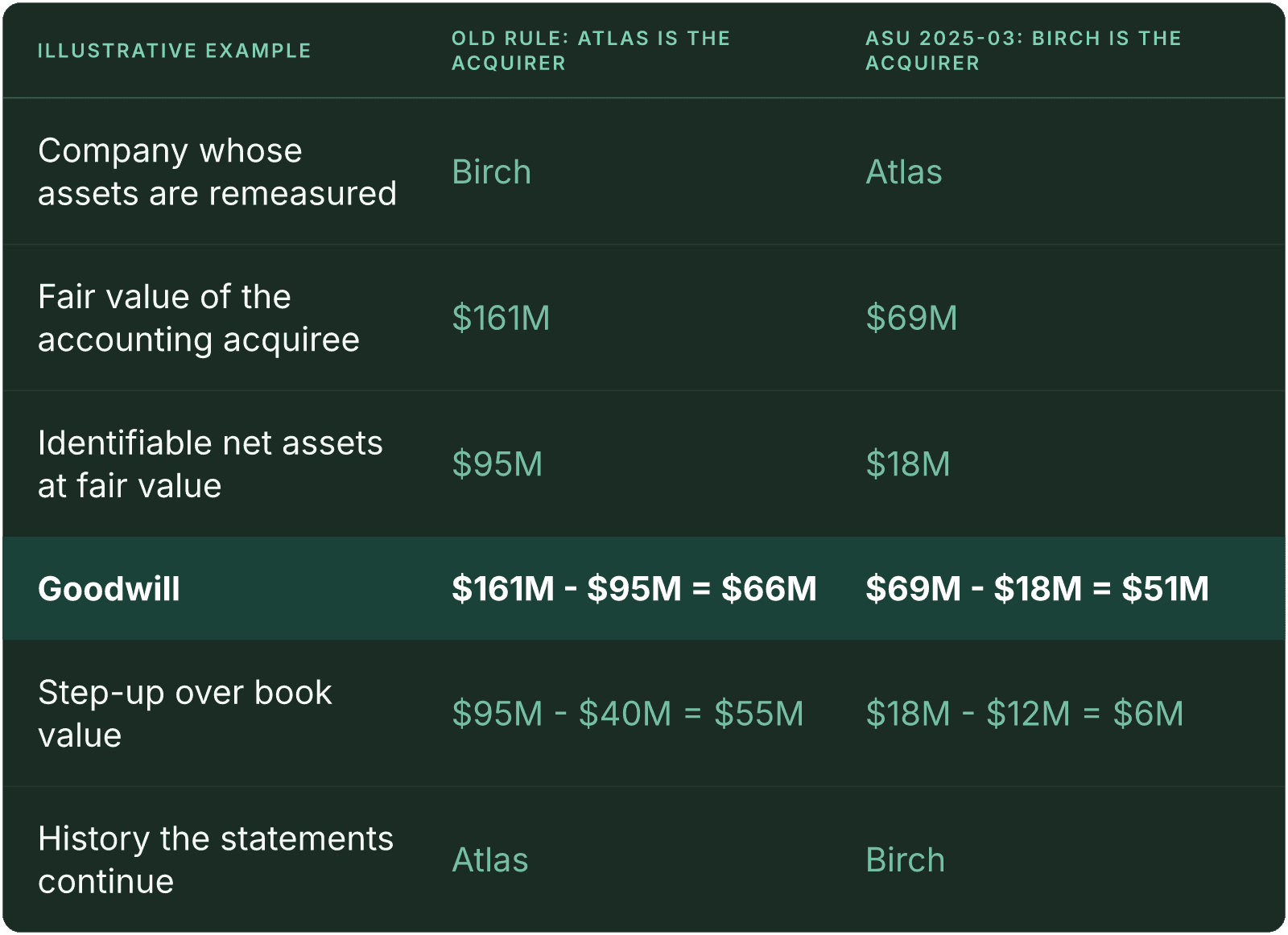
Assume the combined company is worth $230 million, so Birch represents $161 million and Atlas $69 million. Birch's identifiable net assets have a book value of $40 million and a fair value of $95 million. Atlas's identifiable net assets have a book value of $12 million and a fair value of $18 million. The table compares the two outcomes, keeping the goodwill arithmetic simple by treating each company's equity value as the measure of the acquiree.
[](https://www.409.ai/uploads/asu_2025_03_accounting_acquirer_vie_reverse_acquisition_purchase_price_allocation_table_1_24edb1dabd.png)
Under the old rule, Atlas books a $55 million step-up on Birch's assets, mostly in the intangibles that a [customer relationship valuation](https://www.409.ai/articles/customer-relationships-purchase-price-allocation-mpeem-contributory-asset-charges-attrition) and a technology valuation would measure, and that step-up amortizes through the combined company's earnings for years. Under ASU 2025-03, Birch's assets stay at their $40 million carrying amount, Atlas's much smaller balance sheet is remeasured, and the step-up shrinks to $6 million. Goodwill lands on a different business, which matters later for the [impairment test](https://www.409.ai/articles/goodwill-impairment-private-company-asc-350) and for the reporting unit it sits in.
Two cautions on the numbers. First, in a real reverse acquisition the consideration is not simply the legal acquirer's equity value. Under ASC 805-40-30-2 it is measured as the fair value of the shares the accounting acquirer would have had to issue to give the legal acquirer's owners the same percentage of the combined company. With a private legal acquiree that fair value is itself a valuation. Second, the units Birch's former members keep raise noncontrolling interest questions this example leaves out. Neither changes the main point: the scope of the valuation work moves from one company to the other.
When the new rule applies to your deal
ASU 2025-03 is effective for all entities for annual reporting periods beginning after December 15, 2026, and interim periods within them. For a calendar-year company that means deals closing on or after January 1, 2027. A company with a fiscal year starting July 1 applies it from July 1, 2027.
Transition is prospective: the guidance applies to business combinations with an acquisition date on or after the date of initial application, and retrospective application is prohibited. In the year of adoption you disclose the nature of and reason for the change in accounting principle.
Early adoption is permitted in any interim or annual period whose financial statements have not yet been issued or made available for issuance. A company that adopts in an interim period applies it from the start of that interim period or the start of the annual period that includes it. So a calendar-year company closing a VIE deal in December 2026 can still choose the new guidance, provided it adopts for a period whose statements are not out yet.
What to settle before you sign
The acquirer conclusion changes the scope, cost and timing of the valuation, so settle it while the deal terms can still move.
First, confirm the legal acquiree is a business. If it is not, the old rule applies, and the transaction may be an [asset acquisition rather than a business combination](https://www.409.ai/articles/asset-acquisition-vs-business-combination-asc-805-screen-test-goodwill), with no goodwill at all. Second, document the VIE analysis, because the ASC 810 disclosures still depend on it. Third, test whether the deal is primarily an exchange of equity, especially when cash or assumed debt is part of the consideration. Fourth, run the six factors on the signed post-closing documents.
Then scope the valuation for the company the analysis says is the acquiree. If that is the legal acquirer, its intangibles, its deferred taxes and its equity value are what the allocation measures, and the [deferred tax effects](https://www.409.ai/articles/deferred-tax-liability-purchase-price-allocation-stock-deal-goodwill-asc-805) follow that company too. Your auditor will test the acquirer memo first and the [valuation inputs](https://www.409.ai/articles/purchase-price-allocation-cost-asc-805-what-auditors-test) second, and a change of mind after the close means redoing both.
For a 2027 share-for-share deal with a VIE target, the cheapest moment to get this right is before signing. If the factors point to a reverse acquisition, a [purchase price allocation](https://www.409.ai/products/purchase-price-allocation) built for the right company from day one saves you from valuing the wrong balance sheet and starting over during the measurement period.