Education
Asset Approach for a Small Business: When Adjusted Net Assets Set the Price
Owners of asset-heavy small businesses and the advisors beside them: how adjusted net asset value works, why book value misleads, and when it drives the price.
By 409.AI Team - 2026-10-29
# Asset Approach for a Small Business: When Adjusted Net Assets Set the Price
If you own a contracting company, a machine shop, a trucking outfit or a distributor, the first number a buyer, a lender or a divorce court looks at may not be your earnings. It may be what your trucks, equipment, inventory and receivables are worth once someone marks them to current value. That is the asset approach, and for an asset-heavy small business it can be the answer, a floor under the answer, or a number the appraiser sets aside and explains why.
This article is for the owner of a small private company, and for the CPA, attorney, broker or lender sitting beside them. It explains how the adjusted net asset method works, what changes between the balance sheet and the appraisal, and when the result carries real weight.
What the asset approach actually measures
An appraiser usually looks at a business three ways: what similar businesses sold for (the market approach), what the business is expected to earn (the income approach), and what its assets and liabilities are worth (the asset approach). The AICPA's [valuation standard](https://mn.gov/boa/assets/AICPA%20Statement%20on%20Standards%20for%20Valuation%20Services_tcm1233-764403.pdf) names these three families of methods.
The most common asset method is adjusted net asset value. The idea is plain. Take the balance sheet, restate every asset and every liability to its fair market value, and subtract. What is left is the value of the equity under this approach.
The federal estate tax regulation for business interests points the same way. It tells the valuer to consider [a fair appraisal of all the assets of the business](https://www.law.cornell.edu/cfr/text/26/20.2031-3), the demonstrated earning capacity of the business, and special attention to goodwill. Assets and earnings are listed side by side because neither alone tells the whole story. [Revenue Ruling 59-60](https://www.409.ai/articles/revenue-ruling-59-60-small-business-valuation-eight-factors) lists asset value among its eight factors, and our walk through them shows where it sits.
Why book value is not the number
The balance sheet in your accounting software is built to follow tax and accounting rules, not to estimate what a buyer would pay. Three gaps matter most.
Depreciation runs ahead of reality. An excavator bought five years ago may be depreciated to a fraction of cost on the books while selling for much more on the used market. Tax depreciation is often faster than the real decline in value.
Some assets are worth less than they say. Receivables that will never be collected, inventory that has not moved in two years and parts for a machine you no longer own all sit on the books at cost.
Some value is not on the books at all. A fully written-off truck still runs. A lease at a below-market rent has value. An asset the owner paid for personally, or expensed years ago, may not appear.
The appraiser's job is to correct each of these, usually with help. For equipment and vehicles, that often means an independent equipment appraisal. For real estate, a real estate appraiser. The business appraiser then combines the pieces.
A worked example
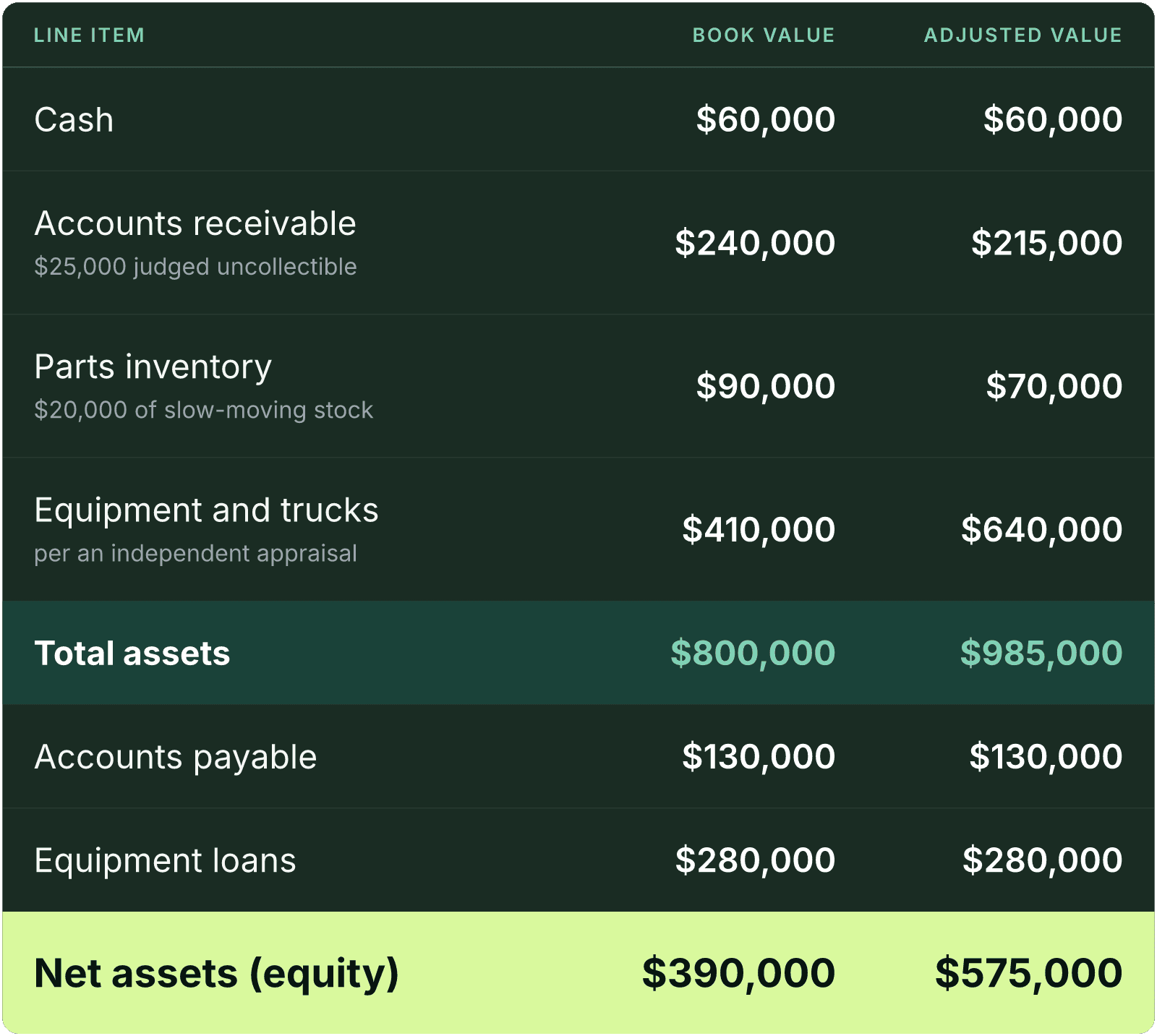
Take a fictional excavation company, called Ridgeline here for illustration. Its balance sheet at the valuation date shows the figures below in the first column. The second column is what an appraiser might conclude after reviewing each line.
[](https://www.409.ai/uploads/asset_approach_adjusted_net_asset_value_small_business_equipment_inventory_table_1_82c4483e6c.png)
The equipment line does almost all of the work. Depreciation had pushed its book value to $410,000, and the appraisal put it at $640,000. The receivables and inventory adjustments pull the other way, by $45,000 together. Net, the appraised equity is $185,000 higher than the book equity.
Notice what did not happen. Nobody asked how much Ridgeline earns. The method values what the company owns minus what it owes, and that is both its strength and its limit.
Where the asset approach carries the most weight
The method earns a lead role in a few situations.
The business is asset-heavy and its earnings are modest. If a company's owner mostly takes only a wage for operating the equipment, the earnings may say little beyond the owner's labor. The assets are the thing a buyer is actually acquiring.
The company holds property or investments. A business whose main job is to own real estate, a portfolio or equipment leased out to others is closer to a holding company, and asset value is usually the better guide to what the equity is worth.
The business is being wound down or sold for parts. When the plan is to stop operating, the question changes from "what will this earn" to "what will the pieces bring, net of selling costs." That is a liquidation view, which is a different premise of value from the going-concern view and usually produces a lower number.
The business has lost money or earns less than a fair wage. If normalized earnings are low or negative, an income approach may give a number that is hard to defend, and the asset value becomes the more reliable reference.
Where it understates, and where it overstates
The method leaves out value that does not show up as a line on a balance sheet: the customer relationships, the trained crew, the reputation, the backlog. A service firm with few assets and steady repeat clients is poorly served by a net asset number. The earnings-based methods capture that value, and so do the goodwill methods covered in our explanation of the [excess earnings method](https://www.409.ai/articles/revenue-ruling-68-609-excess-earnings-method-small-business-goodwill).
It can also overstate. In Ridgeline's case, the $575,000 asset-based figure assumes the equipment is worth $640,000 in use. Suppose the business, after paying a fair wage to the person who runs it, earns $85,000 a year. A buyer who looks at that return against a $575,000 price may decide the business is worth less than its parts, which would mean the owner could do better selling the equipment and closing. An appraiser faces the same tension and has to explain how the two indications fit together.
Two things often appear on both sides of the comparison. First, the [excess cash and non-operating assets](https://www.409.ai/articles/excess-cash-non-operating-assets-small-business-valuation-owner-balance-sheet) sitting in the company: if they are counted in the asset value, they should not also be counted by the earnings method. Second, the [real estate the owner owns personally and rents to the company](https://www.409.ai/articles/related-party-rent-small-business-valuation-owner-owns-building) affects both the earnings and which assets belong in the valuation at all.
How the approaches get reconciled
A credible report rarely stops at one number. It lists the indications from each approach it used, explains why it gives more weight to one, and arrives at a conclusion. For Ridgeline, an appraiser might note that the earnings indication is well below the asset indication, conclude that the business is worth more to its owner as a going concern only if earnings improve, and weigh the asset approach heavily or treat it as the floor.
Whatever weight is chosen, the report should say why. A conclusion based on the asset approach needs to be explained as plainly as one based on earnings, and the owner should ask which assets were appraised, by whom, and on what date. The [difference between a full valuation and a calculation engagement](https://www.409.ai/articles/conclusion-of-value-vs-calculated-value-valuation-vs-calculation-engagement-small-business) matters here too: a calculation may agree in advance to use only one method, and the report should say so.
What to bring to the appraiser
You will save time, and probably fees, if you assemble the following before the engagement starts.
- A current balance sheet and the last three years of tax returns.
- A fixed-asset schedule listing each major piece of equipment, its purchase date, cost and condition.
- An aged receivables report and an inventory listing that flags slow-moving items.
- Any existing equipment or real estate appraisals, and the leases and loan schedules.
- A list of assets the company uses but does not own, and assets the company owns but does not use.
The valuation date matters too. Asset values move, especially for used equipment, so the appraisal should be tied to the date the transaction, loan or event requires.
The takeaway
If your company's value sits mostly in things you can count and appraise, expect the asset approach to be part of the conversation, and expect the balance sheet to be restated before it is trusted. Get the equipment appraised by someone qualified, clean up the receivables and inventory before the valuation date rather than after it, and ask your appraiser to show how the asset and earnings indications compare.
If you need a defensible number for a loan, a buyout or an estate, our [small business valuation service](https://www.409.ai/products/smb-valuation) covers the approaches described here and the report explains which one drives the conclusion and why.