Financial Reporting
ASC 805 vs. Form 8594: One Deal, Two Purchase Price Allocations
Your auditor's ASC 805 allocation and the Form 8594 on your tax return answer different questions. See where a controller's goodwill diverges and why.
By 409.AI Team - 2026-11-04
# ASC 805 vs. Form 8594: One Deal, Two Purchase Price Allocations
If you are the controller of a company that just closed an acquisition, two people will ask you for an allocation of the purchase price, and they will not accept each other's. Your auditor wants the ASC 805 allocation for the financial statements. Your tax preparer wants the Form 8594 allocation for the return. Both start from the same price and the same assets. They finish with different goodwill, and the gap grows every time an earnout moves.
The two documents are not in conflict. They answer different questions, under different rules, for different readers. The trouble starts when a team builds them separately, from two spreadsheets that disagree about what was bought. This article shows where the two allocations part ways, with one worked deal, and how to keep a single asset list behind both.
Two questions, two rulebooks
ASC 805 asks what each identifiable asset and liability was worth on the acquisition date, so the balance sheet starts with fair values and goodwill is what is left over. The IRS asks a narrower question: how much of the price did the buyer pay for each class of asset, so that depreciation, amortization and the seller's gain can be computed.
Form 8594 is the IRS's answer for an asset acquisition. Under the [Instructions for Form 8594](https://www.irs.gov/instructions/i8594), both buyer and seller file it when a group of assets that makes up a trade or business changes hands, goodwill or going concern value could attach to those assets, and the buyer's basis is determined only by the amount paid. The buyer allocates the price using the residual method across seven classes:
- **Class I:** cash and general deposit accounts.
- **Class II:** actively traded personal property, certificates of deposit and foreign currency.
- **Class III:** accounts receivable and assets marked to market at least annually.
- **Class IV:** inventory.
- **Class V:** everything not in another class, such as equipment, buildings and land.
- **Class VI:** section 197 intangibles other than goodwill and going concern value. The list includes workforce in place, customer-based intangibles, covenants not to compete, and trademarks and trade names.
- **Class VII:** goodwill and going concern value.
The price is reduced by Class I first, then allocated to Classes II through VI in order, each up to fair market value, and whatever remains lands in Class VII. The instructions are explicit that no asset other than a Class VII asset can be allocated more than its fair market value on the purchase date.
ASC 805 reaches goodwill by a different route: consideration transferred, plus any noncontrolling interest, minus the fair value of the identifiable net assets. The mechanics look alike, but the inputs differ in three places that matter.
Where the two allocations diverge
Assembled workforce. On the tax side, workforce in place is a named Class VI asset. On the book side, ASC 805 does not recognize an assembled workforce as an identifiable asset: its value stays inside goodwill (ASC 805-20-55-6). If your tax advisor allocates $500,000 to workforce and your valuation specialist allocates nothing, neither is wrong.
Contingent consideration. ASC 805 measures contingent consideration at its acquisition-date fair value and includes it in the price on day one. After that, a liability-classified earnout is remeasured through earnings (ASC 805-30-35-1), so goodwill does not move when the estimate does. Form 8594 works on cost. An earnout that is not paid is not part of the buyer's cost, and when it is paid, it is an increase in consideration taken into account in the year it occurs. Our piece on [how an earnout is valued on day one](https://www.409.ai/articles/earnout-contingent-consideration-valuation-asc-805) covers the book side in depth.
Deals that are not asset acquisitions for tax. Form 8594 applies when the buyer's basis in the assets comes from the price paid. In a stock purchase with no section 338 election, the buyer's tax basis in the target's assets does not change, so there is no tax allocation and no Form 8594. ASC 805 still applies in full, because the book test is whether you acquired a business, not how the deal was papered. A controller in that position has one allocation, the book one, and should say so before someone asks for the other.
A fourth difference runs in the other direction. Whether a transaction is a business combination or an asset acquisition decides whether the book side books goodwill at all, and we walk through that screen in [Asset Acquisition or Business Combination?](https://www.409.ai/articles/asset-acquisition-vs-business-combination-asc-805-screen-test-goodwill) The tax test is separate: goodwill or going concern value only has to be able to attach.
One deal, both allocations
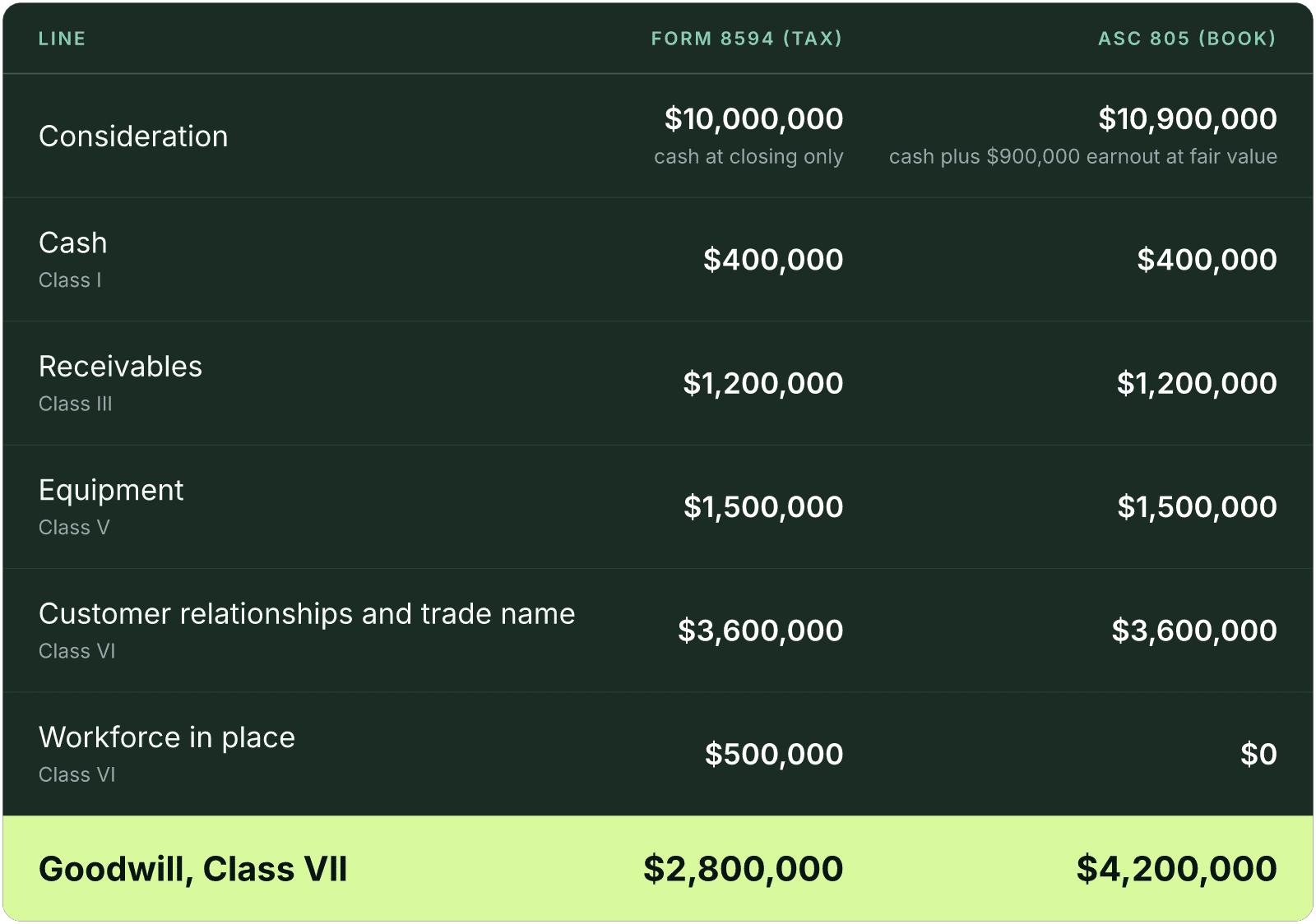
Take a buyer that acquires a small software business for $10,000,000 in cash at closing, plus an earnout of up to $2,000,000 that a valuation specialist puts at a $900,000 fair value on the closing date. To keep the example readable, assume the buyer assumes no liabilities and that the specialist's fair values apply to both allocations. The figures are illustrative.
The identified assets are $400,000 of cash, $1,200,000 of receivables, $1,500,000 of equipment, $3,000,000 of customer relationships and $600,000 of trade name. The specialist also estimates the workforce in place at $500,000.
The table sets the two allocations side by side.
[](https://www.409.ai/uploads/asc_805_vs_form_8594_two_purchase_price_allocations_one_asset_list_table_1_6f7a888ac6.png)
Both columns start from the same asset list. The tax side has a smaller price because the earnout is not yet cost, and it takes $500,000 of workforce out of what would otherwise be goodwill. The book side has a larger price because of the earnout and no workforce line. The two goodwill figures differ by $1,400,000, and every dollar of the difference can be traced to one of those two items: the $900,000 earnout, and the $500,000 of workforce.
That trace is the control worth having. When an auditor asks why the tax and book goodwill disagree, the answer should be a two-line reconciliation, not a discovery exercise.
What happens when the earnout settles
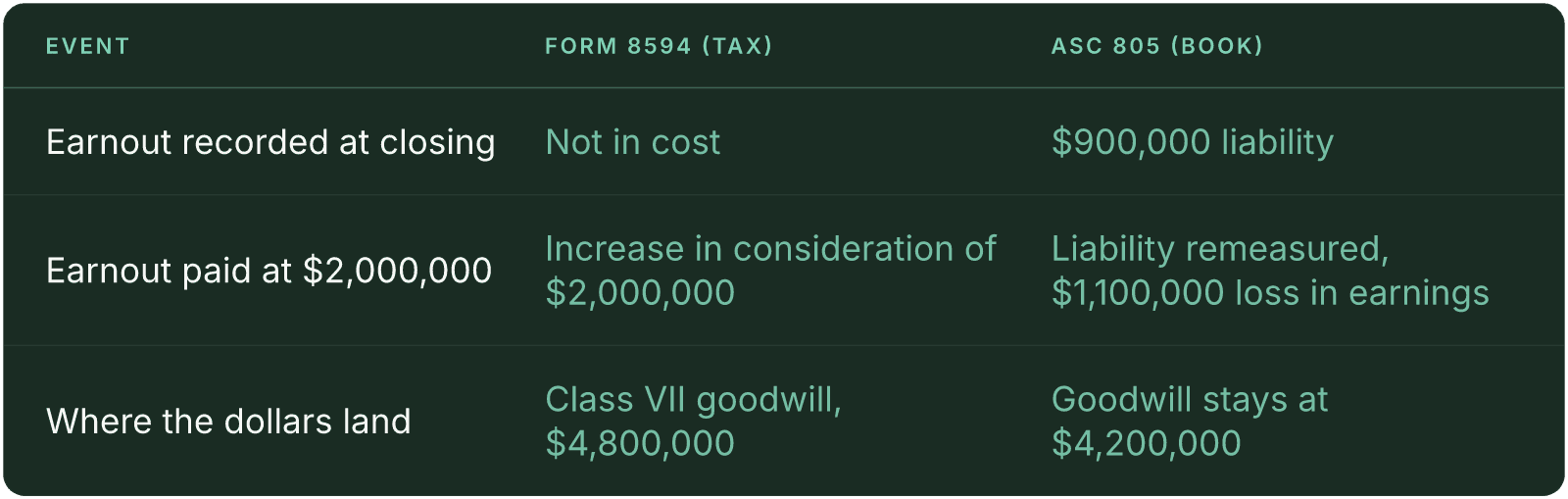
Suppose the earnout pays the full $2,000,000 in year two. The two systems now react differently to the same event.
[](https://www.409.ai/uploads/asc_805_vs_form_8594_two_purchase_price_allocations_one_asset_list_table_2_f59aa87fc1.png)
For the tax side, the instructions say an increase in consideration is allocated to the classes in order, raising each class in proportion to fair market value without pushing any asset above it. In this deal every identified asset already sits at fair value, so the whole $2,000,000 goes to Class VII. The buyer files a supplemental Form 8594 (Parts I and III) with the return for the year the increase is taken into account, giving the reason for the change and the year and form of the original filing.
For the book side, goodwill is fixed at the acquisition date. The $1,100,000 difference between the $900,000 fair value and the $2,000,000 payout runs through the income statement.
A price decrease runs the other way on the form. The instructions reduce Class VII first, then Class VI, then Class V, IV, III and II, so a purchase price adjustment in the buyer's favor comes out of goodwill before it touches the customer list.
After the earnout, the gap between tax goodwill ($4,800,000) and book goodwill ($4,200,000) has flipped since closing: tax goodwill was $1,400,000 below book goodwill then and is $600,000 above it now. A team that tracks only the book number will not see it, and the year-two return will not tie to anything in the audit file.
Keep one asset list behind both
The practical fix is to stop thinking of these as two allocations and treat them as two views of one register. Three habits do most of the work.
First, build one fair value schedule with a line for every asset and liability, and tag each line twice: its ASC 805 treatment (recognized, subsumed in goodwill, separate transaction) and its Form 8594 class. The workforce line is the model case: it exists on the tax view and is zero on the book view, with the note that says why.
Second, record the price twice, deliberately. The register carries the cash paid, the earnout at closing fair value, and the earnout as paid, so each view can pick up the figure it needs. Our guide to [what auditors test in a purchase price allocation](https://www.409.ai/articles/purchase-price-allocation-cost-asc-805-what-auditors-test) lists the inputs that draw the most questions on the book side.
Third, pair the register with a reconciliation page: tax goodwill, plus or minus the workforce, plus or minus the earnout, equals book goodwill. When a later event moves one side, the page shows which line moved.
One point of timing is worth planning around. The Form 8594 is attached to the income tax return for the year the sale occurred, and the instructions warn of penalties for a missing or incorrect form without reasonable cause. The book allocation is first reported in the financial statements, with a measurement period of up to one year to finalize provisional amounts. The two calendars rarely line up, which is one more reason the asset list has to be the shared source.
The seller files its own Form 8594, and the instructions require both parties to report the transaction. Agreeing the class allocation in the purchase agreement, in the same way the buyer and seller already agree the price, avoids the case where the two forms disagree. For readers on the sell side, [how Form 8594 splits the price for a small business seller](https://www.409.ai/articles/form-8594-asset-allocation-small-business-sale) covers the same form from the other chair.
The takeaway for the Q4 close
If you closed a deal this year, ask your auditor and your tax preparer for their current asset lists before the year-end audit starts, and put them next to each other. The differences that should appear are the workforce, the earnout and any deal that is a stock purchase for tax. Anything else is a mismatch in the underlying fair values, and that is the item to fix before either document is final. A single schedule with both tags costs a few hours to build now and saves a reconciliation during fieldwork.
If you want a valuation specialist to prepare the ASC 805 allocation and hand your tax team the same asset schedule, that is what [409.AI's purchase price allocation service](https://www.409.ai/products/purchase-price-allocation) is built for. For the economic test of whether the allocation makes sense, see [reconciling a purchase price allocation to IRR, WACC and WARA](https://www.409.ai/articles/purchase-price-allocation-reconcile-irr-wacc-wara-goodwill-return-asc-805).