Financial Reporting
ASC 360 Asset Groups: Where You Draw the Line Decides the Loss
Controllers: how ASC 360 defines the asset group, why the grouping decides whether step one fails, and how a loss is allocated, with a worked example.
By 409.AI Team - 2026-11-07
# ASC 360 Asset Groups: Where You Draw the Line Decides the Loss
A controller with one clinic, store or plant that has stopped paying its way faces a question before any forecast gets built: which assets does the test cover? ASC 360 calls the answer the asset group, and it can swing the result from a $1.2 million write-down to no write-down at all. Same assets. Same cash. Different line around them.
This article is for the CFO or controller of a company with long-lived assets under pressure and audit fieldwork coming. It covers how the asset group is defined, what the recoverability test does with it, and how a loss gets spread across the assets once one is recorded. For the wider picture of impairment testing, start with our [primer on ASC 350 and ASC 360](https://www.409.ai/articles/what-is-an-impairment-test-asc-350-asc-360-valuation-auditor-file). This piece goes one level deeper on the step that comes first.
What the standard means by an asset group
ASC 360-10-35-23 says that, for the purpose of recognizing and measuring an impairment, a long-lived asset is grouped with other assets and liabilities at the lowest level for which identifiable cash flows are largely independent of the cash flows of other assets and liabilities.
Three words in that sentence do the work.
Lowest. You do not start at the company and work down. You start at the single asset and move up only as far as you must. A press that produces nothing sellable on its own is grouped with the line it feeds. A store whose sales can be traced to its own till is a group by itself.
Identifiable. There has to be a cash flow you can actually point to. If revenue is booked centrally and nobody can say which site earned it, the cash flow is not identifiable below the level where it is booked.
Largely independent. Not wholly. Two clinics that share a billing office can still be separate groups if patients, payers and staff are tied to one site. Two clinics where patients move freely between sites, appointments are booked from one schedule and pricing is negotiated network-wide are probably one group, whatever the building count says.
None of this is a free choice. The grouping follows how the business generates cash, and an auditor will compare it with how management runs the business: how it reports results internally, how it decides to open and close sites, and what it did in earlier periods.
The same assets, two answers
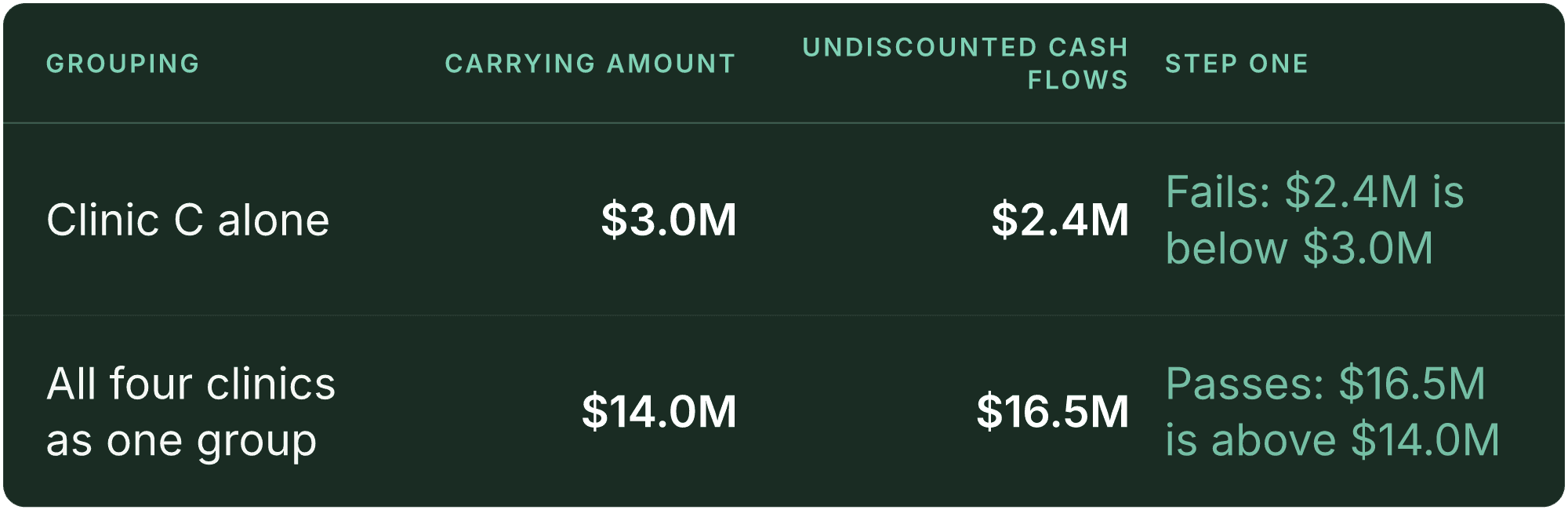
Take a four-clinic operator. Clinic C has lost money for three years. Its assets are leasehold improvements of $1.4 million, equipment of $1.0 million and a right-of-use asset for the lease of $0.6 million, so $3.0 million in all. (Operating lease right-of-use assets are tested under ASC 360 through ASC 842-20-35-9, so they belong in the group.)
The cash flows the group is expected to produce, undiscounted and including what its assets would fetch at the end of their use, come to $2.4 million if Clinic C stands alone. If all four clinics form one group, the carrying amount is $14.0 million and the undiscounted cash flows are $16.5 million. The table sets the two side by side.
[](https://www.409.ai/uploads/asc_360_asset_group_lowest_level_cash_flows_recoverability_test_impairment_loss_table_1_fa9d4a43e9.png)
Clinic C alone is not recoverable, so it moves to measurement. The network passes, so nothing is measured and no loss appears, even though Clinic C is the same sick asset in both rows. The healthy clinics carry it.
That is why the grouping is a documented judgment and not a convenience. A company that draws the group wide because the narrow answer is unpleasant has the weakest file in the building. A company that can show the patient flows, the booking system and the pricing contracts that make the clinics interdependent has a defensible one. Write the reasoning down in the period you first have a reason to test, not in the week the auditor asks.
Step one: the recoverability test
ASC 360-10-35-17 says an asset group's carrying amount is not recoverable when it exceeds the sum of the undiscounted cash flows expected from its use and eventual disposition. Nothing is discounted and no fair value is involved. A group that clears this bar records no impairment, however weak it looks.
The estimate has its own rules, set out in ASC 360-10-35-29 and the paragraphs that follow:
- **Existing service potential.** Cash flows reflect the asset group as it stands at the test date. They do not include the benefit of a future expansion or an upgrade that has not happened.
- **A horizon set by the primary asset.** The primary asset is the one that matters most to the group's ability to generate cash. Its remaining useful life sets how long the forecast runs, and if it is shorter than the lives of other assets in the group, the forecast assumes those others are sold at the end of that period.
- **The entity's own assumptions.** Management's view of how the group will be used governs, but it has to be reasonable and supportable, and consistent with the budgets and forecasts the company uses elsewhere. An impairment forecast far gloomier or sunnier than the board's plan draws questions fast.
- **Probability weighting.** When there are alternative courses of action, such as keep operating or sell within two years, the cash flows are weighted by the likelihood of each.
- **No financing costs.** Interest charges are left out.
The test is also not an annual exercise. ASC 360-10-35-21 asks for a review whenever events or changes in circumstances suggest a carrying amount may not be recoverable. The standard's examples include a significant fall in the asset's market price, a significant adverse change in how it is used or in its physical condition, an adverse change in the legal or business climate, costs far above those originally expected to build or acquire it, a current-period operating or cash flow loss combined with a history of losses, and a current expectation that the asset will more likely than not be sold or disposed of well before the end of its estimated life. A decision to close a site is the last of these, and it also shortens depreciation periods, so it has an accounting effect before it has a valuation one.
Step two: measure, then spread the loss
A group that fails recoverability is measured. The loss is the carrying amount less fair value, and fair value here is an ASC 820 number: the price a market participant would pay, not what management expects to earn. For equipment that usually leans on a cost or market approach. For leasehold improvements and the right-of-use asset it often leans on an income approach, which brings in a discount rate and market-participant assumptions that the auditor will test. Our article on [Level 3 inputs](https://www.409.ai/articles/asc-820-level-3-classification-significant-unobservable-input) explains why one unobservable input is enough to put a whole measurement in that category.
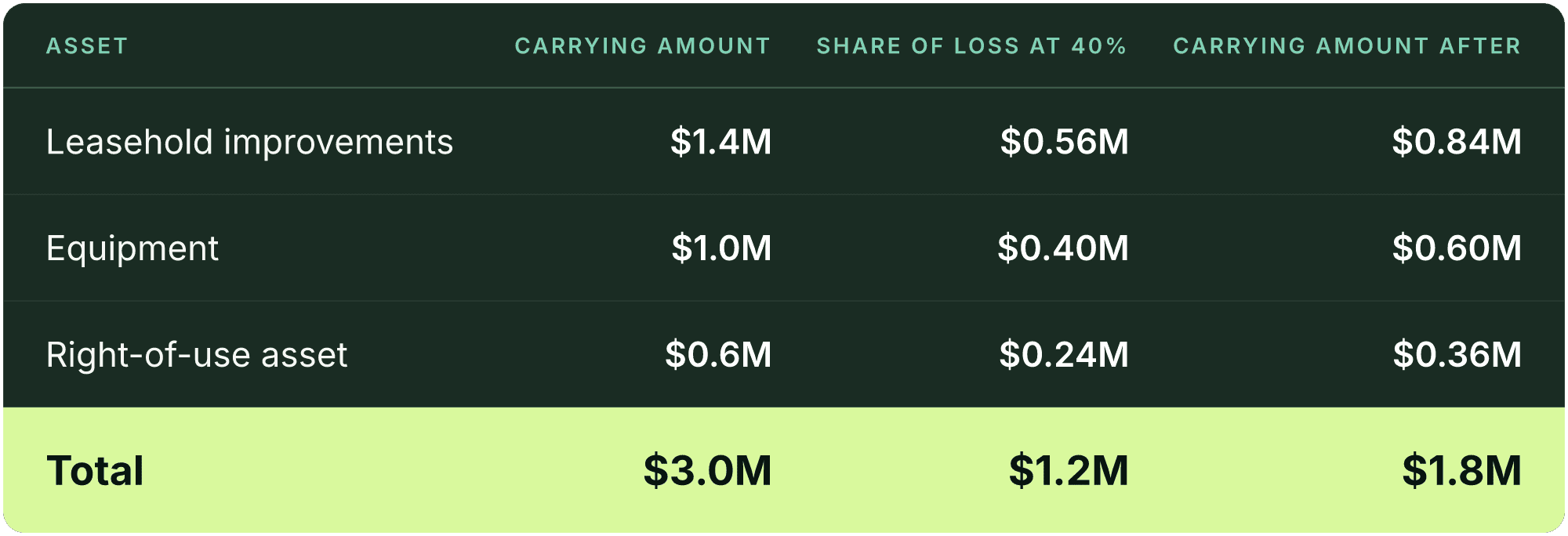
Suppose a market participant would pay $1.8 million for Clinic C's assets. The loss is $3.0 million less $1.8 million, or $1.2 million.
ASC 360-10-35-28 then allocates that loss to the long-lived assets of the group pro rata on their relative carrying amounts. One limit applies: a loss allocated to an individual asset cannot take it below its own fair value when that fair value can be determined without undue cost and effort. Assume here that none of the three has such a value on its own.
[](https://www.409.ai/uploads/asc_360_asset_group_lowest_level_cash_flows_recoverability_test_impairment_loss_table_2_0249be2dd3.png)
The loss is 40% of the $3.0 million, so each asset gives up 40% of its carrying amount. If an appraiser had priced the equipment alone at $0.75 million, the equipment could lose only $0.25 million, and the $0.15 million left over would be pushed back to the other two assets in proportion. The pro rata allocation is where a specialist's asset-level values earn their place in the file.
What the loss leaves behind
Under ASC 360-10-35-20 the written-down amount becomes the asset's new cost basis. Depreciation restarts from the lower figure over the remaining life, so later income statements carry a smaller charge. The standard also prohibits restoring a previously recognized impairment loss, so a recovery in Clinic C's fortunes next year does not reverse the write-down.
Readers reporting under IFRS will notice the difference. IAS 36 uses one step instead of two, measures against the higher of fair value less costs of disposal and value in use, and permits reversal of a loss on assets other than goodwill. The [IAS 36 page](https://www.ifrs.org/issued-standards/list-of-standards/ias-36-impairment-of-assets/) sets out the standard. A group that reports under both frameworks should expect to run two tests.
One order-of-operations point matters if the clinics came out of an acquisition. When a reporting unit holds both long-lived assets and goodwill, the long-lived assets are tested under ASC 360 first, and only then is goodwill tested under ASC 350, so the goodwill test starts from the corrected carrying amount. If you are not sure whether an earlier deal created goodwill at all, the [ASC 805 screen test](https://www.409.ai/articles/asset-acquisition-vs-business-combination-asc-805-screen-test-goodwill) is the place to check, and our piece on [goodwill impairment for private companies](https://www.409.ai/articles/goodwill-impairment-private-company-asc-350) covers what comes next. Assets acquired in a deal start life as the output of a [purchase price allocation](https://www.409.ai/articles/asc-805-purchase-price-allocation-startup-acquisition), and that allocation is the first document an auditor pulls when it tests their carrying amounts.
What to have in the file before fieldwork
A short list will do for most companies, and each item answers a question the auditor will ask:
1. The asset group definition for each location or line, with the cash-flow independence evidence behind it. 2. The indicator review for the period: what was looked at, what was found, and why a test was or was not triggered. 3. The undiscounted forecast, tied to the approved budget, with the primary asset and its remaining life named. 4. The fair value of the group and, where it matters, of individual assets, with the approach and inputs. 5. The allocation schedule and the new depreciation schedule.
A company that wants an independent fair value for step two can have it done by a specialist. 409.AI prices impairment testing at a flat $9,999, with a draft within 24 hours and the final report in five business days on the standard schedule, and the [impairment testing page](https://www.409.ai/products/impairment-testing) is the reference for current scope and terms. Plan the date from your auditor's fieldwork, not from your close.
The takeaway
Before you build a forecast for the struggling site, spend an afternoon on the grouping memo. Say what the lowest level of independent cash flow is, show the evidence, and let the test run from there. If the group is Clinic C alone, expect to measure. If it is the network, you can say why in one paragraph. Either answer holds up when it was reached by the standard, and neither does when it was reached by the result.