Tax
Annual Exclusion Gifts of LLC Units: When the Discount Clauses Make the Gift a Future Interest
Owners gifting family LLC units in December: the clauses behind your valuation discount can make the gift a future interest and cost the $19,000 exclusion.
By 409.AI Team - 2026-11-18
# Annual Exclusion Gifts of LLC Units: When the Discount Clauses Make the Gift a Future Interest
December is when families with a closely held LLC move units to the next generation, one annual exclusion at a time. This piece is for the owner making those gifts and for the estate attorney or CPA preparing the Form 709 behind them. The risk it covers is easy to miss: the operating agreement clauses that support a healthy valuation discount can also turn each gift into a future interest, and a future interest gets no annual exclusion at all.
The exclusion only covers present interests
The annual exclusion lets each donor give up to $19,000 per recipient in 2026 without using any lifetime exemption, according to the [IRS summary of estate and gift tax changes](https://www.irs.gov/businesses/small-businesses-self-employed/whats-new-estate-and-gift-tax). The statute that creates it, [26 U.S.C. 2503(b)](https://www.law.cornell.edu/uscode/text/26/2503), applies only to gifts "other than gifts of future interests in property."
The regulation draws the line. A present interest is "an unrestricted right to the immediate use, possession, or enjoyment of property or the income from property" ([Treas. Reg. 25.2503-3(b)](https://www.law.cornell.edu/cfr/text/26/25.2503-3)). The Supreme Court added the gloss courts still quote: the donee must receive "the right to a substantial present economic benefit" (Fondren v. Commissioner, 324 U.S. 18, 1945).
Owners often assume that handing a child units outright, with a signed assignment and an updated member ledger, is the clearest present interest there is. It isn't automatically. An outright gift of an equity interest can still be a future interest if the donee can't do anything with it today.
What happened in Hackl
Albert and Christine Hackl put tree farms into an LLC called Treeco and gave units to their children, the children's spouses and a trust for the grandchildren, claiming annual exclusions each year. According to a [detailed case summary published by Bessemer Trust](https://www.bessemertrust.com/sites/default/files/2018-06/Wimmer%20Summary_FINAL.pdf), there were 41 donees, worth $820,000 of exclusions a year for the couple.
The operating agreement was drafted the way many family LLC agreements are:
- Mr. Hackl was manager for life and decided whether any cash was distributed.
- No member could withdraw without the manager's approval.
- No member could sell units without the manager's consent, which could be "given or withheld, conditioned or delayed" in his sole discretion.
- A transferee who bought without consent got only the economic rights, with no membership or voting rights.
The land was freshly planted timber that was not expected to produce income for years. The Tax Court (118 T.C. 279, 2002) denied every exclusion, and the Seventh Circuit affirmed in 2003. Its key sentence, as the [Journal of Accountancy summarised](https://www.journalofaccountancy.com/issues/2004/jan/noannualgifttaxexclusionforgiftofllcmembershipunits/): the operating agreement "clearly foreclosed the donees' ability to realize any present economic benefit." The court added that "the onus is on the taxpayers to show that their transfers qualify for the gift tax exclusion."
The court also dismissed the escape hatch in the agreement. A member could, in theory, sell in breach of the agreement to a buyer who would get no vote and no membership. That possibility, the court said, "can hardly be called a substantial economic benefit."
Two ways a gift of units can be a present interest
Read together, the cases that followed Hackl give a donee two routes to a present interest. Either one is enough.
Route one: the donee can turn the units into value now. That means a real ability to sell or withdraw, not a sale that needs the manager's blessing.
Route two: the donee can count on income now. The Tax Court applies a three-part test from Calder v. Commissioner (85 T.C. 713, 1985): the entity will generate income, some portion of that income will flow steadily to the donees, and that portion can be readily ascertained.
Three later cases show where each route holds or fails.
Price v. Commissioner (T.C. Memo. 2010-2). A family limited partnership held marketable securities and had in fact distributed $528,336 to the children between 1997 and 2002. The exclusions were still denied. Partners couldn't sell without the written consent of all partners, distributions were at the general partner's discretion, the agreement said distributions were "secondary to the partnership's primary purpose" of long-term return, and there was a year with no distribution at all. Income existed, but it didn't flow steadily or predictably.
Fisher v. United States (S.D. Ind. 2010). The LLC held undeveloped beachfront land. The children could transfer their interests, but the LLC had a right of first refusal it could pay with non-negotiable promissory notes over up to fifteen years. The court held this "effectively prevents the Fisher Children from transferring their interests in exchange for immediate value."
Estate of Wimmer (T.C. Memo. 2012-157). The partnership held dividend-paying public stock, received dividends every quarter and distributed cash to the partners each year. Transfers were restricted, so route one failed. Route two worked: income was expected, the general partners' fiduciary duties made some distribution necessary, and the partners "could estimate their allocation of quarterly dividends on the basis of the stock's dividend history." The exclusions were allowed.
The clauses that cut the value also cut the exclusion
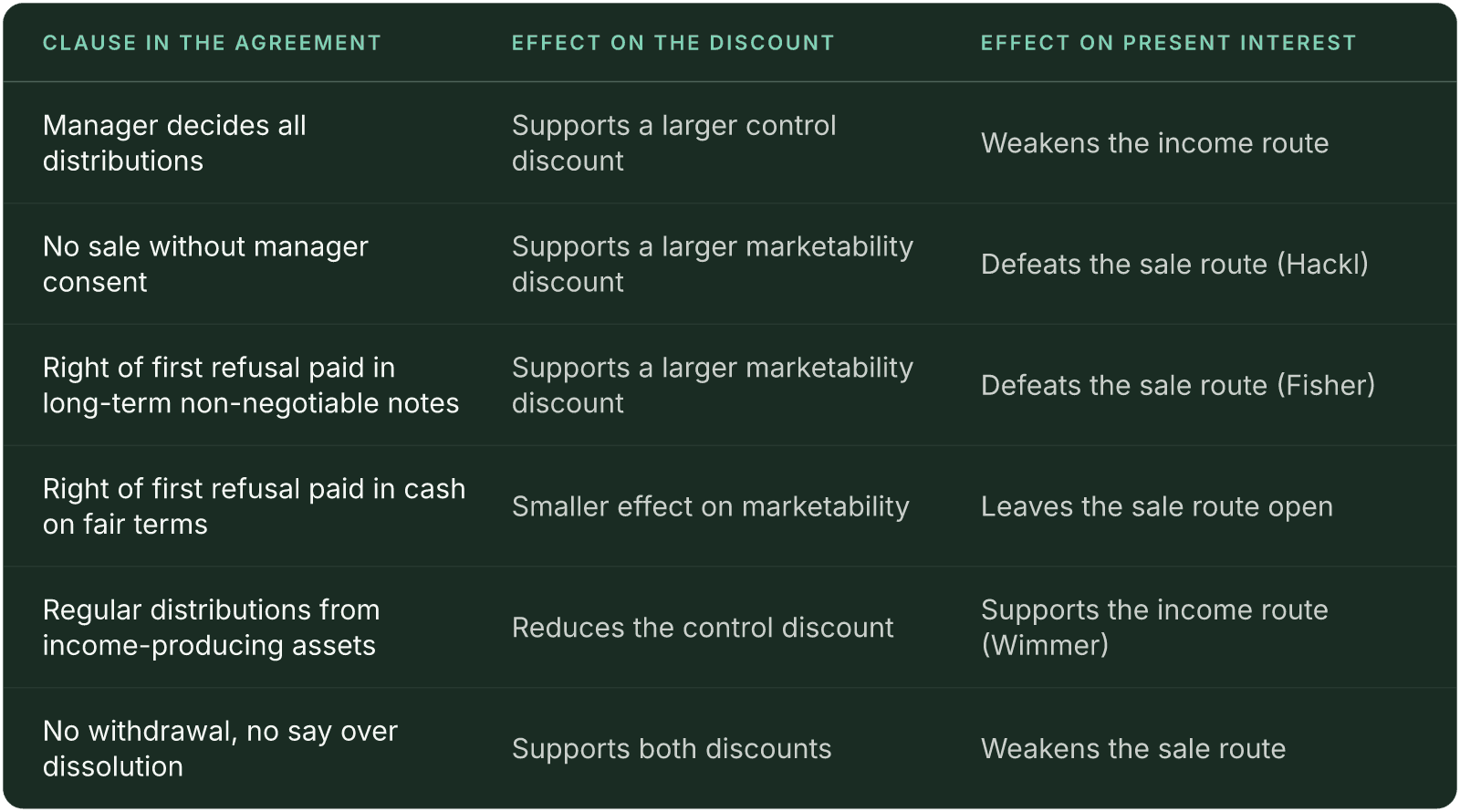
Here is the tension an owner and their advisors have to manage. An appraiser valuing a minority block of LLC units looks at exactly the same agreement the court looked at. Manager control over distributions supports a [discount for lack of control](https://www.409.ai/articles/discount-lack-of-control-dloc-409a-gift-tax-valuation). Consent requirements for any sale, no right to withdraw and no control over dissolution support a [discount for lack of marketability](https://www.409.ai/articles/marketability-discount-minority-stake-family-business-mandelbaum-factors). Those are the same facts that told the Hackl court the donees could not reach any present value.
The table sets the common clauses against both questions.
[](https://www.409.ai/uploads/annual_exclusion_gift_llc_units_present_interest_hackl_form_709_table_1_2ffc80b9b9.png)
None of this means a family has to pick between a discount and an exclusion. Wimmer had transfer restrictions and still kept its exclusions because the income was real and regular. It does mean the agreement has to be read twice, once for value and once for present interest, before the December gifts go out.
What a lost exclusion costs in dollars
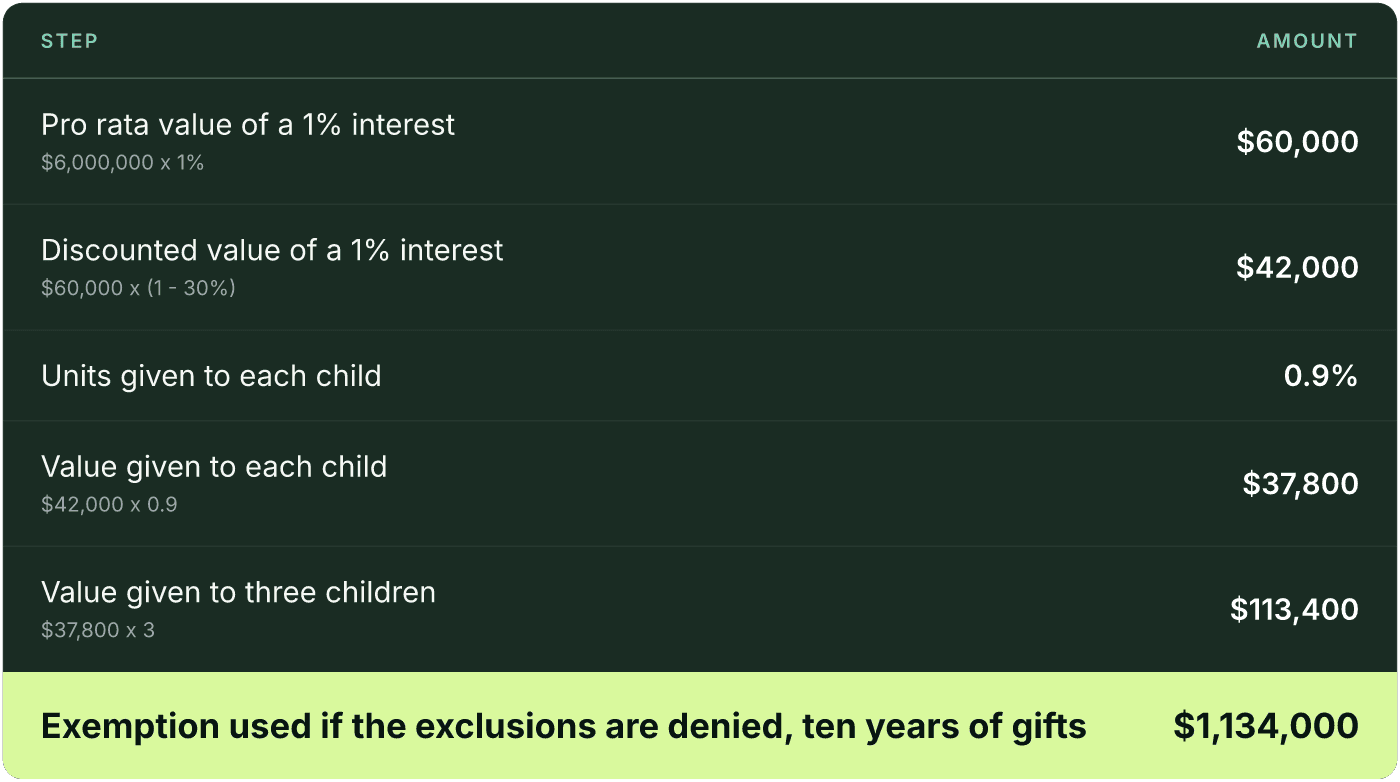
Take a married couple who own a family LLC holding rental property with a net asset value of $6,000,000. They elect gift splitting, so each child can receive $38,000 of units a year inside the two annual exclusions. Assume a qualified appraisal applies a combined 30% discount for lack of control and marketability to a 1% interest. These numbers are illustrative.
[](https://www.409.ai/uploads/annual_exclusion_gift_llc_units_present_interest_hackl_form_709_table_2_1f15a9b82c.png)
If the gifts are present interests, the $113,400 a year uses none of the couple's lifetime exemption. If they are future interests, every dollar becomes a taxable gift. No tax is due while each spouse stays under the $15,000,000 basic exclusion for 2026, but ten years of the same program would quietly consume more than $1.1 million of the couple's combined exclusion, and the IRS can raise the issue on the gift that is still open to examination.
There is also a filing consequence that catches people who think they were under the limit. The [IRS instructions for Form 709](https://www.irs.gov/instructions/i709) say a gift of a future interest is not covered by the annual exclusion and "you must file Form 709 even if the gift was under $19,000." A couple splitting gifts has to file anyway. An unfiled return leaves the gift open, which is why [adequate disclosure on Form 709](https://www.409.ai/articles/form-709-adequate-disclosure-founder-stock-gift) matters as much for small annual gifts as for large ones.
What to check before the December transfer
The planning ideas below come from the case law and from practitioner commentary on it, including the Bessemer Trust summary cited above. They are questions for the attorney who drafts and the CPA who files, not conclusions about any particular agreement.
Read the transfer clause. An outright prohibition, or consent left to the manager's sole discretion, is the Hackl pattern. A right of first refusal with a reasonable time limit and payment in cash or negotiable instruments is the pattern commentators recommend instead.
Make donees members, not assignees. Both Hackl and Price questioned whether a bare assignee interest gives a present benefit. The admission of each donee as a member should be documented.
Look at the income history. If the entity holds assets that produce regular income and distributes some of it every year, the Wimmer route is available. A year with no distribution was part of what sank Price.
Watch the estate-inclusion side. Commentators warn that mandatory distribution or tax-distribution clauses can support an IRS argument under section 2036 that the donor kept the enjoyment of retained units. That risk is larger than a lost exclusion and belongs in the same conversation.
Give the appraiser the final agreement. If the agreement is amended to keep a present interest, the valuation has to reflect the amended terms. A discount computed on last year's restrictions doesn't describe what the child receives this year. Other restrictions bring their own valuation rules too; our piece on [whether the IRS will honor a buy-sell price under section 2703](https://www.409.ai/articles/buy-sell-agreement-price-section-2703-family-business-estate-tax) covers one of them.
Size each gift to the appraised value. The exclusion is measured on the discounted value of what the donee receives on the gift date, so the unit count depends on the appraisal. Our walkthrough of [December or January timing and the 2027 numbers](https://www.409.ai/articles/december-or-january-gift-private-shares-2027-exclusion-rev-proc-2026-35) shows the same arithmetic for private shares.
The takeaway
An annual exclusion gift of LLC units has to pass two tests, and the operating agreement decides both. The discount asks how little control and liquidity the donee has. The exclusion asks whether the donee can get any substantial value now, by selling or by receiving income. Hackl, Price and Fisher lost on the second question with agreements built to win the first. Wimmer kept its exclusions because the income was real.
Before this year's units go out, have the agreement reviewed for both questions and have the units valued on the terms that will actually govern them. A [gift and estate tax valuation](https://www.409.ai/products/gift-estate-tax) that reads the same clauses the court would read gives the Form 709 a number that holds up, and keeps each year's $19,000 doing the work it was meant to do.