Tax
Alternate Valuation Date for a Family Business: When a Second Appraisal Lowers Estate Tax
Executors and CPAs: IRC 2032 lets an estate value a family business six months after death, but only if it cuts both the estate and the tax. How it works.
By 409.AI Team - 2026-10-14
# Alternate Valuation Date for a Family Business: When a Second Appraisal Lowers Estate Tax
When the owner of a private company dies, the estate usually needs one appraisal of the business, dated the day of death. For a few estates, a second appraisal six months later is worth a lot of money. Internal Revenue Code §2032 lets the executor value the whole estate at that later date, but only when doing so lowers both the size of the estate and the tax bill.
This article is for the executor, the CPA or the estate attorney who is handling an estate that holds a closely held business. It explains how the election works, when it can help, and what the business appraisals have to show if you use it. It is general information about valuation, not legal or tax advice, and the election belongs on a return that your attorney or CPA signs off on.
What the election does
The default rule is simple: property in the gross estate is valued on the date of death. Section 2032 gives the executor a one-time choice to use the "alternate valuation date" instead. Under [26 U.S.C. §2032](https://www.law.cornell.edu/uscode/text/26/2032), the rules are:
- Property still held six months after death is valued as of that six-month date.
- Property sold, distributed or otherwise disposed of within those six months is valued on the date it left the estate.
- An interest whose value changes only because time passes, such as a term interest or a note running down toward maturity, is valued at the date of death, adjusted for changes that are not just the passage of time.
The choice is all or nothing. You cannot pick the six-month value for the business and the date-of-death value for the brokerage account. Everything in the gross estate moves to the later date, with the exceptions above.
Two tests the election has to pass
The statute does not let an executor elect just because the numbers look better on one side. Section 2032(c) allows the election only if it decreases both:
1. the value of the gross estate, and 2. the sum of the estate tax and the generation-skipping transfer tax due, after credits.
That second test matters more than people expect. An estate that sits under the federal exemption owes no estate tax at either date, so there is no tax to decrease and the election is not available. For 2026 the basic exclusion amount is $15 million per person, a figure we cover in our post on [gifting startup equity and the 2026 estate tax exemption](https://www.409.ai/articles/gifting-startup-equity-2026-estate-tax-exemption). Many owners of small businesses will be well under it, and for them the alternate date is a footnote.
The election is made on the estate tax return, Form 706, and it is irrevocable once made. The statute also bars it if the return is filed more than one year after its due date, including extensions. The [Form 706 instructions](https://www.irs.gov/forms-pubs/about-form-706) walk through where the election is reported.
A worked example
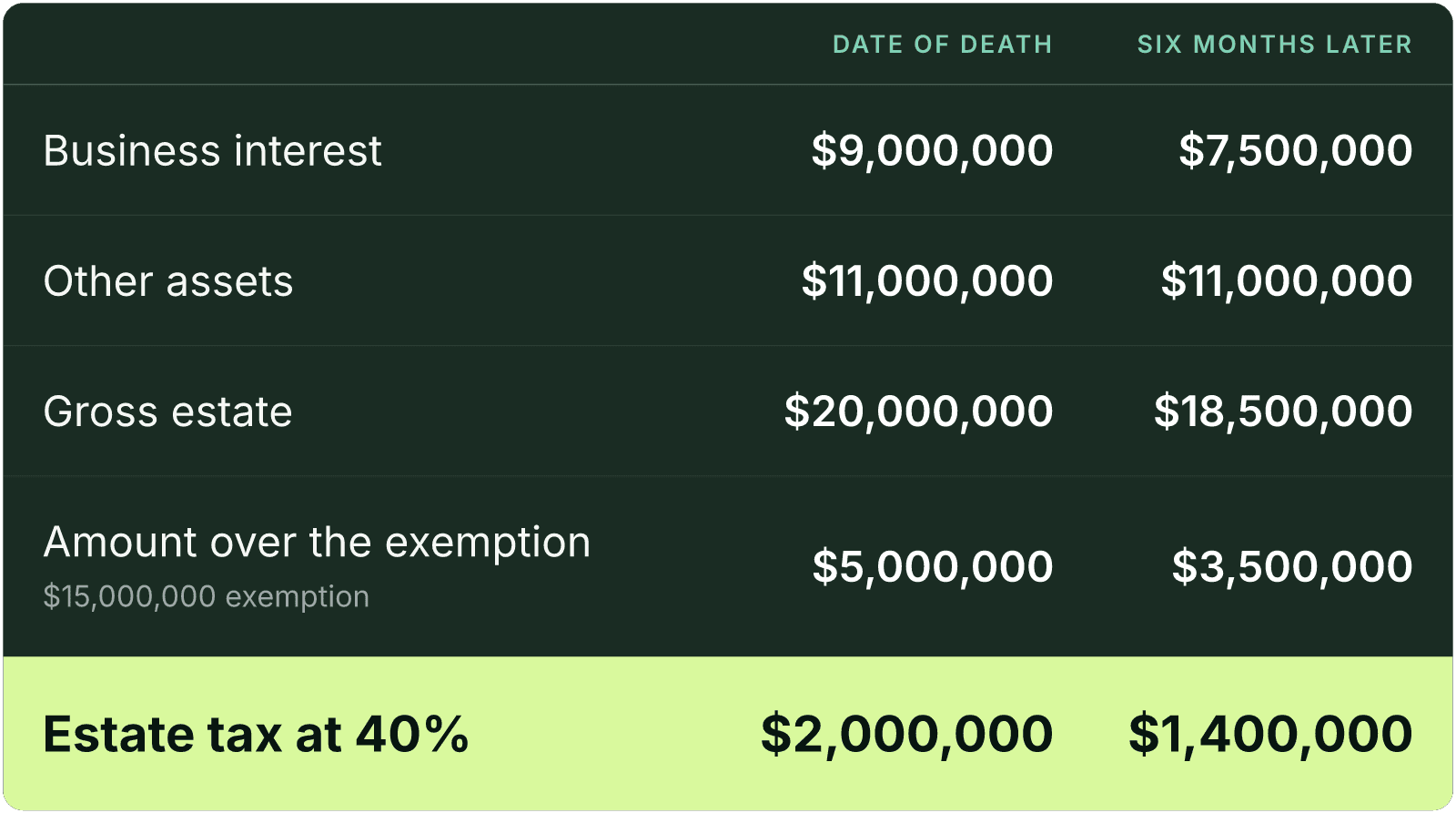
Suppose an owner dies holding a manufacturing company worth $9,000,000 on the date of death, plus $11,000,000 of other assets. Over the next six months a major customer leaves, and the company is worth $7,500,000 on the six-month date. To keep the arithmetic readable, the example ignores deductions, credits and earlier taxable gifts, and uses the 40% top rate on the amount above a $15,000,000 exemption.
The table puts the two dates side by side.
[](https://www.409.ai/uploads/alternate_valuation_date_section_2032_family_business_estate_table_1_34cafb79d5.png)
The election lowers the gross estate by $1,500,000 and the tax by $600,000, so it passes both tests. Run the same facts with a business that gained value, and the six-month date would raise the estate and the tax. The executor would leave the election off and keep the date-of-death value.
Notice what drove the saving. It was not the other assets or the exemption. It was the drop in the one illiquid asset that nobody can price by looking at a screen, which is why the business appraisal carries so much of the weight.
Why a falling market is not the only trigger
Most of the time the election comes up when asset values fall after a death: a market decline, the loss of a key customer, or the founder's own absence hitting revenue. Owner-dependent companies are exposed to that last one. A business that depended on one person's relationships can lose value quickly once that person is gone, and the date-of-death appraisal may have already reflected some of it, or may not have.
A sale can also trigger the later valuation in a different way. If the estate sells the business or a block of shares within six months, those shares are valued at the sale date under the statute. A sale at a price below the date-of-death appraisal does not by itself make the election available, since all the other rules still apply, but it fixes the value of that asset at the actual price. If a buyer's offer is already on the table at death, tell the appraiser early.
What the two appraisals need to say
If the election is a live possibility, the executor should expect to commission two valuations of the business, or one valuation with a clear plan for a second. A few practical points keep the work consistent.
Use the same standard of value on both dates. Estate tax valuation is fair market value, the price a willing buyer and a willing seller would agree on with both having reasonable knowledge of the facts. [Revenue Ruling 59-60](https://www.409.ai/articles/revenue-ruling-59-60-small-business-valuation-eight-factors) lists the factors an appraiser weighs for a closely held company, and the same factors apply at both dates. If the two reports use different methods, a reviewer will ask whether the change in value is real or a change in approach.
Explain the change in value. Between the two dates, what actually happened? A lost contract, a market shift or a change in interest rates are events. A different discount rate chosen by a different appraiser is not. The report for the later date should walk from the first value to the second and name the facts that moved it.
Keep date-specific facts date-specific. Events after the valuation date generally do not belong in that date's value unless they were known or reasonably foreseeable on it. The six-month report values the company as it stood on that later date, with what was then known. It should not read back into the date-of-death report, and the date-of-death report should not borrow from it.
Be consistent on adjustments. Normalized owner compensation, add-backs and discounts for lack of control or marketability should be handled the same way at both dates unless a specific fact changed. Our posts on [owner compensation add-backs](https://www.409.ai/articles/owner-compensation-add-backs-small-business-valuation-sde-ebitda) and [discounts for lack of control](https://www.409.ai/articles/discount-lack-of-control-dloc-409a-gift-tax-valuation) cover those adjustments in more detail.
The income tax side
Estate tax is only half of the picture. Under IRC §1014(a)(2), when the alternate valuation date is elected, the heirs' income tax basis in the property is its value on that date, not the date-of-death value. A lower estate value therefore also means a lower stepped-up basis. If the heirs plan to sell the business soon, a lower basis can mean more capital gain later, and the estate tax saved has to be weighed against it.
Section 6166 is the other interaction to check. An estate that qualifies to pay tax on a closely held business over time tests its eligibility using the value of the business against the adjusted gross estate. We cover that test in our post on [Section 6166 estate tax deferral](https://www.409.ai/articles/section-6166-estate-tax-deferral-closely-held-business-valuation). Because the election changes the values on the return, ask your attorney or CPA whether it also changes that eligibility test for your estate.
A short checklist for the first six months
- **Month one:** order the date-of-death appraisal, and ask whether the estate is large enough that any estate tax could be due. If it is plainly under the exemption, the election is out.
- **Months two to five:** track events that change the value of the business, and keep a written record of them. Note any offers, sales or distributions of shares, because those fix a value on their own date.
- **Month six:** if the estate has tax at stake and the business has moved, order the later-date appraisal while the facts are fresh.
- **Before the return is due:** have the attorney or CPA compare the tax at both dates, including the basis effect, and decide. Form 706 is generally due nine months after death, with an extension available.
The takeaway
The alternate valuation date is a narrow tool. It only helps an estate that owes tax and whose assets have fallen in value, and it can only be used once, for everything. For an executor who holds a family business in that position, the practical step is to treat the six-month date as a real deadline from the first week: keep the records, line the appraiser up early and compare the two tax bills before the return is filed. If you are handling a business valuation for an estate, our [small business valuation service](https://www.409.ai/products/smb-valuation) is built for that kind of report.