Tax
Can I Use My 409A for a Gift Tax Return? What a Gift Valuation Keeps and What It Rebuilds
For founders gifting shares before year-end: why a recent 409A is not the Form 709 appraisal, what the gift valuation rebuilds, and an IRS memo on a stale one.
By 409.AI Team - 2026-10-27
# Can I Use My 409A for a Gift Tax Return? What a Gift Valuation Keeps and What It Rebuilds
You have a 409A report from March. It is independent, under twelve months old, and it says your common stock is worth $0.80 a share. Now it is December, you want to move 500,000 shares into a trust for your children before year-end, and your estate attorney asks for "the appraisal." It feels like you already have one.
This article is for the founder or private-company owner about to gift shares before the end of 2026, and for the attorney or CPA who will sign the Form 709 in April. The 409A and the gift tax valuation use the same words to describe value and then do different jobs. What follows is what a gift valuation keeps from your 409A, what it rebuilds, and one IRS memorandum about a founder who skipped the rebuild.
Same standard, different job
Both reports start from the same sentence. For gift tax, [26 CFR 25.2512-1](https://www.law.cornell.edu/cfr/text/26/25.2512-1) says the value of a gift is "the price at which such property would change hands between a willing buyer and a willing seller, neither being under any compulsion to buy or to sell, and both having reasonable knowledge of relevant facts," measured at the date of the gift.
For option pricing, [26 CFR 1.409A-1(b)(5)(iv)(B)](https://www.law.cornell.edu/cfr/text/26/1.409A-1) asks for "a value determined by the reasonable application of a reasonable valuation method," built from the same kinds of inputs. An independent appraisal dated within twelve months of a grant is presumed reasonable unless the IRS can show it was grossly unreasonable.
So far the two look interchangeable. But a 409A values a class of stock so a board can set strike prices, is never filed, and its 12-month presumption belongs to Section 409A alone. The gift regulation grants no presumption to a report prepared for another purpose. It cares about the date of the gift, the shares you actually gave away, and the examiner who decides whether your Form 709 started the clock.
The clock only starts if the report does its job
Under [26 U.S.C. 6501(a)](https://www.law.cornell.edu/uscode/text/26/6501) the IRS has three years after a return is filed to assess tax. Section 6501(c)(9) removes that limit for a gift not disclosed "in a manner adequate to apprise the Secretary of the nature of such item": such a gift can be revalued at any time, including after you are gone.
What "adequate" means is written out in [Treas. Reg. 301.6501(c)-1(f)](https://www.law.cornell.edu/cfr/text/26/301.6501(c)-1). Paragraph (f)(2) asks for the property, the parties, the trust's EIN and terms, "a detailed description of the method used to determine the fair market value" with the financial data, the restrictions and any discounts claimed. Paragraph (f)(3) lets an appraisal stand in for that description, but only from an appraiser who is neither the donor, the donee, a family member nor an employee of either, and only if the appraisal states the transfer date, the appraisal date and its purpose, and describes the property, the process, the assumptions, the information considered (financial data "sufficiently detailed so that another person can replicate the process"), the reasoning, the method and the specific basis for the value.
Read that list against a typical 409A report. The purpose is wrong (option pricing, not a transfer). The date is wrong (months before the gift). The property is wrong (a class, not the block you transferred with its restrictions). The discounts answer a different question. A 409A can be excellent and still fail every line, because nobody asked it to pass them. The disclosure rule itself is covered in [Adequate Disclosure on Form 709: When a Stock Gift Becomes Final](https://www.409.ai/articles/form-709-adequate-disclosure-founder-stock-gift); this article is about the report that satisfies it.
What the gift valuation keeps, and what it rebuilds
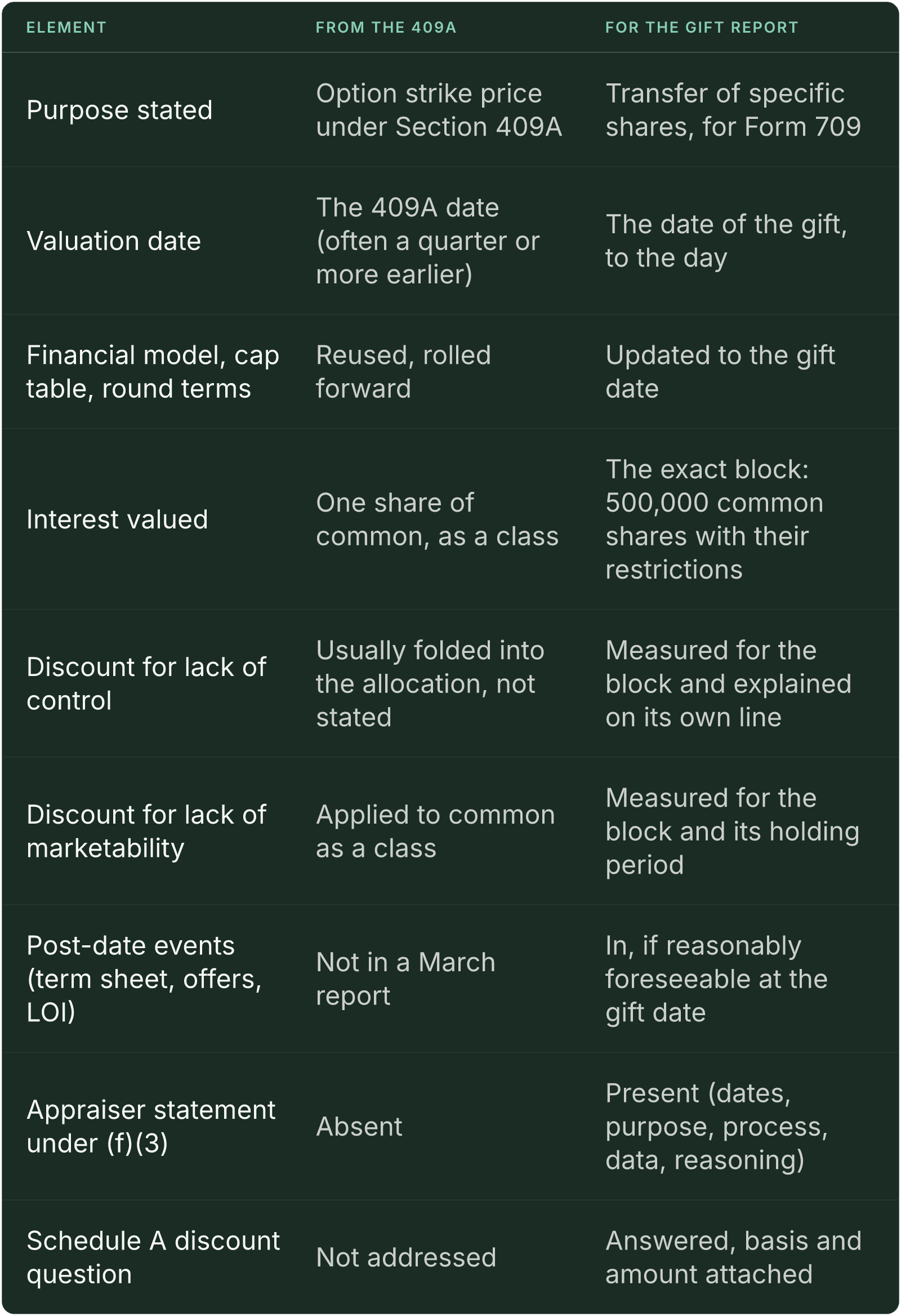
A gift valuation does not start from zero: most of the company-level work in a good 409A survives. What changes is everything that depends on the date, the block and the purpose. The table below is the honest answer to "can I reuse my 409A": yes for the inputs, no for the conclusion.
[](https://www.409.ai/uploads/409a_vs_gift_tax_valuation_form_709_founder_stock_table_1_6ef1257bb8.png)
The rows that decide the most are the date and the events: a gift on December 15 is valued with what a buyer knew on December 15, term sheet included. Why the control discount belongs on the gift return and not in the 409A is in [Discount for Lack of Control: Why Your 409A Skips It and Your Gift Tax Return Can't](https://www.409.ai/articles/discount-lack-of-control-dloc-409a-gift-tax-valuation).
A worked example
Take the founder from the opening. Illustrative numbers, not a specific company.
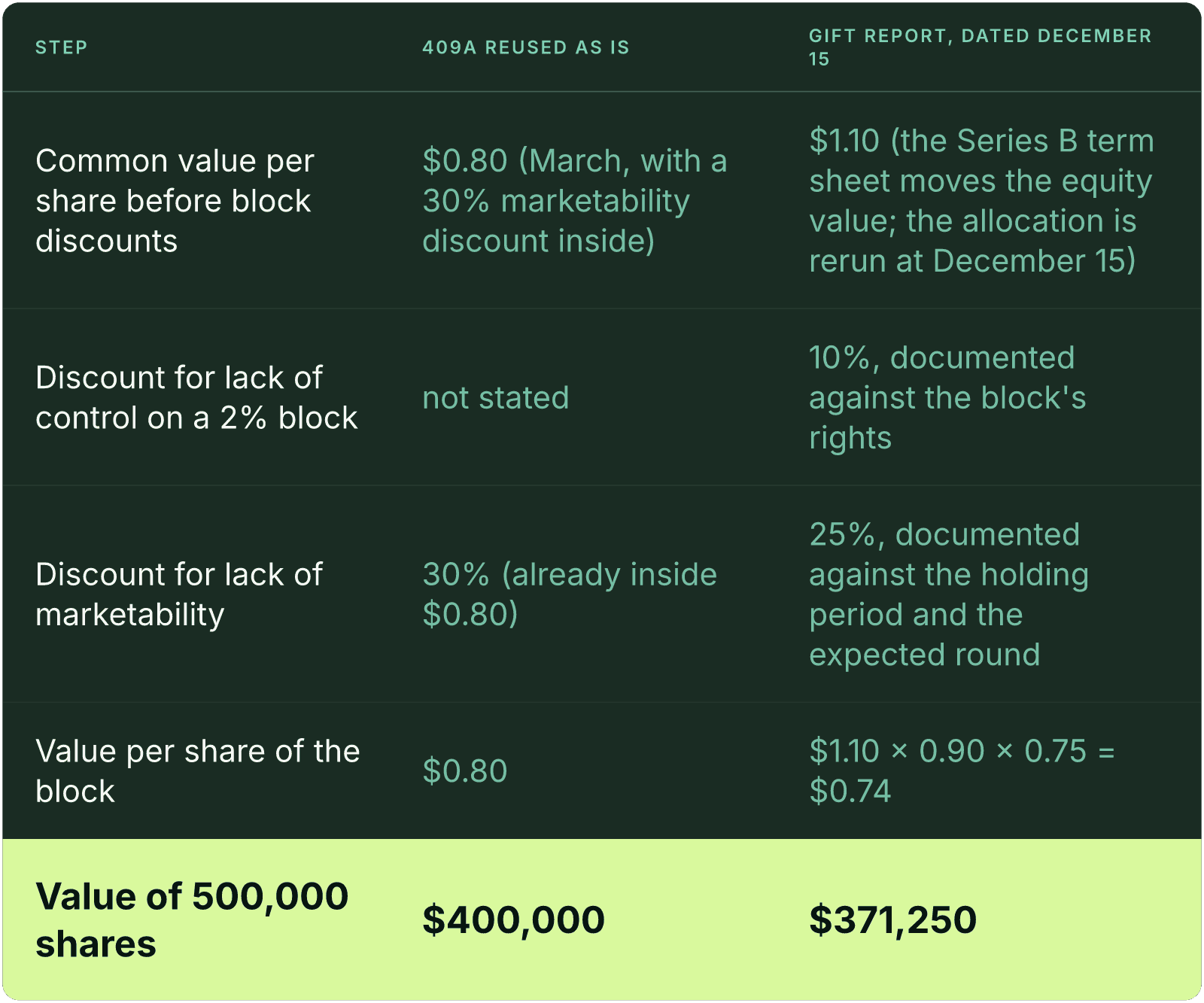
The March 409A backsolved an option pricing model to the Series A price and concluded $0.80 per common share, with a 30% marketability discount inside that number. The 500,000-share gift is 2% of 25 million fully diluted shares: a minority block with no board seat and a right of first refusal on transfer. In November the company signed a Series B term sheet at a higher price, expected to close in January. The gift is dated December 15.
[](https://www.409.ai/uploads/409a_vs_gift_tax_valuation_form_709_founder_stock_table_2_deabd41393.png)
The gift-date value is its own number, and here it is lower than the stale 409A, because the discounts were measured for the block instead of borrowed from a class-level model. With the round closed and an exit in sight, the same arithmetic could go the other way next year. Either way the number is defensible only because it carries its own date, its own discounts and its own appraiser statement. The $400,000 had no support for the question being asked.
Either value uses a slice of the lifetime exclusion, which [Rev. Proc. 2025-32](https://www.irs.gov/pub/irs-drop/rp-25-32.pdf) sets at $15,000,000 per person for 2026 (section 3.14, implementing section 70106 of the One Big Beautiful Bill Act), with a $19,000 annual exclusion per donee (section 4.42). The gift goes on a Form 709 due, per the [IRS instructions](https://www.irs.gov/instructions/i709), "not later than April 15 of the year after the gift was made": April 15, 2027 for a December 2026 gift. If the gift reflects a discount, Schedule A asks you to say so and to attach the basis and the amount. The planning side is in [Gifting Startup Equity in 2026: The $15M Exemption and the Valuation That Makes It Stick](https://www.409.ai/articles/gifting-startup-equity-2026-estate-tax-exemption).
The founder who used a six-month-old 409A
In [Chief Counsel Advice 202152018](https://www.irs.gov/pub/irs-wd/202152018.pdf), released in December 2021, the IRS described a founder who did what the opening of this article suggests. He hired bankers to find a buyer; about six months later five corporations made offers within two weeks. Three days after the last of them he funded a two-year grantor retained annuity trust with company shares, valued with the December 31 appraisal from roughly seven months earlier, a report "obtained in order to satisfy the reporting requirements for nonqualified deferred compensation plans under § 409A." The accepted bid later included a cash tender "nearly three times greater" than that value. The appraisal firm's only explanation: the report "was only six months old, and business operations had not materially changed during the 6-month period."
Chief Counsel's answer was blunt. Under the willing-buyer standard "the hypothetical willing buyer and willing seller of a company would consider a pending merger when valuing stock for gift tax purposes," so the December 31 value "does not represent the fair market value of the shares as of the valuation date." Because the trust's annuity was a percentage of that undervalued figure, paying "an amount that had no relation to the initial fair market value of the property transferred to the trust" was an operational failure: the founder "did not retain a qualified annuity interest under § 2702." The annuity had been paid at "less than 34 cents on the dollar," and the IRS position was that the gift was the full value of the shares, not the near-zero a GRAT is designed to produce.
A CCA may not be cited as precedent, and the facts were extreme: active bids, not a vague hope of a sale. But every founder faces the mechanism in miniature. The 409A was independent and under twelve months old, and still the wrong report, because the gift date knew things the 409A date did not. A summary by Saul Ewing, [Tax risks when valuing a gift with a stale appraisal](https://saul.com/insights/blog/tax-risks-when-valuing-gift-stale-appraisal), reaches the same conclusion: an updated appraisal at funding would have avoided the problem.
What a wrong number costs
The statute never closing is the first cost. The second is the valuation penalty in [26 U.S.C. 6662](https://www.law.cornell.edu/uscode/text/26/6662). If the value claimed on a gift tax return is 65% or less of the correct value, and the resulting underpayment exceeds $5,000, the penalty is 20% of that underpayment. If the claimed value is 40% or less of the correct value, the rate is 40%. A documented $371,250 the IRS later moves to $420,000 is a disagreement; a reused $400,000 against a value built from the term sheet you did not mention is a different conversation.
What to send your attorney instead
Give the valuation provider the 409A, its model, the cap table and the round documents: all of it is reused. Then add what the 409A did not have: the exact gift date and shares with their transfer restrictions; every event since the 409A date (term sheets, LOIs, offers, secondary sales, a round expected to close); and the structure of the gift, since a trust's EIN and terms go on the return and a GRAT has its own mechanics. A buy-sell agreement is another place the IRS tests the price; see [Will the IRS Honor Your Buy-Sell Price?](https://www.409.ai/articles/buy-sell-agreement-price-section-2703-family-business-estate-tax).
Ask for a report that names its purpose and date on the first page, measures and explains the control and marketability discounts for the block, and carries the appraiser's statement of paragraph (f)(3). That is what 409.AI's [gift and estate tax valuation](https://www.409.ai/products/gift-estate-tax) is built to be: the data you assembled for the 409A, rebuilt for the transfer date, the block and the return.
Your March 409A did its job in March. The gift you make in December needs a report that knows it is December.