Equity
409A Valuation for a Distressed Startup: Wind-Down Odds, Going Concern Doubt and Option Grants
Founders and finance leads with under a year of cash: how a 409A weights a possible wind-down, why common can fall near zero, and when an old report fails.
By 409.AI Team - 2026-11-12
# 409A Valuation for a Distressed Startup: Wind-Down Odds, Going Concern Doubt and Option Grants
You have seven months of cash, a raise that stalled, and a board that just used the words "strategic alternatives." Your last 409A says common stock is worth $1.20 a share. It was right a year ago. It almost certainly isn't right now.
This guide is for the founder or finance lead of a venture-backed startup in that position, who still needs to grant options to the people being asked to stay. It covers what the Treasury regulations require of a valuation when the company may not survive, how an appraiser puts a number on a possible shutdown, why common can land close to zero without being wrong, and when the old report stops protecting you.
Why last year's 409A stops working when the cash runs short
Section 409A exempts a stock option only if its exercise price can never be less than the fair market value of the stock on the grant date ([Treas. Reg. § 1.409A-1(b)(5)(i)(A)](https://www.ecfr.gov/current/title-26/section-1.409A-1)). For a private company, that value has to come from "the reasonable application of a reasonable valuation method."
Two sentences of the regulation do most of the work in a distressed company. A method isn't reasonable if it ignores "all available information material to the value of the corporation." And a value calculated earlier isn't reasonable later if it "fails to reflect information available after the date of the calculation that may materially affect the value." The 12-month window people quote is a ceiling, not a guarantee. A report can go stale in month four.
Running short of cash is exactly that kind of information. So is a failed round, a covenant breach on venture debt, a lost anchor customer, or a board resolution to hire a banker to sell the company. Any one of them can make the last report unusable for new grants, the same way a priced round can (our post on [whether a bridge round is a material event](https://www.409.ai/articles/bridge-round-409a-material-event-option-grant-timing) walks through that test).
The direction of the error flips
In a growing company, a stale 409A is dangerous because it's too low: options granted at last year's price come in below today's value, and that is a discounted option under 409A.
In a distressed company, the stale number is usually too high. An option struck at $1.20 when the stock is worth $0.11 doesn't break Section 409A, because the strike is above fair market value. It breaks something else: the option is underwater the day it's granted, so it does nothing for the engineer you're trying to keep through the next six months.
That's why distressed companies order new valuations. The goal isn't to fix a compliance problem; it's to grant at a price that gives the award some chance of being worth something. And the moment you want a lower number, the regulation's "all available information" test starts cutting the other way, as the last section shows.
How the auditor's going concern test feeds the valuation
If your company has audited financial statements, management has to evaluate going concern under ASC 205-40. The question is whether conditions raise substantial doubt about the entity's ability to meet its obligations as they come due within one year after the date the financial statements are issued, as [Deloitte's summary of ASU 2014-15](https://www.iasplus.com/en/publications/us/heads-up/2014/going-concern) explains. Management's plans count only if they're probable of being carried out and of fixing the problem within that year.
A going concern disclosure in your last audited statements is the clearest evidence an appraiser will see. It doesn't set the value, but it tells them the base case of "we raise the next round" can't carry all the weight anymore. If the audit note says substantial doubt exists and the 409A assumes a 100% chance of continued operations, the two documents contradict each other. The IRS, an acquirer's diligence team, or your own auditor at the next grant can read both.
Putting a number on a possible shutdown
When survival is genuinely uncertain, most appraisers stop treating the company as a single going concern and value it as a set of outcomes. Each outcome gets its own equity value, its own payout to common through the [liquidation preference waterfall](https://www.409.ai/articles/liquidation-preferences-waterfall-common-stock-exit), and a probability. Common's value is the weighted result, before a [discount for lack of marketability](https://www.409.ai/articles/discount-lack-marketability-dlom-409a-valuation).
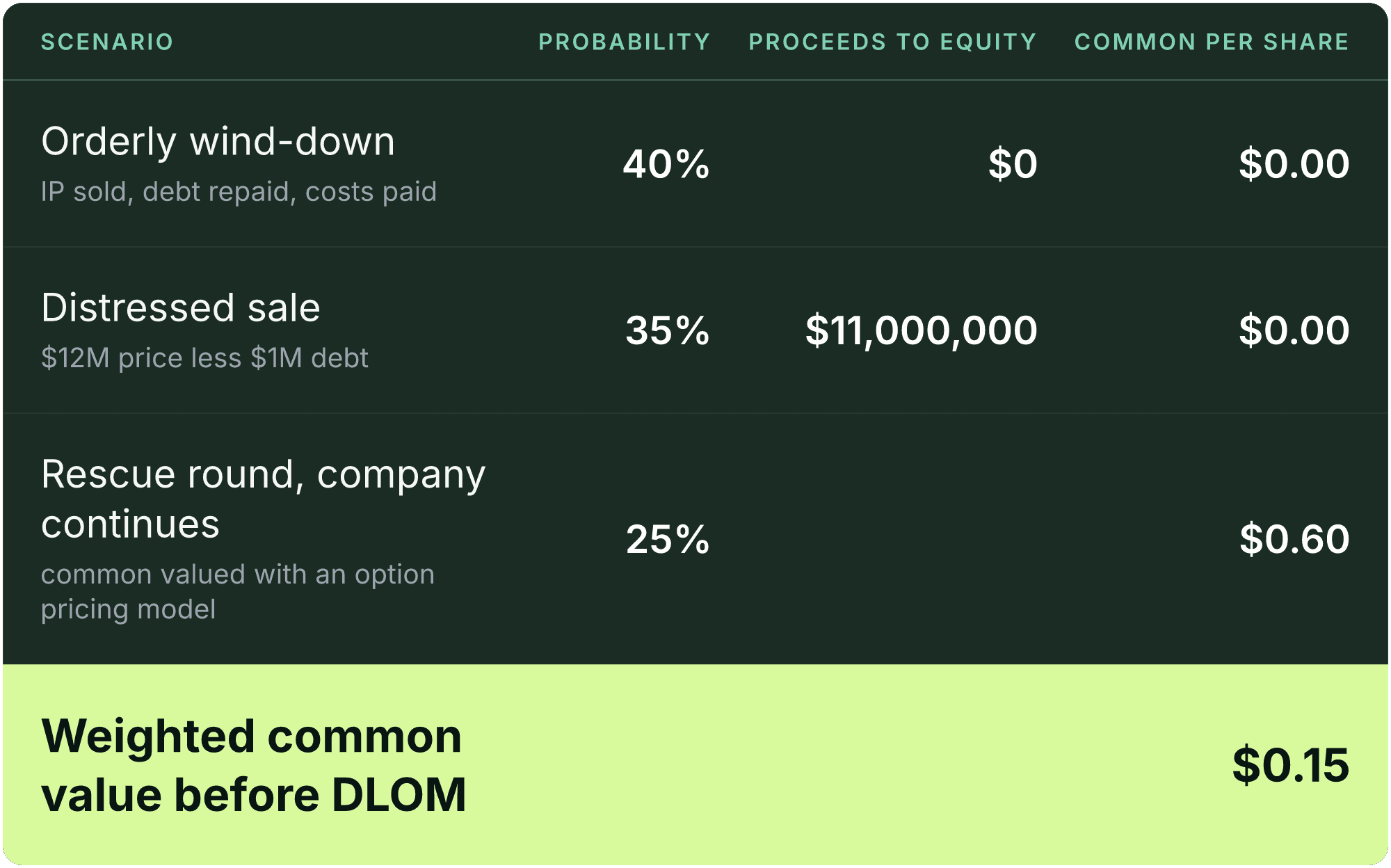
Take an illustrative company. It has 10 million shares of common on a fully diluted basis, $20 million of 1x non-participating preferred (seed and Series A combined), and $1 million of venture debt. Cash covers seven months. The board sees three ways this ends.
[](https://www.409.ai/uploads/409a_valuation_distressed_startup_wind_down_going_concern_option_grants_table_1_e1bffae4c7.png)
The wind-down and the sale both leave common at zero, for different reasons. In the wind-down, the cash and the IP sale barely cover the lender and the shutdown costs. In the sale, $11 million reaches the equity, but the preferred holders are owed $20 million, so they take their preference rather than convert and common gets nothing.
Only the rescue branch gives common a value, and here $0.60 is an assumption standing in for a separate option pricing calculation. Weighted at 25%, it contributes $0.15. A 30% marketability discount brings that to about $0.11 a share, against last year's $1.20.
The probabilities are the part that matters most and the part an auditor or the IRS will push on. "25% chance of a rescue round" needs evidence: term sheets in hand, the number of investors still in conversations, how much insider support the existing preferred holders have signaled, bridge commitments. A model that weights the rescue at 70% with no term sheet is as unsupportable as one that weights it at 5% while a signed term sheet sits in the data room.
The premise of value also shifts as the facts move. While the board is still exploring a sale or a raise, a going concern premise with scenario weights is usual. Once the board has approved a dissolution, the liquidation scenario stops being a probability and becomes the plan. Our [current value method post](https://www.409.ai/articles/current-value-method-409a-allocation-when-right) covers the allocation used when a liquidity event, or a liquidation, is close enough that option value no longer applies.
Can common really be worth almost nothing?
Yes. When preferences exceed any realistic exit value, a value of a few cents a share is often the honest answer, and a report that says so is not broken.
There is a floor of a different kind. A Delaware corporation can't issue shares with par value for consideration worth less than par ([8 Del. C. § 153(a)](https://delcode.delaware.gov/title8/c001/sc05/index.html)). Par is usually a tiny fraction of a cent, so it rarely binds, but an option plan normally sets the strike at the higher of fair market value and par. Check your charter's par value before a board approves a strike of $0.0001.
When the old report still protects you, and when it doesn't
An independent appraisal dated no more than 12 months before the grant is presumed reasonable, and the IRS can overturn it only by showing the method or its application was "grossly unreasonable" ([Treas. Reg. § 1.409A-1(b)(5)(iv)(B)(2)(i)](https://www.ecfr.gov/current/title-26/section-1.409A-1)). That presumption is what most founders mean by the [409A safe harbor](https://www.409.ai/articles/409a-safe-harbor-price-vs-qualified-appraiser), and distress threatens it in two ways.
First, the presumption covers a valuation that was reasonable when made. It doesn't cover one that ignores later information that may materially affect value, under the sentences quoted above. A report finished before the raise collapsed doesn't reflect the collapse.
Second, there's a timing trap specific to early-stage companies. The separate presumption for illiquid stock of a start-up corporation, a written valuation by a qualified person, isn't available if the company may reasonably anticipate a change in control event within 90 days after the grant, or a public offering within 180 days. A distressed company running a sale process can hit the 90-day condition quickly.
The cost of getting it wrong falls on the employee. An option that fails the exemption is deferred compensation, and if the plan doesn't meet Section 409A the holder owes ordinary income tax on the spread in the year the option vests, plus an additional 20% tax and interest at the underpayment rate plus one percentage point ([26 U.S.C. § 409A(a)(1)(B)](https://www.law.cornell.edu/uscode/text/26/409A)).
The trap on the way down: granting before good news
The lower number creates its own temptation. If the board knows a rescue term sheet is days away at a price well above the distressed value, a grant at $0.11 isn't a grant at fair market value. The regulation asks for all available information, and a pending financing is information.
The same applies to the timing of a sale. Granting a large block of options at a near-zero strike a few weeks before signing an acquisition can turn the 409A into exhibit A for an argument that the board knew the value was higher. If a deal or a round is close, finish it or get a valuation that reflects it before granting.
Existing underwater options are a separate decision. Repricing them changes the award and has its own 409A, ISO and ASC 718 consequences, which our [guide to down rounds and underwater options](https://www.409.ai/articles/down-round-409a-underwater-options-repricing) covers step by step.
What to hand the appraiser
A distressed valuation is only as good as the facts behind it. Before you order one, gather:
- the cash forecast with the month the money runs out, and the burn under the cost cuts already approved;
- every term sheet, letter of intent, banker update and investor email that bears on a rescue or a sale;
- the venture debt agreement, any covenant waivers and the lender's payoff amount;
- your most recent audited statements and the going concern note, if there is one;
- board minutes since the last 409A, including any discussion of dissolution.
If the company ends up selling, the same scenario logic shows up again on the other side of the table: the funds that hold your preferred have to mark it at quarter-end, as our post on [how a fund marks a cash-starved portfolio company](https://www.409.ai/articles/fund-mark-distressed-portfolio-company-asc-820-scenarios-lender-first) explains.
The takeaway
If your runway is shorter than your next fundraise, treat the old 409A as expired for new grants, whatever its date. Order a valuation that weights the outcomes you're actually facing, supports each probability with documents, and is refreshed the moment a term sheet or a buyer appears. A low number backed by evidence protects your employees. A low number timed just ahead of good news does the opposite. 409.AI prepares [409A valuations](https://www.409.ai/products/409a) with each report reviewed by a valuation expert, including for companies in exactly this position.